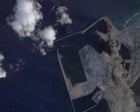
An explosion struck a Russian vessel anchored off the coast of Benghazi, Libya, in what local maritime and security authorities have identified as a suspected drone attack. While initial reports from Tripoli and Benghazi confirmed damage to the ship without immediate mass casualties, the incident represents a sharp escalation in asymmetric naval warfare far beyond the Black Sea.
The strike targets a critical logistics artery. For years, Russian state-linked operators and private military contractors have relied on eastern Libyan ports—controlled by Khalifa Haftar’s Libyan National Army (LNA)—as a transshipment hub for military hardware, fuel, and personnel moving into sub-Saharan Africa. An aerial or maritime drone strike in Benghazi’s waters proves that these logistics corridors are no longer insulated from geopolitical conflict.
Anatomy of a Shadow Maritime Corridor
To understand why a Russian ship in Benghazi matters, you have to look at the map of modern sanctions evasion and expeditionary logistics. Since 2022, Moscow has faced severe restrictions on moving military supplies and sanctioned commodities through traditional European ports and the Turkish Straits, where the Montreux Convention limits naval transit.
Eastern Libya became the workaround.
Ports like Benghazi and Tobruk sit directly across the Mediterranean from European NATO members, yet they operate outside Western regulatory oversight. Under the protection of Haftar’s forces, Russian cargo vessels—often operating with disabled Automatic Identification System (AIS) transponders, a practice known as "going dark"—regularly offload armored vehicles, radar components, air defense systems, and bulk fuel. From Benghazi, these shipments move overland through the Libyan desert into Chad, Sudan, Mali, and the Central African Republic, sustaining operations for the Africa Corps, the Kremlin-controlled successor to the Wagner Group.
When an explosion hits one of these vessels at anchor, it is rarely a random maritime accident. Commercial shipping accidents—such as boiler explosions or cargo fires—leave distinct forensic signatures, typically originating from inside the engine room or cargo hold and accompanied by immediate distress calls to international maritime rescue coordination centers. In contrast, Libyan port officials noted external impact characteristics consistent with an unmanned aerial vehicle (UAV) or an unmanned surface vessel (USV).
The tactical logic is clear. Interdicting cargo overland in the Sahel requires massive air superiority or risky special forces raids across thousands of miles of desert. Hitting a vessel while it sits stationary in port or at an outer anchorage creates an immediate bottleneck at a single choke point.
How Unmanned Systems Changed Naval Interdiction
For decades, attacking a merchant or auxiliary ship in a foreign port required a state actor with submarines, fast-attack craft, or long-range strike aircraft. Every one of those assets carries an unmistakable national signature. A torpedo or an anti-ship cruise missile leaves debris that points directly back to a specific defense ministry, triggering immediate diplomatic or military retaliation.
Drones erased that attribution threshold.
Modern long-range one-way attack drones and low-profile maritime drones cost a fraction of conventional munitions and can be launched from converted commercial trawlers, coastal smuggling vessels, or remote stretches of unpatrolled shoreline. The central Mediterranean is uniquely suited for this kind of covert launch. Thousands of fishing boats, migrant-smuggling skiffs, and coastal freighters crisscross the waters between Tunisia, Malta, Sicily, and Libya every day. Slipping a containerized drone launcher onto the deck of an unremarkable cargo ship requires minimal logistical footprint.
Once launched, these systems exploit the blind spots of commercial and semi-militarized ports. Benghazi’s harbor defenses were built to deter conventional air raids by rival Libyan factions, not low-flying, small-cross-section drones skimming just meters above the sea surface. Standard coastal surveillance radar frequently filters out small, slow-moving targets to avoid clutter from wave action and flocks of birds. By the time harbor sentries hear the buzz of a two-stroke engine or spot a silhouette against the night sky, the warhead is already seconds from impact.
The Forensic Gray Zone
Investigating a suspected drone strike in a fractured state like Libya presents immediate evidentiary problems. Unlike NATO ports where naval explosive ordnance disposal teams immediately cordon off the blast zone and catalog shrapnel, Benghazi is governed by parallel security structures loyal to Haftar’s command.
Information is tightly rationed.
When local authorities describe an incident as a "suspected drone attack," that phrasing serves two purposes. First, it reflects genuine preliminary physical evidence—such as localized hull perforation above the waterline, fragmentation patterns typical of shaped charges, or acoustic reports from harbor workers. Second, it allows local commanders to acknowledge an external security breach without immediately naming a perpetrator they may not be equipped to confront.
Without independent access to the hull, metallurgical testing of recovered fragments, or satellite synthetic aperture radar (SAR) imagery taken immediately before and after the blast, outside analysts must rely on secondary indicators. These include sudden shifts in anchorage patterns, emergency tugboat deployments, and changes in marine war-risk insurance premiums for vessels calling at Cyrenaican ports.
Who Has the Motive and Capability
Assigning responsibility for a strike in the eastern Mediterranean requires separating capability from strategic motive. Several actors possess the technical means to execute a drone strike off Benghazi, yet each operates under vastly different political constraints.
- Ukrainian Special Operations: Kyiv has repeatedly demonstrated the willingness and capability to target Russian military and shadow-fleet assets far outside the immediate theater of war. Ukrainian intelligence services have previously conducted operations against Russian-aligned mercenaries in Sudan and struck vessels linked to Russian logistics in the Mediterranean and Black Sea. Targeting a supply ship in Benghazi directly disrupts the logistical chain feeding both Moscow’s African operations and its broader war economy.
- Rival Libyan Factions: Libya remains divided between the UN-recognized Government of National Unity in Tripoli and Haftar’s administration in the east. While a fragile ceasefire has largely held, proxy competition continues. However, launching a strike against a Russian asset in Benghazi carries severe escalation risks for Tripoli, potentially inviting Russian air defense deployments or direct retaliation against western Libyan infrastructure.
- Regional or Western Intelligence Proxies: Several Mediterranean powers view Russia’s entrenchment in eastern Libya—including reports of Moscow seeking long-term naval basing rights in Tobruk—as a direct threat to NATO’s southern flank. While direct Western military strikes on a Russian-flagged vessel in peacetime would cross a major escalatory red line, covertly enabling third-party actors or local proxies sits squarely within historical precedent.
- Internal Sabotage or Criminal Disputes: Eastern Libya’s ports are hubs not just for military hardware, but for lucrative fuel smuggling, narcotics trafficking, and illicit currency networks. Disputes over port fees, smuggling routes, or unpaid protection money among local militias and foreign operators occasionally erupt into targeted violence, though the use of sophisticated drone munitions points toward state-level capability rather than local gang warfare.
Consider a hypothetical scenario to illustrate the operational complexity. Suppose an intelligence service tracks a sanctioned cargo vessel loading armored personnel carriers in Tartus, Syria, or Novorossiysk, Russia, bound for Benghazi. Rather than intercepting the ship on the high seas—an act of war under international maritime law—operatives stage a commercial fishing vessel in international waters forty nautical miles north of Libya. Under cover of darkness, they launch two commercial-grade fixed-wing drones fitted with tandem warheads. The drones fly below radar horizon, strike the ship’s bridge and propulsion systems while it waits for a pilot boat outside Benghazi, and leave no traceable launch platform behind. The vessel is disabled, the cargo is delayed for months, and no government has to claim responsibility.
The Ripple Effects Across Mediterranean Shipping
The blast off Benghazi sends an immediate shockwave through the global maritime industry, particularly the opaque network of aging tankers and cargo ships operating outside Western insurance and classification societies.
For the past three years, maritime insurers in London and Oslo have steadily raised Additional War Risk Premiums for vessels transiting the Black Sea and the Red Sea. The central Mediterranean, despite Libya’s civil conflict, had largely stabilized as a transit corridor for commercial shipping moving between the Suez Canal and the Strait of Gibraltar. A confirmed drone strike on a vessel at anchor changes that risk calculus overnight.
Even ships with no connection to Russia or military logistics face collateral danger. Electronic warfare countermeasures—specifically GPS spoofing and AIS jamming—intensify rapidly around ports experiencing drone threats. When local military forces activate jamming systems to confuse incoming drone navigation, civilian cargo ships in the vicinity lose accurate satellite positioning. In congested port approaches like Benghazi, where narrow channels and submerged wrecks require precise navigation, electronic interference sharply increases the risk of groundings and collisions.
Furthermore, port state control authorities across southern Europe—in Greece, Italy, and Malta—are likely to tighten inspections on vessels arriving from eastern Libyan ports. Any ship showing signs of unexplained hull repairs, unscheduled drift periods, or transponder gaps faces detention, financial penalties, and blacklisting by major charterers.
Strategic Consequences for Moscow and Haftar
For Khalifa Haftar, the attack exposes a fundamental vulnerability in his security bargain with Moscow. Haftar has traded port access, airbase privileges at Al-Khadim and Al-Jufra, and political alignment in exchange for Russian military hardware, diplomatic backing, and regime security. If Haftar’s forces cannot guarantee the physical security of Russian vessels sitting in their primary maritime hub, the strategic value of eastern Libya drops precipitously.
The immediate response in Benghazi will almost certainly involve tighter port perimeters, expanded maritime exclusion zones, and the deployment of short-range electronic warfare and anti-aircraft systems around harbor facilities. Yet every layer of defense added to protect Russian logistics further militarizes civilian port infrastructure, complicating commercial trade that eastern Libya’s economy relies upon for food and consumer goods.
For Moscow, the incident underscores the fragility of its expeditionary reach. Maintaining military influence across Mali, Burkina Faso, Niger, and the Central African Republic requires a continuous, unbroken pipeline of fuel, ammunition, and spare parts. Unlike the United States or France, which maintain vast fleets of strategic airlifters and global networks of formal bases, Russia’s African presence hangs on a handful of aging cargo ships and a few semi-permissive ports.
A single explosion off Benghazi does not sever that pipeline, nor does it halt Russian operations on the continent. What it does is strip away the illusion of sanctuary. Every captain piloting a shadow-fleet freighter into the Gulf of Sidra now has to account for the possibility that the final miles to the pier are an active combat zone.