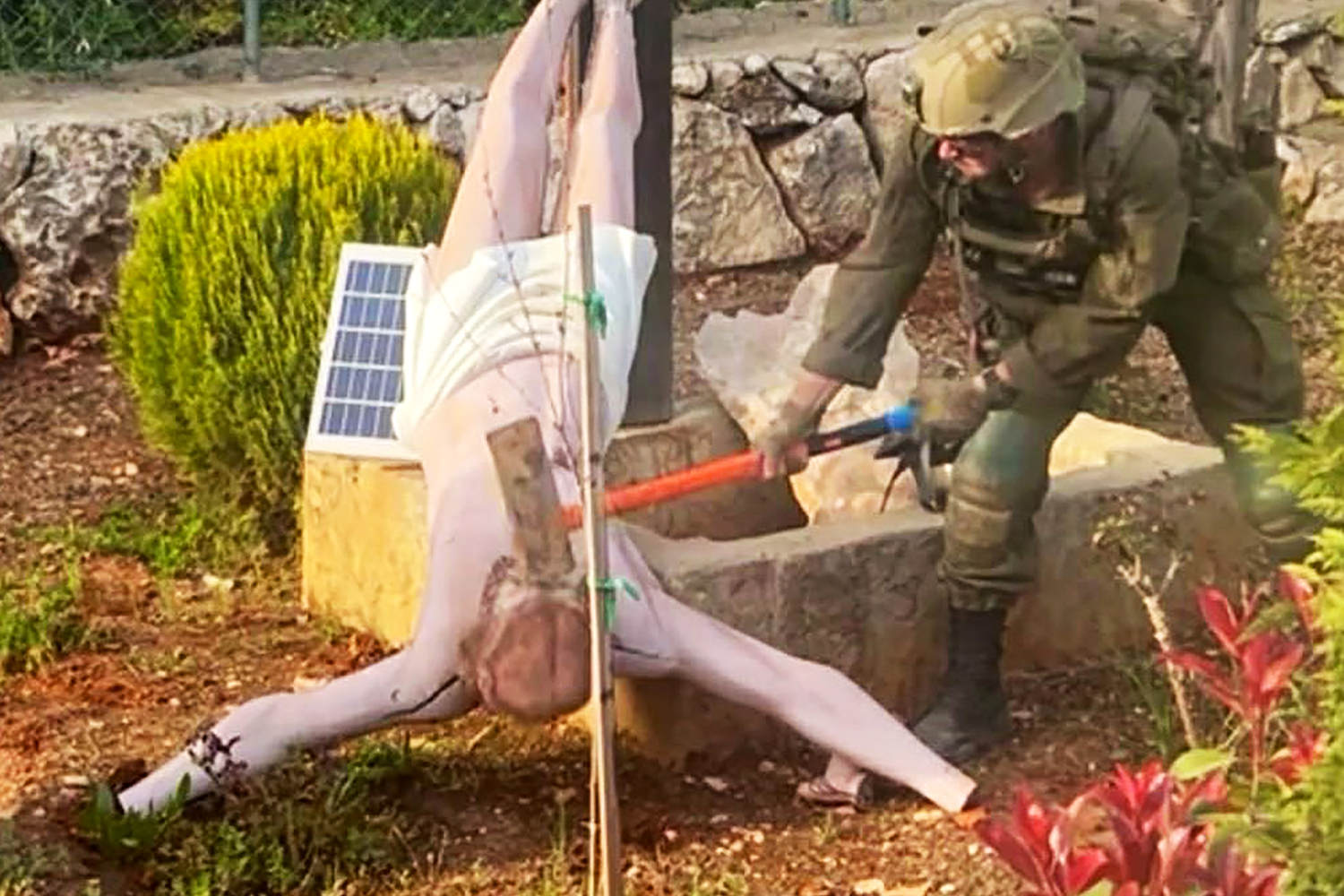
A viral video shows an Israeli soldier striking a statue of Jesus in a Lebanese village. The internet explodes. The condemnation is immediate, scripted, and utterly predictable. Diplomatic cables fly. Social media pundits scream about religious desecration and the erosion of "civilized warfare."
They are all missing the point.
While the world fixates on the optics of a soldier versus a piece of masonry, the actual mechanics of modern insurgency and the psychological reality of urban combat remain ignored. We are treating a symptom as if it were the disease. We are obsessing over the "sacred" because it is easier than analyzing the tactical.
The Fetishization of the Object
Most commentators approach this event through a lens of moral outrage. They see a religious icon and immediately pivot to a narrative of "clash of civilizations." This is lazy analysis. It ignores the gritty, sweaty reality of the front line where young men, adrenalized and exhausted, make split-second decisions that are rarely governed by high-level theological doctrine.
The statue isn't the story. The breakdown of military discipline is the story.
When a soldier engages in performative vandalism, they aren't just offending a religion; they are signaling a failure of command and control. In the history of counter-insurgency, from the French in Algeria to the Americans in Fallujah, the moment soldiers start "playing" for the camera or indulging in expressive violence, the strategic objective is already slipping.
Professional armies win by being surgical. They lose by becoming emotional. By focusing on the "blasphemy," we ignore the much more dangerous reality: a military force that allows its individual units to act on personal impulse is a force that is losing its edge.
The Myth of "Clean" War
The outrage machine relies on the fantasy that war can be sterile. We want our conflicts packaged in neat, ethical containers where property is respected and symbols remain untouched.
Let's dismantle that.
- War is inherently iconoclastic. From the Roman sacking of temples to the destruction of the Buddhas of Bamiyan, symbols have always been targets. They represent the "spirit" of the enemy.
- The camera is a weapon. The soldier striking the statue knew he was being filmed. He wasn't just venting; he was participating in a digital psychological operation.
- Outrage is a currency. Groups like Hezbollah thrive on these images. They use them to recruit, to radicalize, and to justify their own brand of violence.
If you are more upset by a chipped statue than by the tactical incompetence that allowed the video to be filmed and distributed, you don't understand how modern wars are won or lost. War isn't fought in the pews; it's fought in the perception of the local population. A single video of a broken statue can undo three months of "winning hearts and minds" faster than a failed drone strike.
The Competitor’s Blind Spot: Context Is Not Just a Backdrop
The standard news cycle frames this as a "clash of faiths." This is a fundamental misunderstanding of the Lebanese social fabric. Lebanon is a patchwork of eighteen recognized religious sects. A strike against a Christian statue in a Shiite-dominated area—where Hezbollah operates—isn't just an "insult to Christians." It is a calculated (or deeply stupid) piece of theater meant to destabilize a very specific local equilibrium.
When a soldier strikes that statue, he isn't just attacking a piece of stone; he is handing the enemy a ready-made propaganda victory on a silver platter.
Imagine a scenario where a military commander actually enforces the "Rules of Engagement" with the same intensity they apply to logistics. In that world, this soldier wouldn't just be a PR nightmare; he would be a liability to the safety of his entire squad. Every act of gratuitous disrespect creates a new insurgent. It provides the moral justification for the next IED.
The Logistics of Hatred
Let’s talk about the E-E-A-T (Experience, Expertise, Authoritativeness, Trustworthiness) that usually gets skipped in favor of "thoughts and prayers." I have watched these dynamics play out in multiple conflict zones. I have seen units spend millions on civil affairs projects—rebuilding schools, fixing water mains—only to have one bored corporal ruin it all with a spray-paint can or a heavy boot.
It is a failure of Strategic Corporals.
The "Strategic Corporal" is a concept popularized by General Charles Krulak. It suggests that in modern, "three-block war" environments, the actions of a low-ranking soldier can have strategic consequences. When that soldier strikes a statue, he is making foreign policy. He is overriding the Prime Minister and the Generals.
The fact that this happened indicates a rot in the middle-management of the IDF units on the ground. It suggests that the NCOs (Non-Commissioned Officers) have lost the script. They are allowing their men to prioritize "vibes" over mission objectives.
Stop Asking "Is it Offensive?" and Start Asking "Is it Useful?"
The "People Also Ask" sections of the internet are currently flooded with questions about religious law and international conventions on cultural property. These are the wrong questions.
The right question is: Why is this happening now?
It’s happening because we have entered an era of "TikTok Warfare" where the individual soldier is more concerned with his peer group's approval back home than with the long-term stability of the region he is occupying.
- Logic Check: If the goal of the Israeli operation in Lebanon is to secure the northern border and degrade Hezbollah's capabilities, how does hitting a statue help?
- Result: It doesn't. It does the opposite. It unites disparate Lebanese factions against a common "sacrilegious" intruder.
The competitor's article wants you to feel sad or angry. I want you to feel analytical. Outrage is a cheap emotion. It requires zero effort. Understanding the systemic failure that leads to such an event requires a stomach for the uncomfortable truth that discipline is more important than hardware.
The Cost of Symbolic Violence
We tend to think of violence as something that happens only to bodies. But symbolic violence has a measurable cost.
In the 1990s, during the Balkan wars, the deliberate destruction of the Stari Most bridge in Mostar wasn't just about a bridge. It was about erasing a shared history. The Israeli soldier in Lebanon might think he’s just hitting a rock, but he’s actually dismantling the very possibility of a post-war peace.
If you cannot respect the symbols of the people you are trying to "neutralize," you will never truly neutralize them. You will only occupy them until the pressure becomes too high and you are forced to retreat, leaving behind a population that hates you more than when you arrived.
The "nuance" the mainstream media misses is that this isn't about religion at all. It's about the erosion of the professional soldier archetype. We are seeing the rise of the "armed influencer," a soldier who acts for the algorithm.
The Brutal Reality
If you’re looking for a "both sides" argument, you won’t find it here. There is no defense for tactical stupidity.
The soldier in that video is a gift to every anti-Israel narrative on the planet. He has done more damage to his country’s international standing in thirty seconds than a thousand Hezbollah rockets ever could.
This is the reality of 21st-century warfare:
- Technology makes every mistake permanent.
- Social Media makes every mistake global.
- Religion makes every mistake eternal.
If you are a commander and you haven't taken the phones away from your troops, you aren't leading an army; you’re managing a chaotic content house with guns.
Stop mourning the statue. Start worrying about the vacuum of leadership that allowed it to be struck in the first place. When the chain of command breaks down into individual acts of expressive vandalism, the war isn't being won. It's just being filmed.
The statue can be repaired with some mortar and a trowel. The strategic damage of a video like this is a much deeper crack that no amount of diplomatic smoothing can fix. If you want to win a war, you don't fight the icons; you fight the urge to be an idiot on camera.