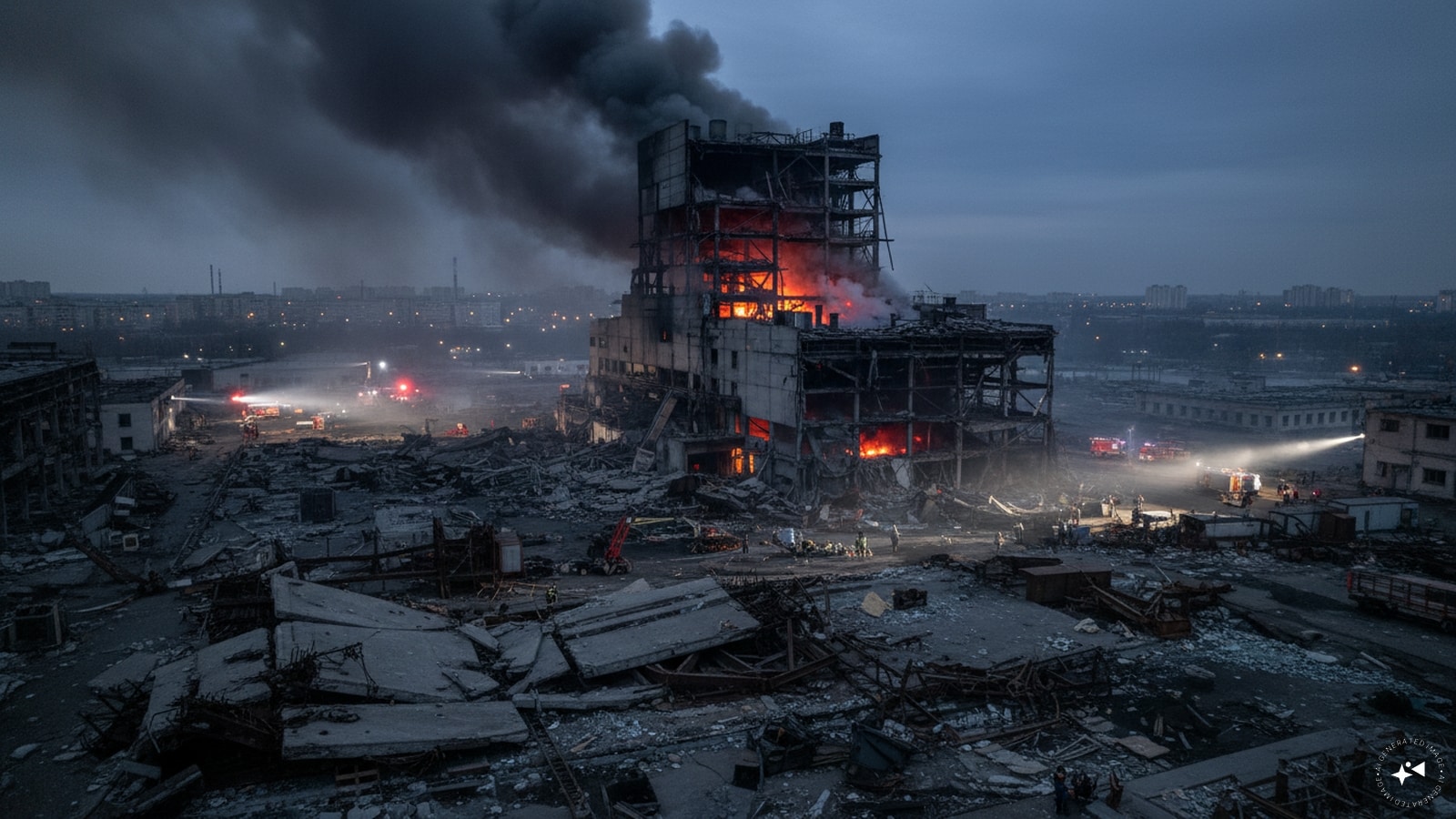
The headlines are predictable. When Kyiv launches a massive swarm of long-range drones deep across the border, setting fire to fuel depots and military installations while civilian casualties trickle into the sixes, the mainstream media treats the event as a grand tactical turning point. They frame it as retaliation, escalation, or a psychological blow to Moscow. They miss the mark completely.
This is not a paradigm shift. It is structural theater. Building on this theme, you can also read: Why the Latest Strike on Hezbollah Will Break the Fragile Border Deal.
If you analyze modern attritional warfare through the lens of moral victories and symbolic acreage, you will misread every single escalation. I have spent years studying the logistics of industrial-scale state conflict, watching analysts mistake tactical noise for strategic signal. They look at a burning oil tank in a border region and hallucinate a crumbling regime. They ignore the balance sheets, the material throughput, and the hard math of production lines.
Stop asking whether these aerial strikes cross invisible red lines. Ask whether they alter the arithmetic of exhaustion. They do not. Experts at The Washington Post have shared their thoughts on this situation.
The Fallacy of the Symbolic Strike
The lazy consensus holds that bringing the war home to the Russian populace forces the Kremlin to reckon with the human and physical cost of its invasion. The theory sounds clean in a press briefing. Hit their infrastructure, dent their pride, make the citizens feel the friction.
Human psychology does not work that way under an authoritarian security apparatus.
When drones strike residential areas or provincial industrial sites, the immediate political effect is not mass panic or anti-war uprising. It is consolidation. State media takes the charred debris, wraps it in the flag, and converts minor property damage into immediate justification for further mobilization. You do not crack public resolve by dropping ordnance on provincial towns; you harden it.
Military planners know this, yet political leadership greenlights these operations for domestic optics. Kyiv needs to show its backers in Western capitals that it can bite back, that the aid money is buying reach, that the asymmetry of the fight cuts both ways. But optics are not strategy. Optics burn fuel that could be conserved for defensive engineering. Optics spend finite hardware on targets that possess zero industrial replacement friction for an adversary built to absorb punishment.
The Logistics of Attrition Nobody Wants to Calculate
Let us look at the brutal balance sheet of long-range drone warfare.
Building a low-cost, long-range loitering munition is cheap compared to air defense missiles, but it is still an expensive way to deliver a minor explosion to a hardened target thousands of miles away. Russia’s industrial base, backed by sanction-evading supply chains and domestic munitions factories operating on triple shifts, treats burned fuel depots the way a heavy smoker treats a cough. It is an annoyance. It requires a patch job. It does not stop the factory floor from stamping out glide bombs.
Conversely, Ukraine fights under a severe industrial deficit. Every complex guidance system, every microchip, and every high-grade propulsion unit spent on a retaliatory strike across the border is a unit not deployed on the front lines to shred advancing armored columns.
This is the trade-off the cheerleaders of escalation refuse to confront. Resources are strictly finite. When you allocate sophisticated engineering capability to strategic signaling, you starve tactical defense.
Imagine a scenario where a manufacturing plant produces one hundred precision strike units in a month. Fifty go to long-range retaliatory flights designed to generate headlines in Western newspapers. Fifty go to stopping tanks fifty meters from a trench line. Which set of choices keeps the line from collapsing?
The answer is obvious to anyone who has ever managed a supply chain under duress. Yet commentators keep cheering for the flashy fireworks over the boring, bloody work of holding ground.
The Danger of Escalation Dominance
There is another layer of delusion surrounding these large-scale cross-border attacks: the belief that Moscow lacks escalation dominance.
Every time drones hit targets inside Russia, analysts hold their breath for a catastrophic response, wondering if this is the strike that triggers a wider European conflagration. When nothing apocalyptic happens immediately, they assume Moscow is weak, deterred, or running out of options.
This is a dangerous misreading of Russian military doctrine. Moscow plays the long game of structural grinding. They are not interested in flashy tit-for-tat exchanges that drain their resources inefficiently. They prefer to let the meat grinder of positional warfare do the heavy lifting, knowing that time, demography, and industrial capacity heavily favor the larger state in a war of endurance.
When you poke a bear with a stick, the bear does not always roar right away. Sometimes, it simply leans its full weight on you until your ribs crack.
Mistaking restraint for impotence is a fatal error. The silence following a series of drone strikes is rarely a sign of weakness; it is often the quiet sound of military planners recalculating how much more pressure the adversary can take before total structural failure sets in. By celebrating these attacks as major victories, western observers encourage an escalation spiral where Ukraine trades its long-term survival for short-term headlines.
The Real Question We Should Be Asking
People constantly ask: How many strikes inside Russia will it take to change the political calculus in the Kremlin?
The question is fundamentally flawed. It assumes the Kremlin’s calculus is sensitive to the same pressures that democratic governments face. It assumes public opinion in an autocracy dictates military policy.
The correct question is: How long can a country surviving on foreign financial life support and dwindling internal manpower sustain a campaign of symbolic retaliation while losing the war of attrition on its own soil?
We have seen this movie before. In every prolonged conflict involving a severe asymmetry of scale, the smaller power is nudged by well-meaning external allies into adopting strategies that mimic the adversary's strengths while ignoring its own vulnerabilities. Air campaigns against the home territory of a massive industrial power look impressive on evening news broadcasts, but they rarely alter the outcome of a war won or lost in the trenches.
Ukraine's defenders are remarkably brave. Their tactical innovation has rewritten the manual on modern drone deployment. But bravery and ingenuity cannot bend the laws of industrial logistics.
Stop pretending that burning a fuel tank three hundred miles inside enemy territory brings peace any closer. It buys a news cycle. It satisfies a craving for revenge. And it drains the resources needed to survive the next twenty-four hours on the actual front line.
Until leadership on both sides of the supply equation faces up to the math of exhaustion, these massive aerial attacks will remain what they have always been: expensive theater masking a slow, grinding defeat.


