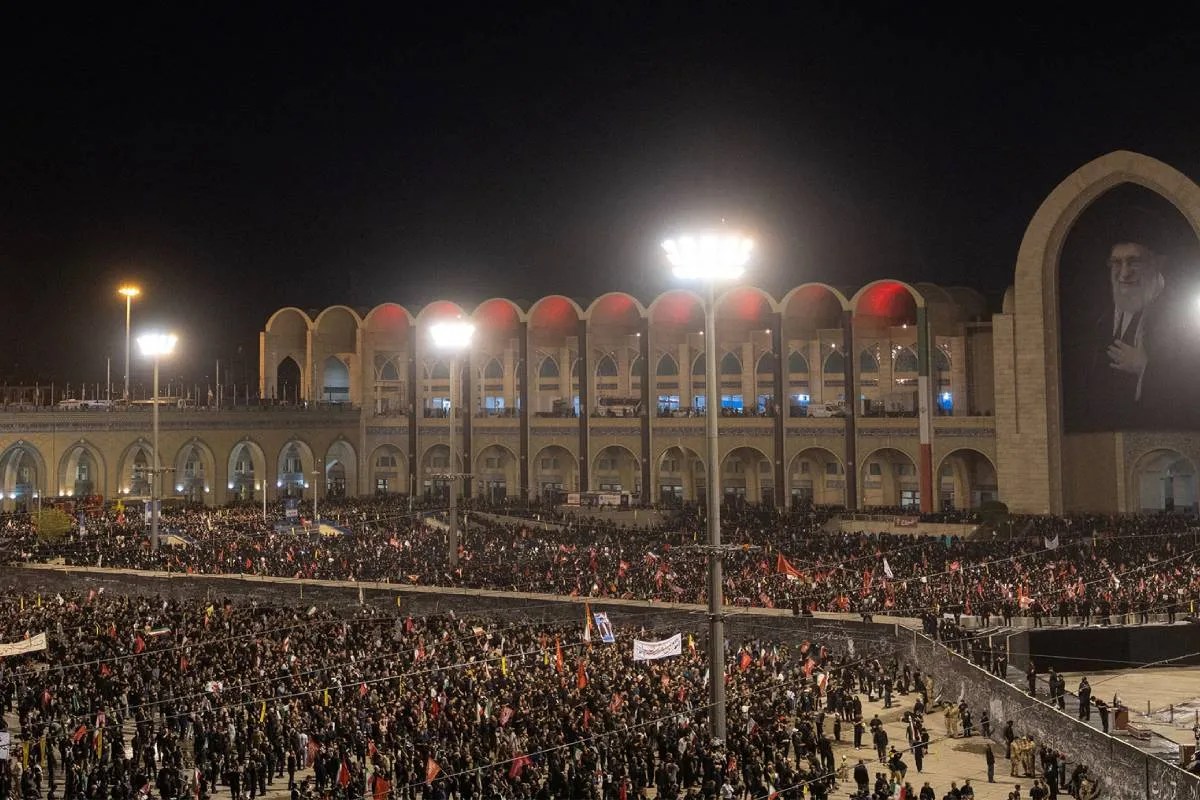
The recent public calls for the assassination of the American president during Ayatollah Khamenei’s funeral procession in Tehran are not a sudden outburst of rogue extremism. They are the predictable output of a carefully state-managed theater designed to project power during a moment of profound regime vulnerability. While standard news feeds focused on the shocking nature of the rhetoric, the real story lies in how the Iranian security apparatus uses managed public fury to mask deep structural instability at home and how Western intelligence completely misjudged the impact of maximum pressure tactics.
The chants echoing through the streets of Tehran targeted the sitting U.S. president with direct, state-sanctioned death threats. For casual observers, it looked like spontaneous rage. For those who have monitored the region for decades, it was a highly coordinated geopolitical distraction.
The Mechanics of State Sponsored Fury
Public mourning in the Islamic Republic has always been an instrument of statecraft. The massive crowds seen at high-profile funerals are rarely entirely organic, nor are they entirely forced. They are a complex mix of ideological loyalties, bureaucratic mobilization, and economic incentives.
Government employees, military personnel, and students are routinely bussed into the capital to ensure the streets look packed for international television cameras. The slogans shouted from the podiums are vetted by the Ministry of Culture and Islamic Guidance. When a crowd asks why a foreign leader is still alive, they are repeating a script written in the upper echelons of the Islamic Revolutionary Guard Corps (IRGC).
This performative anger serves a dual purpose. Domestically, it creates an illusion of national unity and consensus. Internationally, it acts as a psychological deterrent, signaling to Washington and its allies that the regime's base remains radicalized and ready for conflict.
The Real Target is Not Washington
By directing the crowd's anger outward toward the White House, the clerical establishment successfully shifts attention away from a collapsing domestic reality. The Iranian economy is suffocating under hyperinflation. The national currency, the rial, has hit historic lows, wiping out the life savings of the middle class.
Protests over water shortages, labor strikes, and social restrictions have flared up with increasing frequency across the provinces. By elevating the American president to the status of an immediate, existential threat during a sacred funeral ritual, the regime attempts to frame domestic dissent as treason. It is a classic authoritarian survival tactic.
The Illusion of Effective Western Sanctions
For years, Washington has operated under the assumption that economic strangulation would either force the Iranian regime to the negotiating table or trigger a popular revolution. The scene at Khamenei’s funeral exposes the fundamental flaw in this logic.
Economic isolation has not weakened the hardliners; it has systematically destroyed the moderate opposition.
The merchants of the bazaar and the technocratic middle class, who once formed the backbone of the reformist movement, have been impoverished by international sanctions. Meanwhile, the IRGC has seized total control of the black market, smuggling networks, and state-subsidized industries. They have grown wealthier and more entrenched while the average citizen struggles to buy meat.
+------------------------------------+------------------------------------+
| Sanctions Intended Effect          | Actual Ground Reality              |
+------------------------------------+------------------------------------+
| Weaken the regime's financial base | IRGC monopolizes the black market  |
| Empower domestic opposition        | Middle class is economically wiped |
| Force diplomatic concessions       | Hardliners consolidate total power  |
+------------------------------------+------------------------------------+
The aggressive rhetoric broadcast from the funeral is the voice of a regime that feels it has nothing left to lose from the international community. When you cut off every avenue of legitimate commerce and diplomacy, you lose all leverage to incentivize moderate behavior.
The Failure of Intelligence and the Escalation Loop
Western intelligence agencies routinely miscalculate the internal dynamics of the Iranian leadership. They treat the regime as a monolith, failing to see the fierce factional battles taking place behind closed doors.
The calls for assassination are part of an internal power struggle to determine who will control the security apparatus in the post-Khamenei era. Hardline factions within the IRGC use extreme anti-Western rhetoric to prove their ideological purity and secure their positions against pragmatic elements who might favor a deal with the West.
This creates a dangerous escalation loop. A hardline commander makes a provocative statement to secure his domestic position. Washington responds with fresh sanctions or military deployments. The hardline commander then uses the American response to justify further repression at home and aggression abroad.
The Asymmetric Threat Landscape
Iran knows it cannot match the United States in a conventional military confrontation. Its navy cannot hold the Persian Gulf against an American carrier strike group, and its air force relies on aging, decades-old airframes. Therefore, the regime invests heavily in asymmetric warfare.
- Proxy Networks: Funding and arming militias across Iraq, Syria, Lebanon, and Yemen to strike Western interests without triggering a direct war on Iranian soil.
- Cyber Warfare: Developing sophisticated hacking capabilities targeting critical infrastructure, financial institutions, and government agencies in the West.
- State-Sanctioned Terrorism: Utilizing operational cells abroad to track, intimidate, and target dissidents or foreign officials.
The rhetoric at the funeral is the public face of this asymmetric strategy. It reminds the world that Iran operates outside the conventional rules of international diplomacy.
De-escalation Without Capitulation
The current policy framework is broken. Doubling down on the same economic pressure tactics that failed for the last decade will not silence the crowds in Tehran or stop the enrichment of uranium. It will only push the region closer to an miscalculated war that neither side can afford.
A smarter approach requires shifting focus from broad economic punishment, which harms the civilian population, to hyper-targeted financial and logistical disruptions aimed specifically at the IRGC’s overseas business empires. Western nations must aggressively dismantle the front companies operating in Europe, Asia, and the UAE that launder money for the regime's elite.
Simultaneously, diplomatic channels must remain open, not as a sign of weakness, but as a tactical necessity. True intelligence is gained through engagement, and the best way to exploit the regime’s internal fractures is to offer realistic off-ramps that force the hardliners to choose between ideological purity and political survival.
The screaming crowds in Tehran are a symptom of a deeper, systemic rot, but they are also a mirror reflecting the limitations of a Western foreign policy that relies on bludgeoning rather than strategy.