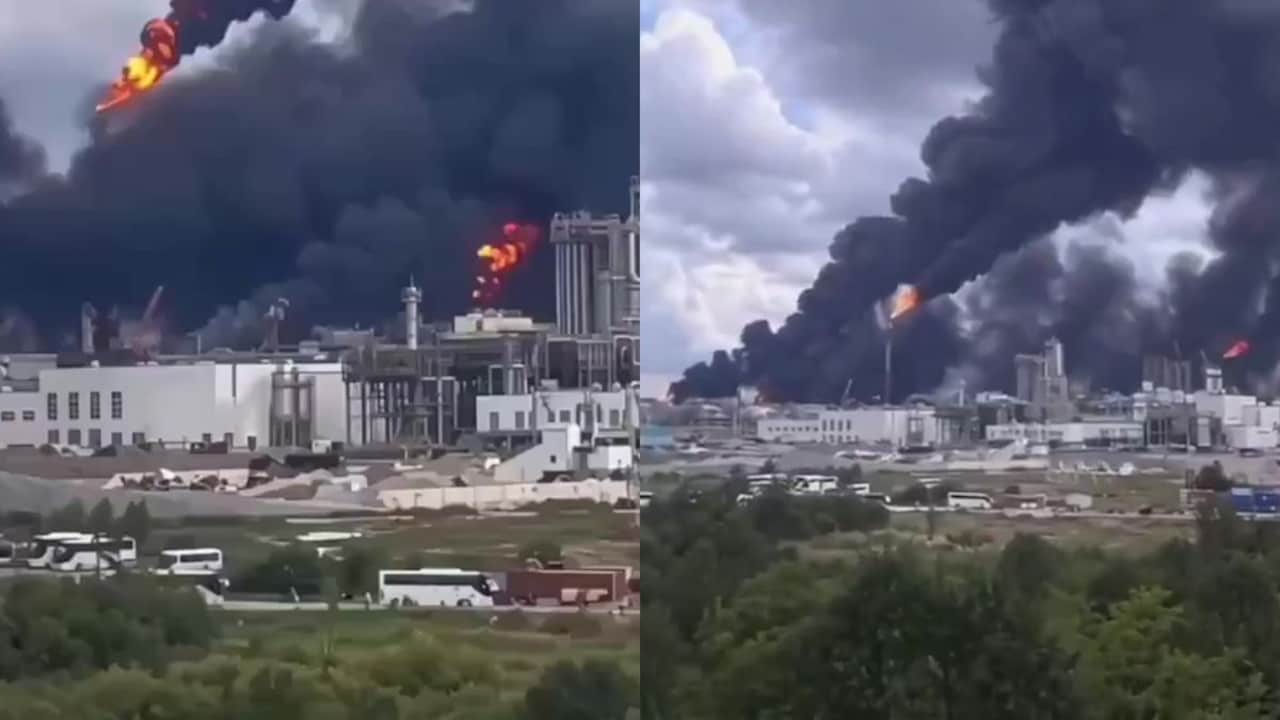
Every mainstream headline about the recent disaster at the multi-billion-dollar Russo-Chinese energy complex treats the explosion like an act of god. Media outlets love a good, sensationalist tragedy. They point to the casualty count, the fireball, the ten-billion-dollar price tag, and throw their hands up at geopolitical volatility or sudden operational failure.
They are missing the entire point. If you liked this article, you might want to look at: this related article.
I have watched state-backed engineering consortia push timelines past physical breaking points for decades. When you merge Soviet-era infrastructural arrogance with frantic, high-demand Asiatic resource acquisition, you do not get a reliable supply chain. You get a ticking time bomb. The lazy consensus says this disaster is a random black swan event born from sudden technical failure or mysterious sabotage.
The truth is much simpler and far more damning: the facility was mathematically doomed the moment the first concrete was poured under impossible political deadlines. For another look on this story, check out the latest coverage from Business Insider.
The Myth of State-Backed Industrial Invulnerability
Let us look past the smoke and address the foundational engineering fallacy driving these mega-developments. The conventional narrative assumes that when two superpowers throw ten billion dollars at a processing complex, safety margins scale linearly with the budget.
That is absolute nonsense.
In heavy hydrocarbon processing, complexity grows exponentially, while oversight gets diluted across bureaucratic fiefdoms. When dealing with cryogenic natural gas liquefaction and ultra-high-pressure transport lines, a single mismanaged weld on a low-temperature alloy pipe can vaporize an entire compression train.
I have walked through facilities where safety inspectors were sidelined because their timeline reports threatened to embarrass political appointees. Bureaucrats care about ribbon-cutting ceremonies and milestone declarations. They do not care about metallurgical fatigue under sub-zero Siberian operating conditions.
When you rush commissioning phases to meet an arbitrary diplomatic anniversary or a trade summit deadline, corners are not just cut. They are obliterated.
Why the Sanction-Driven Supply Chain Forced a Fatal Compromise
The mainstream analysis loves to blame external sanctions for everything. Yes, Western trade restrictions cut off direct access to specialized European turbine manufacturers and advanced digital control systems. But blaming sanctions alone lets the project operators off the hook for poor architectural substitution.
When Western vendors pulled out, the consortium did not slow down to redesign their control loops for domestic or alternative hardware. They improvised. They substituted critical instrumentation with unproven equivalents, patched proprietary software logic with third-party workarounds, and bypassed redundant fail-safes to keep commissioning schedules intact.
Imagine a scenario where an aircraft manufacturer swaps out flight-control computers with untested components mid-assembly because their primary supplier walked away. Would you step onto that plane? Of course not. Yet, energy markets act surprised when a massive gas complex experiences a catastrophic containment failure after identical shortcuts are taken with high-pressure flammable vapors.
The engineering reality is brutal: cryogenic gas processing does not negotiate with political expediency. Methane under extreme pressure behaves according to physics, not press releases.
The Geopolitical Fallout Nobody Is Talking About
Beyond the tragic loss of life and the incinerated capital, the financial fallout of this disaster exposes a structural flaw in bilateral energy dependencies. Beijing needs guaranteed baseload energy to fuel its industrial output, and Moscow needs a solvent buyer to replace lost European markets.
This mutual desperation created a psychological hazard. Both sides ignored glaring red flags during safety audits because acknowledging those risks meant admitting the entire partnership model was unstable.
When you build a pipeline and processing hub under intense geopolitical pressure, redundancy becomes the first casualty. Every safety valve you omit saves a week of downtime. Every secondary flare stack you value-engineer out of the budget saves a few million dollars. Multiply that mindset across a ten-billion-dollar footprint, and you engineer a catastrophe from the blueprint stage onward.
Dismantling the Recovery Timeline
Analysts are already predicting a quick rebuild. They claim state capital will flow back in, repairs will be expedited, and gas will resume flowing by next year.
That expectation ignores how modern industrial procurement actually works. You cannot simply order custom hyper-pressure compressors off a shelf. The specialized metallurgy required for extreme northern gas processing takes years to forge, cast, and test. If the original manufacturing ecosystem is closed off due to trade barriers, replicating those components domestically requires a technological base that cannot be spun up overnight via decree.
The hubris of the planners lies in assuming capital can buy time. It cannot. Physics requires a specific cooling down period, a specific metallurgical aging process, and rigorous non-destructive testing cycles that cannot be bypassed with overtime shifts.
The Real Lesson of the Disaster
Stop listening to commentators who treat energy megaprojects as static numbers on a balance sheet. These facilities are hyper-complex, fragile ecosystems governed by the unforgiving laws of thermodynamics.
When political vanity overrides engineering discipline, explosions are not accidents. They are mathematical certainties waiting for a calendar date.
Next time you hear about a record-breaking state infrastructure marvel, check the safety margins, look at who signed off on the expedited timelines, and ask yourself how long before the pressure overcomes the propaganda.