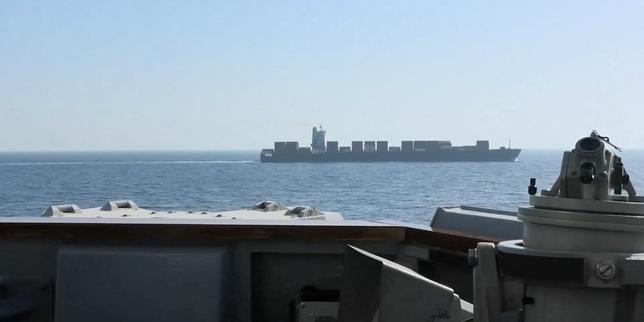
The Strait of Hormuz is the world's most dangerous chokepoint. It’s a narrow strip of water where one wrong move triggers a global energy crisis or a localized war. Recently, that wrong move happened. The US Navy opened fire on the Iranian-flagged cargo vessel Touska. This wasn't a routine patrol or a simple warning. It was a kinetic intervention that ended with American sailors boarding and taking control of the ship. Now, Tehran is screaming about retaliation, and the global shipping industry is holding its breath.
You’ve probably seen the headlines. They focus on the explosion and the drama. But the real story is why this happened now and what it says about the crumbling state of maritime security in the Middle East. This isn't just about one ship. It’s about the fact that the old rules of the sea don't seem to apply anymore.
What happened during the Touska intercept
The encounter didn't start with a bang. It started with a standoff. According to reports from the Fifth Fleet, the Touska was suspected of carrying illicit cargo—specifically advanced drone components and missile parts destined for regional proxies. When the US Navy destroyer USS Carney signaled the vessel to stop for a "Right of Visit" boarding, the Iranians ignored the radio calls.
They didn't just ignore them. They maneuvered aggressively.
When a multi-thousand-ton cargo ship tries to ram a destroyer, the rules of engagement change. The US Navy fired warning shots first. They used 25mm chain guns to spray the water across the Touska’s bow. When the Iranian crew refused to de-escalate and began preparing what appeared to be small arms on the deck, the order was given to disable the vessel.
Precision fire hit the Touska’s bridge and engine room. It was surgical but violent. Minutes later, a Visit, Board, Search, and Seizure (VBSS) team landed via helicopter. They secured the ship, detained the crew, and began an inspection that confirmed the presence of military-grade hardware hidden beneath bags of industrial chemicals.
Why the Strait of Hormuz is a powder keg
You can't understand this event without looking at a map. The Strait of Hormuz is only 21 miles wide at its narrowest point. About 20% of the world's liquid petroleum passes through here every single day. If Iran closes this gate, the global economy takes a massive hit.
Iran knows this. They’ve spent decades perfecting "gray zone" warfare. They don't want a full-scale naval battle with the United States because they know they'd lose. Instead, they use ships like the Touska to smuggle weapons or harass tankers. It’s a strategy of a thousand cuts.
By using "civilian" cargo ships for military logistics, Iran forces the US into a difficult position. If the US does nothing, the weapons reach their destination. If the US acts, Iran plays the victim card on the international stage. It's a calculated gamble that has worked for years. This time, the gamble failed.
Tehran is promising a response
The Iranian Revolutionary Guard Corps (IRGC) hasn't been quiet. Their leadership issued a statement calling the seizure an "act of piracy" and a "violation of international law." They’re promising a response that will make the Americans regret their "arrogance."
What does that response actually look like? It probably won't be a direct attack on a US carrier strike group. That’s suicide. Instead, look for these three things:
- Seizing Western tankers: Expect the IRGC to grab a Greek or British-flagged tanker in "retaliation." They’ve done it before with the Stena Impero and the Advantage Sweet.
- Drone swarms: Iran has mastered cheap, effective suicide drones. They might use these to harass commercial shipping or US bases in the region.
- Cyber attacks: Expect a surge in attempts to disrupt port operations or shipping logistics companies globally.
Honestly, the "retaliation" is already happening in the form of increased insurance premiums for any ship brave enough to sail through the Persian Gulf right now.
The legal gray area of seizing ships at sea
Critics often ask if the US has the right to just board a ship in international waters. The answer is complicated. Under the United Nations Convention on the Law of the Sea (UNCLOS), ships generally have "sovereign immunity" on the high seas. However, there are exceptions for piracy, slave trading, and ships without nationality.
The US argues that the Touska was being used for state-sponsored smuggling that violates UN Security Council resolutions. Specifically, the transfer of weapons to groups like the Houthis in Yemen. When a ship is used to facilitate terrorism, the US maintains it has the authority to intervene. Iran, of course, disagrees. They see the entire Persian Gulf as their backyard and any US presence as an illegal occupation.
The impact on global energy prices
The market reacts to bullets faster than it reacts to diplomacy. As soon as news of the gunfire broke, Brent crude prices spiked. Traders hate uncertainty. The fear isn't that the Touska is gone; it’s that the next ten ships might be targeted too.
If you're a shipowner, your costs just went up. Not just because of fuel, but because of "war risk" insurance. Some companies are already telling their captains to take the long way around Africa, avoiding the Suez Canal and the Strait of Hormuz entirely. That adds weeks to delivery times and millions of dollars to the final price of the goods you buy.
What you should watch for next
The next 48 hours are the most critical. If Iran doesn't launch a counter-operation immediately, it might mean they’re looking for a diplomatic exit or planning something much larger. Watch the movement of the Iranian fast-attack boats. If they start swarming near the shipping lanes, things are about to get much worse.
The US Navy isn't backing down. They’ve reinforced their presence with additional assets, including unmanned surface vessels that can monitor the Strait 24/7. This isn't a temporary flare-up. It’s the new normal for maritime trade in 2026.
If you’re invested in energy or shipping, don't ignore this. The Touska incident is a signal that the period of "watching and waiting" is over. We’ve entered a phase of active confrontation. Keep an eye on the official Fourth and Fifth Fleet communications for verified updates, as the amount of disinformation coming out of state-controlled media right now is staggering.
The best thing you can do is stay informed through diverse sources and prepare for continued volatility in the commodities market. The situation is fluid, and in the Strait of Hormuz, peace is always a fragile thing.