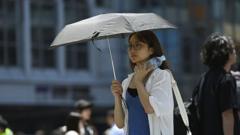
Japan's recent introduction of the term Kokushyo (Cruel Heat) to describe days exceeding 40°C represents a fundamental shift from meteorological observation to public health risk management. This is not a mere linguistic update; it is a structural recalibration of the nation’s warning systems necessitated by the failure of previous nomenclature to trigger appropriate socio-economic responses. When the previous ceiling of Moshoyo (Fierce Heat) at 35°C became a common summer occurrence, the psychological and operational "alert fatigue" rendered the existing classification system obsolete.
The Hierarchy of Thermal Classification
The Japan Weather Association (JWA) maintains a precise taxonomy of heat that dictates everything from power grid management to school closures. The introduction of a 40°C tier addresses a specific data gap where the physiological stress on the human body transitions from manageable discomfort to systemic failure. The classification now operates on four primary levels:
- Natsubi (Summer Day): ≥ 25°C. The threshold for increased cooling demand.
- Manatsubi (Midsummer Day): ≥ 30°C. Significant rise in heatstroke hospitalizations.
- Moshoyo (Fierce Heat Day): ≥ 35°C. High-risk zone; outdoor activity typically restricted.
- Kokushyo (Cruel Heat Day): ≥ 40°C. Immediate threat to life; infrastructure failure risk.
This nomenclature serves as a predictive tool for the Heat Index (WBGT - Wet Bulb Globe Temperature). The WBGT is the critical metric here, as it incorporates humidity, wind speed, and solar radiation. At 40°C, even moderate humidity levels can push the WBGT toward 31°C or higher, a level where the human body loses the ability to cool itself through evaporation.
The Mechanism of Alert Fatigue and Risk Perception
The logic behind creating new terminology lies in the "anchoring effect." When 35°C was the highest designated category, the public perceived it as the extreme limit of danger. However, as climate data shows a steady increase in the frequency of these days, the "extreme" became the "norm." This normalization leads to a dangerous reduction in proactive safety measures.
The JWA’s decision utilizes the Linguistic Relativity Principle: by providing a specific, harsher name for 40°C+, they force a cognitive distinction in the public mind. A "Fierce Heat" day might suggest staying hydrated; a "Cruel Heat" day suggests that physical presence outdoors is a life-threatening variable. This categorization is essential for legal and corporate frameworks to trigger "force majeure" clauses or mandatory work-from-home protocols without the friction of subjective interpretation.
Urban Heat Island (UHI) Amplification Factors
The emergence of 40°C days in Japanese prefectures like Yamanashi and Gunma is not solely a result of global atmospheric trends. It is exacerbated by a specific convergence of topographical and structural factors:
- The Foehn Effect: Dry, hot air descending from mountain ranges undergoes adiabatic heating, raising temperatures rapidly as the air reaches the basins.
- Thermal Inertia of High-Density Concrete: Japanese urban centers possess high thermal mass. Surfaces absorb short-wave radiation during the day and emit long-wave radiation at night, preventing the "tropical night" (Chottaiya) from cooling below 25°C.
- Anthropogenic Heat Waste: The energy required to cool a massive urban population creates a feedback loop. Air conditioning units expel heat into the streets, further raising the external ambient temperature.
Economic and Operational Cost Functions
The transition to a "Cruel Heat" environment imposes a quantifiable tax on the Japanese economy. This can be analyzed through three primary cost pillars:
1. The Labor Productivity Deficit
Beyond 35°C, cognitive function and physical output decline sharply. For industries like construction, logistics, and agriculture, a 40°C day represents a total stoppage of work. The cost of these "lost days" is a direct hit to GDP. Companies must now factor in "Heat-Related Downtime" as a standard operational risk, much like snow days in northern climates.
2. Grid Reliability and Peak Demand Spikes
The 40°C threshold pushes the electrical grid to its theoretical limit. The "reserve margin"—the difference between capacity and demand—often drops below the 3% safety threshold during these peaks. The introduction of the new term allows the Ministry of Economy, Trade and Industry (METI) to issue more aggressive "Power Saving Requests" with higher public compliance, as the terminology signals a crisis rather than a standard seasonal fluctuation.
3. The Public Health Infrastructure Burden
The correlation between temperature and emergency room admissions is non-linear. A 1°C rise from 39°C to 40°C causes a significantly higher percentage increase in heatstroke cases than a rise from 29°C to 30°C. This exponential curve threatens to overwhelm ambulance services and hospital bed capacity.
Structural Limitations of the Current System
Despite the linguistic upgrade, several systemic bottlenecks remain.
The first limitation is the reliance on Dry Bulb Temperature for public messaging. While "40°C" is a powerful headline, it does not account for the "Death by Humidity" scenario found in coastal cities like Osaka or Tokyo. A 38°C day with 80% humidity is more lethal than a 41°C day with 20% humidity. The current nomenclature system risks oversimplifying the danger if it focuses exclusively on the number on the thermometer.
The second bottleneck is the Urban Architectural Legacy. Most Japanese residential structures built during the post-war boom were designed for ventilation, not insulation. In a 40°C environment, traditional ventilation becomes a liability, as it invites scorching air inside. The transition to high-performance insulation and "cool roofs" is moving at a pace that lags behind the acceleration of these extreme heat events.
Strategic Infrastructure Adaptation
To move beyond reactive terminology, Japanese urban planning is pivoting toward "Heat Resilience" through specific technological interventions:
- Mist-Cooling Networks: Integrated into transit hubs to lower localized temperatures by 2-3°C through evaporative cooling.
- Heat-Blocking Pavements: Utilization of solar-reflective coatings on roads to reduce surface temperatures by up to 10°C.
- Cooling Shelters: The legal designation of public buildings as "Cooling Centers" where citizens have a right to access air conditioning during Kokushyo events.
The data suggests that the frequency of 40°C days will increase by an estimated 200-300% over the next two decades in the Kanto and Kansai regions. This makes the "Cruel Heat" designation a permanent fixture of the Japanese calendar rather than a seasonal anomaly.
Strategic planning for corporations operating in Japan must now include a Thermal Risk Audit. This involves re-evaluating supply chain logistics, employee insurance premiums, and the energy efficiency of physical assets against a baseline where 40°C is an expected operational variable. The linguistic shift is the first step in a broader societal hardening against an increasingly hostile climate.