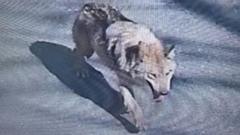
The escape of a predator from a controlled environment into a high-density human population center creates a high-stakes logistics and sensing problem. In the recent incident involving an escaped wolf from the Daejeon O-World zoo, the operational challenge was not merely one of tracking, but of signal-to-noise optimization. Traditional search methods—foot patrols and visual sightings—fail against the physiological advantages of Canis lupus, specifically its crepuscular activity patterns and camouflage. By deploying thermal imaging cameras (TICs) and Forward-Looking Infrared (FLIR) equipped drones, South Korean authorities shifted the tactical framework from reactive pursuit to a systematic heat-signature sweep.
The Physics of Detection: Differential Heat Signatures
Thermal imaging does not "see" through objects; it measures the long-wave infrared radiation (LWIR) emitted by bodies. In the context of a wolf escape, the effectiveness of this technology is governed by the thermal contrast between the animal’s surface temperature and the surrounding environment.
- The Thermal Gradient: A wolf’s coat is an evolved insulator, designed to retain body heat. However, heat leakage occurs at "thermal windows"—the eyes, mouth, ears, and paws. In the temperate climate of South Korea, particularly during evening hours when the ambient temperature drops, the Delta T (the difference between the wolf’s surface and the ground) increases, making the animal a high-contrast target against a cooling landscape.
- Emissivity Complications: Different materials emit infrared energy at different rates. Dense foliage, rocks, and concrete can retain solar heat (thermal inertia), creating "false positives" or "clutter." The tactical failure of many thermal searches stems from an inability to distinguish a 38°C biological heat source from a sun-warmed rock of the same temperature.
- Atmospheric Attenuation: Humidity and precipitation scatter infrared radiation. On the days following the Daejeon escape, atmospheric conditions dictated the effective range of the sensors. High humidity levels act as a veil, absorbing the signal and forcing drone operators to fly at lower altitudes, which increases the risk of acoustic spooking—where the noise of the drone drives the wolf deeper into cover.
Tactical Deployment Layers: The Search Grid
The recovery operation utilized a tri-layer surveillance architecture designed to shrink the search radius through process of elimination.
- Aerial Tier (Wide Area): UAVs equipped with high-resolution radiometric sensors scanned large swaths of the mountainous terrain surrounding the zoo. These units operate on a lawnmower pattern, ensuring zero-gap coverage.
- Stationary Tier (Chokepoints): Thermal cameras mounted on tripod systems were placed along known game trails and water sources. This assumes the wolf will follow the path of least resistance or biological necessity.
- Handheld Tier (Interception): Ground teams used monocular thermal scanners for final-phase identification. This is the most dangerous phase, as it requires closing the distance within the "flight zone" of the animal.
The Behavioral Bottleneck: Predator Psychology vs. Technical Specs
The primary limitation of infrared technology is the "canopy effect." If a wolf remains stationary under dense evergreen cover, the thermal energy is blocked by the leaf layer. This necessitates an understanding of the wolf’s energy budget and movement triggers.
An escaped captive wolf experiences a "novelty shock" phase. Unlike wild wolves, captive-bred animals lack a developed mental map of the local terrain but possess a reduced fear of human structures. This creates a volatile movement pattern. The search teams had to account for two competing hypotheses:
- The Displacement Hypothesis: The wolf, driven by fear, moves in a linear direction away from the point of escape until it finds a secure "denning" site.
- The Site-Fidelity Hypothesis: The animal remains in a tight radius around the zoo, attracted by familiar scents and the potential for food.
Data from the recovery effort suggests that the wolf followed a pattern of concealment during peak human activity hours, moving only when the thermal contrast was highest. The decision to use TICs was not just a tech-driven choice; it was a response to the animal's tactical advantage in low-light environments.
Operational Risks and Thermal Limitations
While thermal imaging provides a significant edge, it introduces specific vulnerabilities into the recovery mission.
- Battery Degradation and Duty Cycles: Continuous drone flights require a massive logistical tail of charging stations and swappable batteries. A gap in surveillance of even fifteen minutes can allow an animal moving at 8 km/h to exit the primary search zone.
- The Urban Interface Problem: As the search moves closer to residential areas, the thermal noise increases exponentially. Every idling car, HVAC exhaust, and domestic pet creates a heat signature that must be manually filtered by the operator. This leads to "operator fatigue," where the likelihood of missing the actual target increases the longer the search lasts.
- Sensor Saturation: Mid-day searches are largely ineffective. When the sun is at its zenith, the ground temperature often matches or exceeds the animal’s surface temperature, resulting in "washout." The search becomes a race against the clock to utilize the "thermal crossover" periods—the short windows at dawn and dusk when the temperature differential is most pronounced.
Resource Allocation and Cost-Benefit Analysis
A recovery operation of this scale involves a complex cost function. The deployment of specialized police units, zoo staff, and high-tech equipment incurs a daily burn rate that must be weighed against the public safety risk.
The "Probability of Detection" (POD) is a function of sensor resolution, altitude, and the speed of the search. To maximize POD, the search area must be divided into high-probability sectors based on ecological modeling. For the Daejeon wolf, this meant prioritizing northern slopes (cooler, denser cover) and areas with accessible water. The use of TICs allows for a "force multiplier" effect, where a single drone operator can cover the same ground as fifty ground-based searchers in one-tenth of the time.
Strategic Recommendations for Zoo Security and Recovery
The Daejeon incident serves as a blueprint for modernizing zoo escape protocols. The shift from manual search to sensor-driven recovery is inevitable, but it requires a pre-integrated infrastructure.
Facilities must move beyond reactive deployment. A proactive thermal strategy requires:
- Baseline Thermal Mapping: Zoos should maintain infrared maps of the surrounding 5km radius during different seasons. This allows software to automatically filter out permanent "hot spots" (transformers, heat-retaining rocks) during an actual emergency.
- Acoustic-Thermal Integration: Future drones should combine thermal sensors with directional microphones capable of picking up high-frequency vocalizations or the sound of movement through dry underbrush.
- Automated Target Recognition (ATR): Rather than relying on human eyes to spot a white dot on a screen, machine learning models trained on wolf-specific gaits and heat profiles should be used to flag high-confidence targets in real-time.
The most effective recovery occurs within the first four hours of escape. Once an animal moves beyond the immediate perimeter and enters the "extended landscape" phase, the search volume increases by the square of the distance traveled. Thermal imaging is the only tool capable of countering this geometric expansion of the search area, provided the technology is deployed with an understanding of both the physics of infrared radiation and the biological imperatives of the target.
The final strategic move in any urban predator recovery is the establishment of a "thermal containment line"—a perimeter of stationary sensors that triggers an alert the moment a signature matching the target's size and heat profile crosses it. This transforms the operation from a "search and find" to a "wait and intercept" model, significantly reducing the probability of human-wildlife conflict.