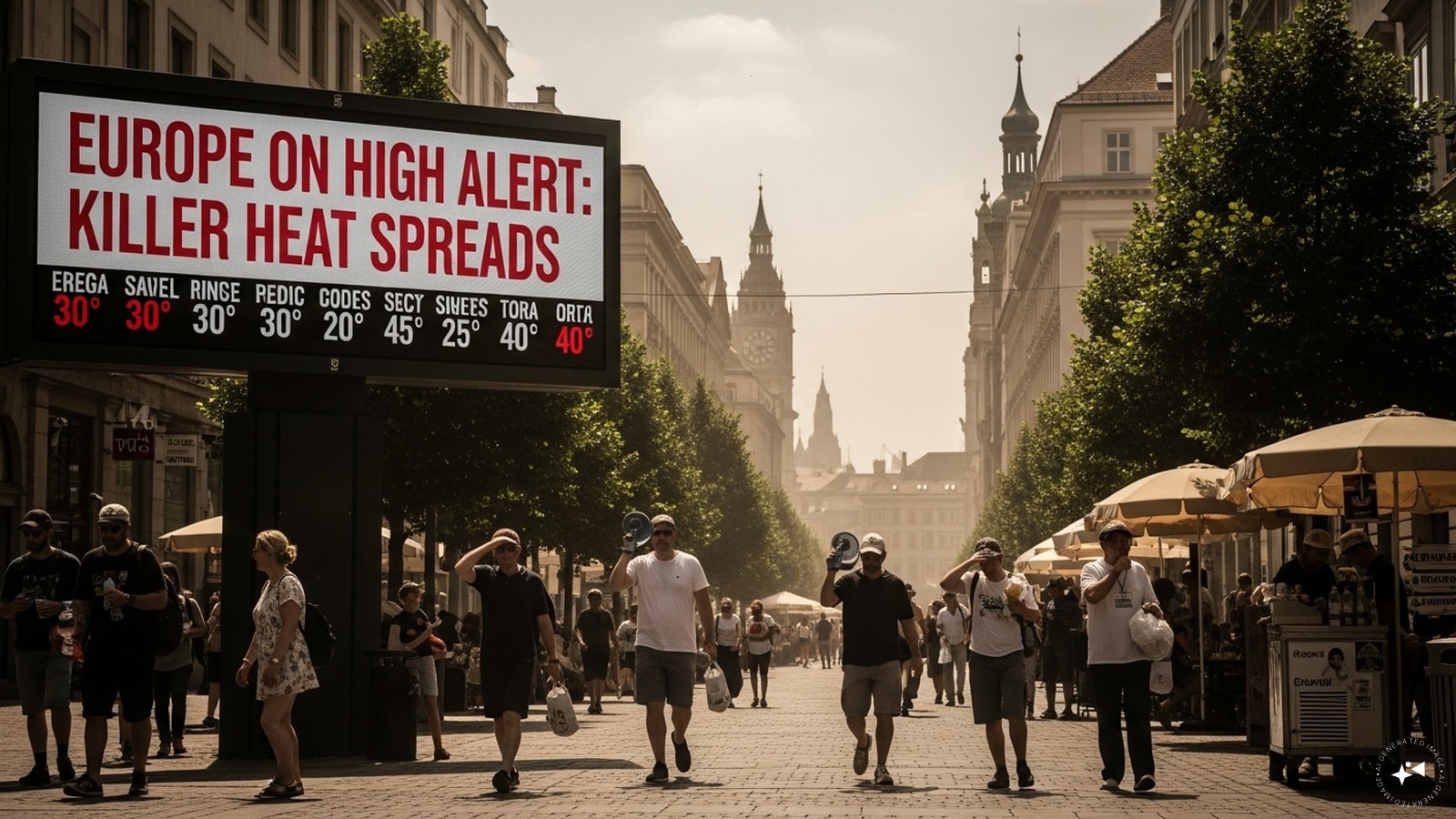
The operational capacity of European infrastructure is failing under the thermodynamic realities of the modern climate. In June 2026, an atmospheric phenomenon known as an Omega block locked a high-pressure system over the continent, driving ambient temperatures up to 18°C above seasonal averages. This is not a temporary meteorological anomaly; it is a structural stress test revealing that Western Europe’s built environment operates on an obsolete thermal baseline.
The primary vulnerability lies in a systemic mismatch: regional infrastructure was engineered for heat dissipation, yet it is now required to manage sustained thermal absorption. When daytime temperatures breach 40°C and nighttime temperatures fail to drop below 20°C—a threshold defining a "tropical night"—the natural cooling cycle of materials and human biology is interrupted. The resulting failure cascade can be analyzed through three core structural pillars: thermodynamic infrastructure degradation, cold-chain logistical failures, and urban microclimate amplification.
The Triad of Structural Vulnerability
1. Thermodynamic Infrastructure Degradation
Civil engineering relies on predictable thermal expansion coefficients. When ambient conditions exceed these design parameters, materials experience mechanical failure.
- Linear Infrastructure Deflection: On the German A2 motorway, extreme surface temperatures caused unreinforced concrete slabs to undergo compressive stress beyond their material limits, resulting in instantaneous buckling and explosive road ruptures.
- Rail Network Desynchronization: Steel rail tracks exposed to direct solar radiation can reach temperatures 20°C higher than the surrounding air. In the United Kingdom, where lines are pre-stressed to a stress-free temperature of 27°C, ambient heat forcing temperatures toward 36°C drives rails past their critical lateral stability threshold, causing track buckling and triggering mandatory rail speed restrictions to reduce dynamic loads.
2. Cold-Chain Logistical Failures and Mechanical Overload
Industrial cooling systems are bound by the laws of thermodynamics; their efficiency is inversely proportional to the ambient temperature of the external environment.
- The Carnot Efficiency Deficit: As the temperature differential between the interior evaporator and the exterior condenser narrows, refrigeration units and air conditioners must consume exponentially more electrical energy to reject the same amount of heat.
- The Institutional HVAC Bottleneck: Across continental Europe, public buildings, museums, and hospitals rely on legacy HVAC installations that cannot manage prolonged 40°C thermal loads. The temporary suspension of ticket sales at Italy's Uffizi Gallery exemplifies this bottleneck: when the ambient outdoor air exceeds the heat rejection capability of the condenser loops, system pressures spike, forcing automated safety shutdowns to prevent compressor failure.
3. Urban Microclimate Amplification
The spatial configuration of European cities alters local energy balances, transforming regional heat waves into acute hyper-localized hazards.
- The Urban Heat Island (UHI) Index: Dense urban centers convert solar radiation into sensible heat via high-thermal-mass materials like asphalt, stone, and traditional zinc roofing. In Paris, daytime temperatures on dense streets regularly measure 3°C to 5°C higher than adjacent rural areas.
- The Nighttime Recovery Deficit: High-density construction impedes longwave radiation from escaping back into the atmosphere at night. When zinc rooftops absorb heat all day and radiate it into top-floor apartments overnight, the Wet Bulb Globe Temperature (WBGT)—a holistic metric factoring in humidity, wind speed, and solar radiation—frequently remains above the human safety threshold of 28°C. This prevents the human body from shedding core heat during sleep, leading to a cumulative physiological strain that manifests in an exponential surge in emergency medical demands.
Quantifying the Residential Air Conditioning Bottleneck
The structural inability to mitigate indoor heat stress is exacerbated by a stark adoption deficit in climate-control technology. Data from the International Energy Agency indicates that residential air conditioning penetration in Europe stands at approximately 20%. This low baseline creates an immediate risk profile contrast when compared to regions like the United States or Japan, where penetration exceeds 90%.
[European Residential Climate Control Deficit]
Total Households:   |==================================================| 100%
AC Installed:       |==========| 20%
Vulnerable Units:   |========================================| 80%
The primary barrier to rapid AC deployment is not merely capital expenditure, but structural compatibility. Western European housing stock is heavily weighted toward historic masonry and multi-family legacy apartments. These structures lack the ductwork required for central air systems, have window configurations incompatible with standard American-style window units, and are frequently subject to strict historical preservation laws that prohibit the installation of external split-system condenser units on building facades. Consequently, the market relies on inefficient portable single-hose units that introduce negative pressure, drawing hot outdoor air back into the living space through structural gaps and neutralizing a significant portion of the cooling effect.
Strategic Countermeasures for Civil Infrastructure
Mitigating this systemic vulnerability requires an immediate shift from passive emergency management to active structural retrofitting. Municipalities and infrastructure operators must deploy capital across three distinct horizons.
First, rail network operators must transition from standard thermal pre-stressing to adaptive tensioning or high-temperature alloy integration. By raising the standard stress-free temperature baseline of rail steel in historically temperate zones, networks can minimize the probability of summer buckling, though this introduces a secondary requirement for enhanced inspection during winter contraction cycles.
Second, urban planning authorities must mandate the deployment of high-albedo coatings and passive shading configurations. Retrofitting zinc and asphalt roofs with reflective, emissive cool-roof polymers can reduce peak surface temperatures by up to 25°C, directly lowering the internal thermal load of top-floor residential units and reducing the ambient UHI effect.
Finally, emergency medical infrastructure must decouple from regional power grids through localized microgrids paired with thermal energy storage systems. Because grid failure risk correlates perfectly with peak air-conditioning demands during extreme heat events, hospitals require independent, redundant cooling loops powered by on-site solar photovoltaic arrays paired with ice-storage chillers that freeze water during off-peak hours to provide non-electric cooling during peak daytime stress.
The historical assumption that Europe’s climate is inherently temperate is structurally dead. Every asset management strategy, municipal budget, and infrastructure blueprint must now be updated to operate under a baseline where 40°C is a recurring operational standard rather than an extraordinary contingency. Asset managers who fail to price this thermal friction into their long-term capital expenditure cycles will face accelerating structural depreciation and systemic operational downtime.