In the quiet, windswept department of Pas-de-Calais in northern France, the air smells of wet earth and winter wheat. It is the kind of quiet that has settled over these fields for centuries, interrupted only by the tractor engine or the low hum of distant traffic.
Then came the transformers. Expanding on this theme, you can find more in: Why China's Methodical Moon Mission Plan Might Actually Beat Artemis.
First came the security fences, topped with razor wire. Then the concrete monoliths—windowless, massive, stretching across former farmland like windowless grey coffins. Inside, millions of tiny silicon chips hum at absolute peak capacity, crunching linear algebra to generate text, synthesize voices, and paint digital imagery for millions of users worldwide.
Outside, on a crisp November morning, standing near the canal at Corbehem, a farmer named Jean-Marc clutches a hand-painted wooden sign. His hands are calloused, stained with the soil his family has turned over for three generations. The sign doesn't read like a manifesto. It is simple: Our water is not your prompt. Observers at The Next Web have also weighed in on this trend.
Jean-Marc is not a Luddite. He uses a smartphone. He checks satellite weather feeds. But last July, during a brutal heatwave that baked northern Europe, the water table beneath his fields dropped to levels he had never seen in his fifty-four years. Local authorities imposed strict agricultural curfews. Jean-Marc was forbidden from watering his crops past noon.
Three kilometers down the road, the cooling towers of a newly commissioned data center complex blew heat plumes into the shimmering summer air, drawing millions of liters of fresh groundwater every single day to keep hyper-expensive server racks from melting.
The digital world, it turns out, is relentlessly, brutally physical.
For a decade, technology was sold to us as a miracle of weightlessness. We spoke of "the cloud" as if our photos, messages, and algorithms existed in a ethereal, heavenly ether. We uploaded our memories and offloaded our thinking, convinced that digital progress was clean, green, and immaterial.
It was a magnificent illusion.
The cloud has an address. It has concrete foundations, massive diesel generators, heavy cooling pipes, and an appetite for electricity that is breaking power grids across Western Europe.
When you ask an artificial intelligence to write a poem, summarize a PDF, or render an image, that request does not travel into a vacuum. It travels down undersea fiber-optic cables to places like Corbehem, Amsterdam, Helsinki, and Berlin. There, thousands of graphics processing units pull massive electric currents, glowing with heat. To keep those chips from frying, massive cooling loops pump cold water through the systems. The water evaporates into the sky.
The machine drinks. The local community thirsts.
Consider the sheer scale of what is happening under the surface. In Ireland, data centers now devour twenty-three percent of the nation's entire grid electricity—more than all urban homes combined. In the UK, over three hundred planned server hubs are waiting to connect to an already straining grid, representing dynamic power demands that dwarf the peak electricity capacity of the entire country.
Europe is caught in a profound conflict of interest. In Brussels, EU policymakers are terrified of falling behind in the global technological arms race. They have pushed aggressive mandates to triple the continent’s data center footprint within five to seven years. They talk of digital sovereignty, competitive edges, and technological independence.
On the ground, in the villages and suburban peripheries, citizens are staring at their monthly utility statements and watching their lakes dry up.
The tension finally snapped.
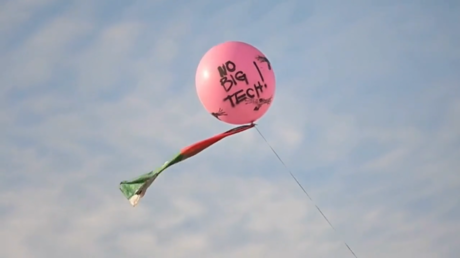
Organized under the banner of the "Stop Dirty Data Centres" coalition, tens of thousands of people across more than fifteen countries spilled into the streets. This was not a localized NIMBY movement complaining about property values. It was a coordinated, cross-border rebellion against the hidden costs of Big Tech’s relentless expansion.
In Amsterdam, hundreds of activists cut through wire fencing, breached a Microsoft construction site, and climbed towering yellow cranes, shutting down operations for hours until riot police moved in with batons. In Helsinki, over a thousand citizens marched past Google’s corporate offices directly to the Finnish parliament, demanding an immediate halt to facility construction on cleared forest land.
The anger is palpable because the bargain feels broken. Local municipalities hand out massive tax breaks and fast-tracked environmental permits to multi-trillion-dollar corporations. In return, the community receives a handful of permanent jobs—mostly security guards and facility technicians—and a permanent strain on their local infrastructure.
A single server building can pull as much power as a mid-sized city. When a new facility hooks into the local power grid, it absorbs the available energy capacity. Housing projects are delayed because the grid cannot support both new apartments and new server farms. Electricity prices for ordinary households spike to cover grid upgrades.
The people living next door pay for the machine’s power twice: once on their monthly bill, and once with their environment.
┌───────────────────────────────────────────────────────────┐
│                 THE HIDDEN INFRASTRUCTURE                 │
├──────────────────────────┬────────────────────────────────┤
│ Resource                 │ Real-World Impact              │
├──────────────────────────┼────────────────────────────────┤
│ Grid Electricity         │ Competes directly with home    │
│                          │ power, driving up rates        │
├──────────────────────────┼────────────────────────────────┤
│ Fresh Groundwater        │ Evaporated in cooling towers   │
│                          │ during regional droughts       │
├──────────────────────────┼────────────────────────────────┤
│ Land & Forest            │ Clear-cut for windowless       │
│                          │ concrete server monoliths      │
└──────────────────────────┴────────────────────────────────┘
The video below shows the physical scale of these facilities and the raw intensity of the civil pushback taking place across the continent.
What makes this moment so troubling is the secrecy. Ask a local mayor how much water the new data center down the road consumes annually, and you will likely be met with a wall of non-disclosure agreements. Tech companies treat their water and energy usage metrics as proprietary trade secrets.
They claim transparency would give competitors an advantage. But to the family whose municipal well is running low, that secrecy feels like theft.
We are forcing a false choice between human well-being and digital convenience. No one is arguing that we should dismantle the internet or revert to paper ledgers. The internet has given humanity unprecedented access to knowledge, connection, and opportunity.
The real problem lies elsewhere: in the unquestioned assumption that compute power can expand infinitely without regard for physical limits.
We have been told that artificial intelligence will solve our greatest challenges, including climate change. But there is a bitter irony in burning coal and gas to power algorithms designed to optimize solar panels, or draining clean aquifers to cool chips that write emails we don't even want to read.
The crowd gathered in the cold rain outside the European Parliament in Brussels did not look like radical eco-warriors. They were mothers, small-business owners, high school teachers, and retired engineers. They carried banners that read: Bits will not feed us. Bytes will not quench our thirst.
As twilight fell over the European quarter, Jean-Marc sat on the tailgate of his truck, looking at a photo of his farm on his phone. The screen glowed softly against the darkening sky.
He stared at the display, tapping the glass, fully aware of the absurdity. The very device in his palm was connected by an invisible thread to the concrete fortress down the road from his crops. He looked from the glowing screen to the horizon, where the massive cooling towers continued their silent, steady exhale into the cold evening air.
The cloud is not in the sky. It is in our soil, taking what we need to survive.


