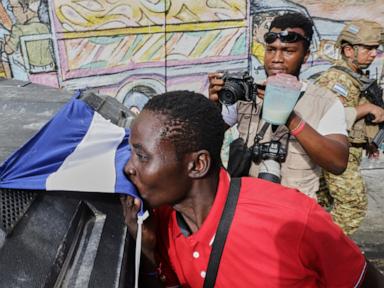
When thousands of people march through the streets of Port-au-Prince waving Salvadoran flags and chanting the name of El Salvador’s president, you know traditional diplomacy has completely failed.
That exact scene unfolded in Haiti’s capital. Frustrated residents gathered in massive numbers to praise Nayib Bukele and welcome the presence of Salvadoran troops deployed to help combat the armed gangs strangling their country. For years, Haitians have watched international summits come and go while armed coalitions seized neighborhoods, shut down ports, and turned daily survival into a high-stakes gamble. Now, ordinary citizens are bypassing polite political talking points and demanding the one thing that actually worked somewhere else in the region: an iron-fisted security crackdown.
Let's be honest about why this is happening. People living under constant extortion and kidnapping threats don't care about academic debates over statecraft. They want to walk to the market without getting shot.
Why Bukele Became a Folk Hero in Port-au-Prince
To understand why crowds in Haiti are cheering for a Central American leader, you have to look at the sheer desperation on the ground and the stark contrast El Salvador offers.
Not long ago, El Salvador held the grim title of the murder capital of the world. Gangs like MS-13 and Barrio 18 controlled vast territory, taxed local businesses into bankruptcy, and dictated where citizens could travel. Then Bukele took office, declared a state of emergency in 2022, suspended certain constitutional rights, and launched a massive military and police sweep that locked up tens of thousands of suspected gang members in mega-prisons. The homicide rate plummeted. Streets that hadn't been safe after dark for decades suddenly filled with families again.
Haitians watched all of this unfold on their phones.
Meanwhile, in Port-au-Prince, armed coalitions like Viv Ansanm consolidated control over roughly 80% of the capital. Over half a million people were forced from their homes. Hospitals closed. Schools shuttered. When El Salvador agreed to send a contingent of military personnel to join the international security support mission in Haiti, it wasn't treated by locals as just another foreign deployment. It was viewed as the arrival of specialists who had already beaten the exact same disease.
Crowds didn't show up to praise bureaucrats in New York or Washington. They showed up for Bukele because his approach produced visible, undeniable results in record time.
What Most Foreign Observers Miss About the Protests
If you read standard international coverage of these demonstrations, you'll usually see a predictable framing. Analysts worry about democratic backsliding, human rights abuses, and the risks of importing El Salvador’s heavy-handed tactics into a fragile state without functioning courts.
Those concerns aren't imaginary. In El Salvador, human rights organizations documented thousands of arbitrary arrests, deaths in custody, and a near-total lack of due process during the crackdown. Exporting that model to Haiti—where the justice system is barely breathing and police infrastructure has been systematically burned down by gangs—carries massive risks. Innocents will almost certainly get caught in the dragnet if mass detention becomes the primary strategy.
Yet focusing exclusively on legal theory misses the lived reality of the people marching in Port-au-Prince.
When a state collapses to the point where armed groups control the food supply, fuel terminals, and main highways, constitutional niceties feel like an insult to the people bleeding in the streets. For a street vendor in Port-au-Prince paying half her daily income in gang protection money, the "Bukele model" doesn't represent authoritarianism. It represents the restoration of basic order.
Here's what international observers consistently get wrong about Haiti's security crisis:
- They assume citizens prioritize institutional reform over immediate safety. You cannot build courts, hold elections, or fix corruption while gunmen occupy the Ministry of Justice and the central hospital. Security comes first. Everything else is secondary.
- They underestimate regional solidarity. Haitians feel burned by decades of U.N. missions that brought scandal, cholera, and little lasting stability. Seeing troops from a fellow Latin American nation that overcame similar gang terror carries a completely different psychological weight.
- They treat gang violence as a policing issue rather than asymmetric warfare. Haiti's armed groups aren't petty street criminals. They use military-grade rifles, armored vehicles, and coordinated urban warfare tactics.
The Reality of Salvadoran Troops on the Ground in Haiti
Praising Bukele in the streets is one thing. Actually dismantling Haiti's gang networks is another beast entirely.
El Salvador's deployment to Haiti is relatively small, focused primarily on medical evacuation, logistics, and tactical support alongside the Kenyan-led Multinational Security Support (MSS) mission and the Haitian National Police (PNH). Unlike in San Salvador, where Bukele commanded his entire domestic military apparatus, centralized the prison system, and controlled every lever of government, Salvadoran forces in Haiti are operating as a supporting element inside a complex, underfunded international coalition.
That distinction matters enormously.
In El Salvador, gangs had a rigid hierarchy, distinct tattoos, and clear territorial boundaries that made mass identification and detention brutally efficient. Haiti’s armed landscape is far more fluid. Gangs shift alliances constantly, blend into dense informal settlements like Cité Soleil, and maintain deep ties to corrupt political and economic elites who supply them with weapons and ammunition.
You can't just copy-paste the CECOT mega-prison strategy onto Port-au-Prince overnight. Even if joint forces clear a neighborhood today, someone has to hold it tomorrow. Without a rebuilt Haitian police force, functioning local courts, and an end to the illicit arms flow coming largely from overseas, tactical victories on the streets risk evaporating the moment foreign troops pull back.
The Shift in Regional Politics Nobody Can Ignore
Regardless of how the operational challenges play out, the demonstrations in Port-au-Prince confirm a massive shift across Latin America and the Caribbean.
"Bukelismo" is no longer just a Salvadoran domestic phenomenon. From Ecuador to Honduras and now deep inside Haiti, public patience with traditional security doctrines has evaporated. Voters and protesters alike are openly embracing leaders who promise swift, uncompromising force against organized crime, even when that force bends or breaks conventional democratic norms.
For policymakers watching from abroad, lecturing Haitians about the dangers of authoritarianism won't change minds in Port-au-Prince. If democratic governments want to offer a viable alternative to strongman politics, they have to prove that rules-based security missions can actually deliver safety on the ground—and fast.
How to Follow This Story Without Falling for the Spin
Because the debate around Bukele and Haiti's security mission is heavily polarized, coverage often swings between uncritical hero worship and detached legalistic scolding. If you want an accurate picture of whether this intervention is actually working, track concrete indicators rather than political speeches:
- Watch territorial control around key infrastructure. Real progress means the permanent reopening of the main port in Port-au-Prince, unobstructed access to the Varreux fuel terminal, and the clearing of National Routes 1 and 2 connecting the capital to the rest of the country.
- Track police recruitment and retention. Foreign troops are a temporary bridge. Sustainable security depends on whether the Haitian National Police can rebuild its ranks, get paid on time, and hold territory independently after joint operations clear a sector.
- Monitor arms interdiction efforts. Gangs don't manufacture their own ammunition in Haiti. Look for concrete enforcement actions targeting the maritime smuggling routes and corrupt networks supplying heavy weaponry into the country.
- Listen to local civil society and displaced residents. The clearest measure of success isn't a press release from a foreign ministry—it's whether the hundreds of thousands of internally displaced Haitians actually feel safe enough to pack up their shelters and return to their neighborhoods.