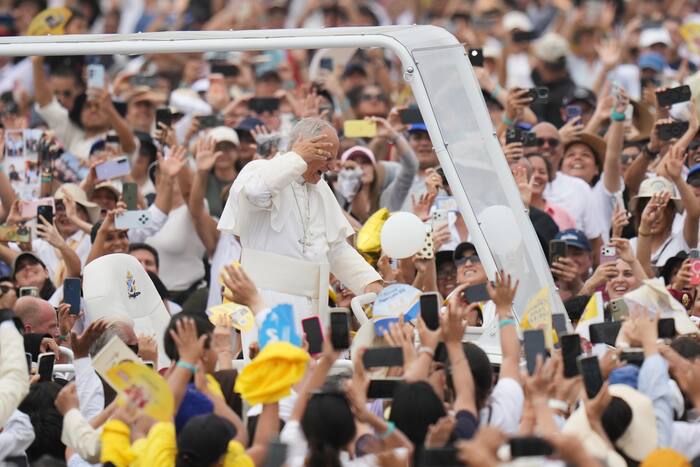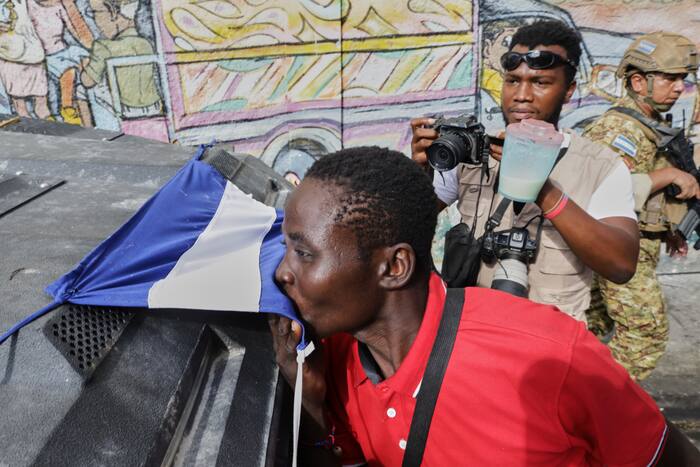
Thousands of demonstrators marched through the streets of Port-au-Prince carrying Salvadoran flags, chanting the name of President Nayib Bukele, and praising the arrival of Salvadoran troops deployed to help dismantle Haiti’s armed coalitions. Their demand is simple. Haitians want the same ruthless, uncompromising security crackdown that transformed El Salvador from the murder capital of the Western Hemisphere into a country where families can walk the streets after dark. Driven to exhaustion by years of kidnappings, blockades, and institutional collapse, ordinary citizens are looking past traditional diplomatic channels and demanding an iron-fist solution to restore basic survival.
The sight of Salvadoran banners waving above the rubble of Haiti's capital marks a profound shift in how the Caribbean nation views foreign intervention. For decades, international missions in Haiti have been met with deep skepticism, resentment, and outright hostility. Past deployments left behind political paralysis, economic dependency, and catastrophic public health failures that scarred the national psyche. Yet the crowd in Port-au-Prince was not protesting foreign boots on the ground. They were celebrating them.
The Anatomy of Desperation in Port-au-Prince
To understand why a Central American populist strongman has become a folk hero in a French- and Creole-speaking Caribbean nation, you have to look at the daily reality of life in the capital. Armed alliances, most notably the Viv Ansanm coalition, have systematically choked off the country's economic arteries. Ports have been shuttered. Hospitals have been looted and burned. Millions have been displaced from their neighborhoods, forced to shelter in makeshift camps inside schools and government ministries while gang leaders dictate who eats, who travels, and who lives.
Traditional policing has virtually ceased to exist in large swaths of the metropolitan area. The Haitian National Police, underfunded, outgunned, and plagued by attrition, has struggled to hold territory against syndicates armed with high-caliber military weapons trafficked largely from the United States. When the state retreats, survival becomes the only currency.
In that vacuum, ideological debates over due process and constitutional guardrails feel like luxuries reserved for people living behind fortified walls in foreign capitals. A street vendor in Delmas or a bus driver in Carrefour does not care about the academic critiques of mass incarceration. They care about whether they can transport goods from the port to the market without paying a lethal extortion tax at three different checkpoints.
The Failure of Incremental Diplomacy
For years, the international community approached Haiti's crisis through the lens of gradual institutional reform. Diplomats drafted roadmaps for elections, convened transitional councils, and pledged funds for long-term governance programs. On paper, those frameworks looked orderly. On the ground, they were entirely detached from reality.
You cannot hold a credible election when armed groups control the roads leading to the polling stations. You cannot rebuild a judiciary when judges are assassinated in traffic and courthouses are burned to the ground. By insisting on political consensus before security could be established, foreign policymakers effectively handed armed coalitions a veto over Haiti's future. The public watched transitional bodies bicker over cabinet appointments while neighborhoods fell one by one.
That frustration is the fuel behind the demonstrations. When protesters hold up portraits of Nayib Bukele, they are delivering a blunt verdict on their own political class and its international backers. They are saying that order must come first, and everything else is secondary.
How the Salvadoran Model Captured the Haitian Imagination
El Salvador's transformation under Bukele is not an abstract case study in Latin America. It is a viral, hyper-visible political phenomenon broadcast directly onto smartphones across the region. For years, MS-13 and Barrio 18 exercised territorial control over Salvadoran neighborhoods that mirrored what Haitians experience today. Extortion crippled small businesses, invisible borders divided cities, and homicide rates ranked among the highest in the world.
Beginning in March 2022, Bukele's government instituted a state of exception that suspended key constitutional rights, deployed the military alongside police, and led to the arrest of tens of thousands of suspected gang members. The administration constructed the Terrorism Confinement Center, a massive maximum-security facility designed to sever communication between imprisoned leaders and street-level operatives. Homicides plummeted. Extortion rings collapsed.
For Haitians watching from afar, the parallel was unmistakable. If a small, resource-constrained country in Central America could break the back of entrenched criminal syndicates in a matter of months, why was Haiti still trapped in an endless cycle of negotiation and retreat?
The Arrival of Salvadoran Forces
The symbolic power of the Bukele model became tangible with the deployment of Salvadoran military personnel joining the Multinational Security Support mission in Haiti. While Kenyan police officers formed the initial backbone of the international force, the arrival of troops from El Salvador carried a distinct psychological weight.
Unlike soldiers from nations with no recent experience fighting urban insurgencies, Salvadoran forces brought direct, hard-won institutional knowledge of dismantling entrenched street gangs. Their presence signaled a potential shift from defensive peacekeeping—guarding airports, ports, and diplomatic compounds—toward offensive, intelligence-driven operations aimed at reclaiming territory.
For the demonstrators in Port-au-Prince, those troops represent more than just additional manpower. They represent proof of concept.
The Structural Differences Nobody Wants to Talk About
Here is where the hard reality of investigative analysis collides with street-level optimism. Transplanting the Salvadoran model directly onto Haitian soil faces massive structural, logistical, and political obstacles that cannot be solved by sheer willpower alone.
First, look at the state apparatus. When Bukele launched his crackdown, he commanded a functioning, centralized state with an intact military, a loyal police force, a unified executive branch, and a tax base capable of funding massive prison construction. Haiti possesses none of those advantages. Its government is an unelected transitional arrangement struggling to assert authority beyond a few fortified blocks. Its tax collection infrastructure has been decimated by the closure of customs offices and ports. There is no Haitian equivalent of the Terrorism Confinement Center waiting to house tens of thousands of detainees, and no functioning court system ready to process them.
Second, examine the nature of the armed groups. Salvadoran gangs, while ruthless, were primarily street-level extortion and drug-distribution networks whose members lived within the communities they terrorized and identified themselves through visible tattoos and territorial markers. Haiti's armed coalitions operate differently. Many are led by former police officers, political enforcers, and heavily armed militias that possess armored vehicles, heavy machine guns, and drones. They are deeply intertwined with segments of Haiti's political and economic elite, who have historically used armed groups to protect business monopolies, suppress rivals, and manipulate elections.
The Intelligence Deficit
A mass arrest campaign without accurate intelligence in Port-au-Prince carries catastrophic risks. In El Salvador, the state spent years mapping gang structures before launching its sweep, and even then, human rights organizations documented thousands of arbitrary detentions of innocent citizens caught in dragnet operations.
In Haiti, years of institutional collapse have hollowed out domestic intelligence networks. Foreign troops, whether from Kenya or El Salvador, do not speak Haitian Creole fluently, do not know the intricate social geography of neighborhoods like Cité Soleil or Bel Air, and cannot easily distinguish between a coerced resident and an active combatant. Without reliable local intelligence, aggressive military sweeps risk alienating the very population currently cheering in the streets.
The Geopolitical Gamble Behind the Deployment
Why did San Salvador agree to send troops to one of the most dangerous operational environments in the world? The answer lies in regional diplomacy and strategic branding.
For Nayib Bukele, contributing forces to the mission in Haiti elevates his standing from a controversial domestic populist to an indispensable regional security partner. By stepping up where wealthier nations hesitated to commit combat troops, El Salvador gains diplomatic capital with Washington and international institutions. It reinforces the narrative that the Salvadoran security doctrine is an exportable solution to hemispheric instability.
Yet this creates a delicate balancing act for the international coalition. The mission in Haiti operates under strict rules of engagement funded largely by countries that officially condemn the suspension of civil liberties in El Salvador. While Haitian protesters want Salvadoran troops to unleash the full fury of the state of exception, international donors expect those same troops to adhere to traditional peacekeeping standards, human rights vetting, and proportional force.
That tension sits at the core of the operation. If the multinational force moves too cautiously, Haitian public support will evaporate, turning street celebrations back into anti-foreign protests. If it moves with unchecked aggression and causes heavy civilian casualties, international funding and diplomatic backing could fracture overnight.
What History Tells Us About Strongman Solutions in Haiti
Haiti's history offers sobering lessons about the seductive appeal of absolute authority during moments of chaos. Time and again, the promise of iron-fisted stability has paved the way for entrenched dictatorship.
During the mid-twentieth century, François Duvalier rose to power promising order, national dignity, and the dismantling of entrenched elites. What followed was decades of state terror enforced by the Tonton Macoute, economic stagnation, and the systematic destruction of independent civic institutions. Even after the fall of the Duvalier regime, periodic demands for a strongman to sweep away corruption and crime repeatedly collided with the reality that unchecked security forces rarely surrender power once the immediate crisis passes.
A hypothetical scenario illustrates the danger clearly. Imagine a foreign-backed security force successfully clears Port-au-Prince's major highways and ports within six months using aggressive sweep tactics. Commerce resumes, kidnappings drop, and public approval soars. Now ask the next question. Who fills the vacuum? If the underlying judicial, electoral, and economic systems remain broken, power simply consolidates around whoever controls the guns and the detention centers. Without parallel institutional rebuilding, a security crackdown does not cure the disease; it merely changes the uniform of the person holding the weapon.
The Economic Root System
Any honest assessment of Haiti's crisis must also confront the financial architecture sustaining the violence. Armed groups do not manufacture rifles or ammunition in Port-au-Prince. Every bullet fired in the capital is imported, paid for through extortion, kidnapping ransoms, contraband smuggling, and illicit political patronage.
Arresting foot soldiers in impoverished neighborhoods will never permanently pacify Haiti if the financiers, arms traffickers, and corrupt officials profiting from the chaos remain untouched. In El Salvador, dismantling gang finances required freezing assets, auditing municipal contracts, and prosecuting colluding politicians. In Haiti, where sanctioned elites still wield immense behind-the-scenes influence, targeting the financial roots of the crisis requires a level of political courage that transitional authorities have yet to demonstrate.
The Verdict From the Streets
Despite these sobering realities, dismissing the demonstrators in Port-au-Prince as naive misses the fundamental truth of their situation. People trapped in a burning building do not debate the architectural flaws of the fire truck. They demand water.
For years, ordinary Haitians have borne the full weight of state failure while watching international conferences produce endless communiqués and few tangible results. The rallies praising Bukele and Salvadoran troops are a rational response to an intolerable status quo. They reflect a population that has lost patience with half-measures and is willing to embrace radical disruption if it offers even a slim chance of reclaiming their streets, their businesses, and their children's futures.
Whether the deployment of Salvadoran forces marks a genuine turning point or becomes another chapter in Haiti's long history of frustrated interventions will depend entirely on execution. Troops on the ground can clear barricades and reopen roads, and their specialized experience offers a vital tactical boost to an exhausted police force. Yet guns alone cannot build a state. Until Haitian leaders and their international partners pair kinetic security operations with real judicial accountability and an end to elite impunity, the peace won in the streets will always remain fragile.
For now, the banners waving in Port-au-Prince deliver an unmistakable message to the world. Haitians are done waiting for slow solutions, and they will back anyone willing to fight for the basic right to live without fear.