The wind in Hokkaido does not merely blow. It bites. It sweeps across the northernmost wildness of Japan, carrying the scent of pine and frozen sea, burying the tracks of the Sekihoku Main Line under drifts of white powder so thick they can swallow a man whole.
In the depths of winter, Kami-Shirataki station felt less like a transit hub and more like an island at the edge of the world. It was a weather-beaten wooden platform. A rusting sign. A single track cutting through the silence of a dying rural outpost. By 2012, the logging industry that once sustained this community had vanished. The families moved away. The houses emptied, their windows staring blankly out at the encroaching forest.
Japan Railways faced a spreadsheet reality. The station was hemorrhaging money. Maintaining a line through brutal sub-zero winters requires clearing snow, checking rails, and heating switchboxes. It costs a fortune. For a station with zero passenger traffic, the corporate math was simple.
Close it.
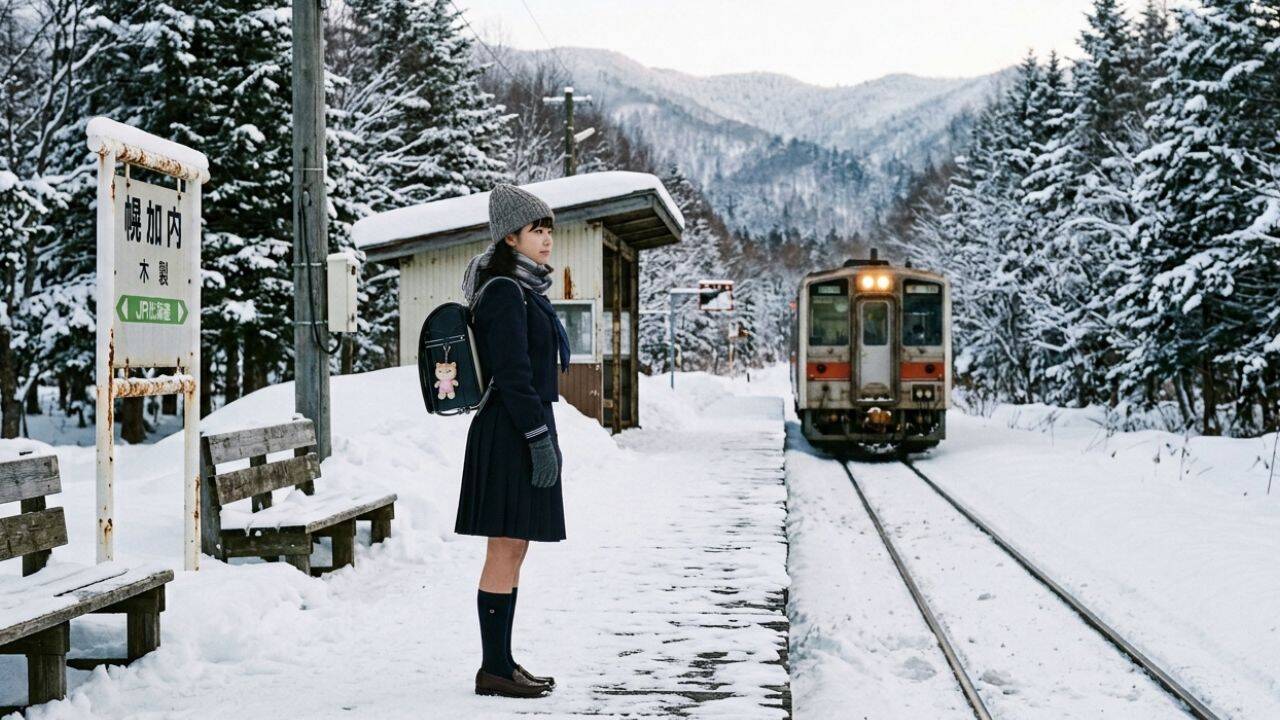
Yet, when the executives sat down with the data, they discovered a anomaly. A single blip on the ridership charts. One person was still using the platform. Every single morning, a high school girl named Kana Harada stood on that frozen wood, waiting for the 7:04 AM train to take her to class. Every afternoon, the train dropped her back off.
What happened next defied every rule of modern corporate logic.
The Arithmetic of Human Worth
We live in an era obsessed with optimization. Efficiency is our god. We look at spreadsheets to decide which hospitals stay open, which bus routes survive, and which communities are allowed to fade into obscurity. If a service does not turn a profit, we are told it is a luxury we can no longer afford.
Imagine the conversation in that Tokyo boardroom. To keep Kami-Shirataki open meant deploying maintenance crews to a remote northern forest for the sake of one teenage citizen. It meant keeping an entire scheduling apparatus alive for two daily stops. From a strict business perspective, it was madness.
But Japan Railways did not close the station.
Instead, they looked at the high school freshman and made a promise. They pledged to keep the station running until the day she graduated. They even adjusted the train’s timetable by a few minutes to ensure it aligned perfectly with her school schedule.
This was not a marketing stunt. For years, the decision remained a quiet local reality, unnoticed by the wider world until a few years before the station's final day. It was a choice born from an old, deeply rooted philosophy: some debts are not measured in yen.
Consider the alternative. Had the trains stopped, Kana’s education would have effectively ended, or her family would have been forced to uproot their lives entirely. In rural Hokkaido, public transit is not a convenience. It is oxygen. To cut the line is to suffocate the town. By deciding that one girl’s future was worth more than the operational deficit of a remote outpost, the railway system chose a different kind of balance sheet. They invested in human potential.
The Rhythm of the Rails
To understand the weight of this choice, you have to understand the isolation of a northern Japanese winter. The silence is heavy. It presses against your chest.
Every morning, long before the sun managed to color the horizon a pale, icy blue, Kana would walk to the platform. The temperature frequently dropped below minus twenty degrees. Your breath freezes on your eyelashes. The metal of the station sign cracks under the tension of the cold.
Then, a sound.
A low rumble vibrating through the soles of her boots. A distant headlight piercing the snow haze. The diesel engine of the single-car train would roar to life against the quiet, pulling up to the platform precisely at 7:04 AM. The doors would hiss open. The conductor would nod.
Warmth.
For three years, this ritual held the winters at bay. It became a heartbeat for a valley that was otherwise stopping. Local residents, recognizing the quiet gravity of what the railway was doing, took it upon themselves to tend to the station. They cleared the platform of snow. They made sure the path was safe. It became a collective act of resistance against the decline of their home.
This is where the standard narrative of corporate coldness falls apart. We are conditioned to expect institutions to fail us. We expect them to cut corners, to automate us away, to treat our unique lives as statistical noise. When an entity as massive as a national railway system pauses, looks down at a lone individual on a map, and says, We see you, and you matter, it feels like a miracle.
But it should not be a miracle. It should be the baseline.
The Final Departure
Time, like the Sekihoku Main Line, moves in only one direction.
In March of 2016, the snow began to soften. The edges of the platform thawed, revealing the dark, weathered wood underneath. March in Japan is the season of endings and beginnings. It is graduation season.
Kana Harada completed her final exams. She donned her uniform one last time. On March 25, a small crowd gathered at the remote platform. Neighbors who had watched her grow, railroad enthusiasts who had caught wind of the story, and local officials stood together in the crisp air.
The train arrived. Kana stepped aboard for her final journey as a student. She carried bouquets of flowers gifted by the people who had kept her world connected. As the train pulled away, the crowd cheered, waving banners of gratitude.
The next day, Japan Railways permanently closed Kami-Shirataki station, alongside two other underutilized stops in the area. The promise had been kept. The contract was fulfilled.
Today, the platform is gone, or reclaimed by the Hokkaido brush. The train no longer slows down as it passes through the valley. It speeds through the trees, a blur of metal and glass, rushing toward larger cities, bigger markets, and denser crowds.
It is easy to look at this story as a quaint piece of nostalgia, a heartwarming anomaly from a distant corner of the world. That misses the point entirely. The story of the lone schoolgirl and the train is a mirror. It asks us what we are willing to carry when the cargo isn't profitable. It challenges the modern dogma that everything must justify its existence through a profit margin.
A civilization is not measured by how fast its fastest trains go, or how rich its corporate boardrooms become. It is measured by whether it will stop an entire train in the middle of a blizzard, just to make sure one person can find her way home.