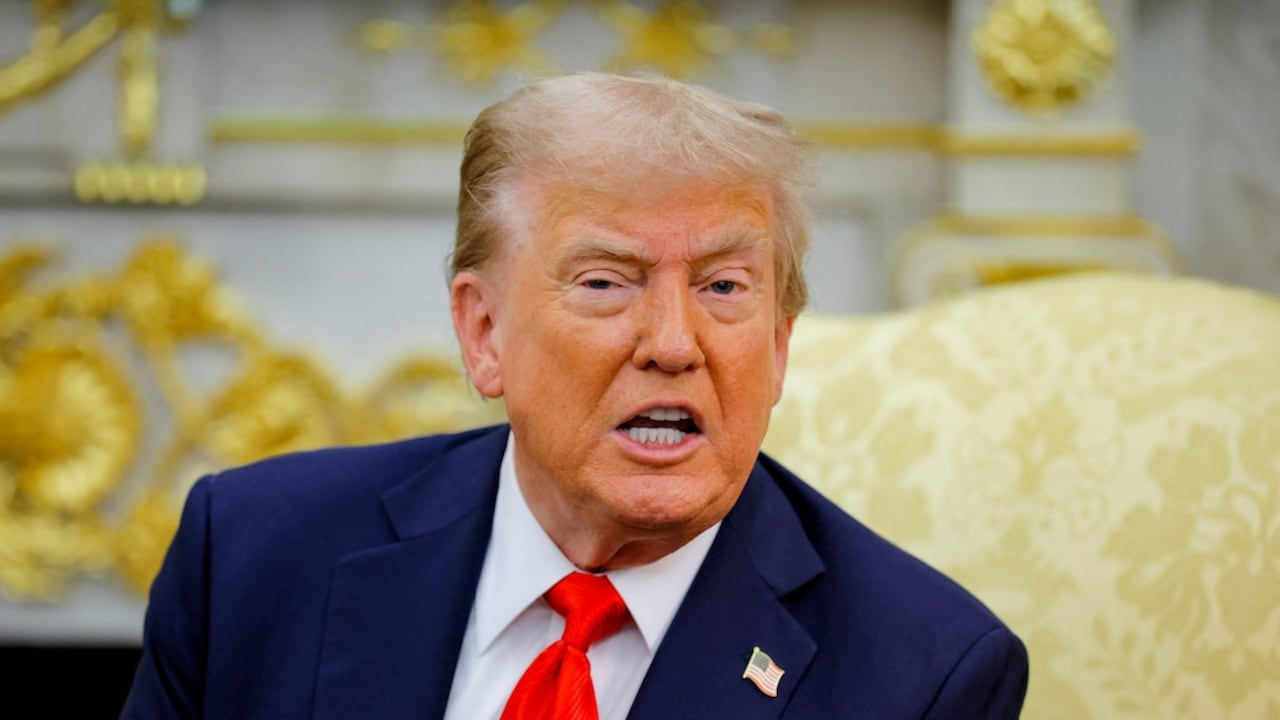
Donald Trump has zero patience for the AI safety crowd, and he made that painfully clear this week by branding AI critics as "negative forces" just 24 hours after global leaders called for an industry slowdown.
If you've been following the clash between Washington's deregulation push and international AI safety advocates, this collision was inevitable. One side sees artificial intelligence as an existential threat that demands strict guardrails and a coordinated pause. The other sees it as an economic and geopolitical race where slowing down means handing the keys to Beijing.
Trump isn't interested in compromise.
What Sparked the Negative Forces Remark
The timing wasn't an accident. A day before Trump's comments, an international coalition of researchers, policymakers, and ethicists renewed calls for a global slowdown on frontier AI development. Their argument is familiar by now. Large language models and autonomous systems are scaling faster than our ability to test, audit, or govern them.
Trump's response cut straight through the academic caution. Speaking to supporters and industry figures, he dismissed the warnings entirely, labeling the skeptics "negative forces" trying to strangle American innovation before it reaches full speed.
It's classic Trump framing. Complex regulatory debates get boiled down to winners versus losers, builders versus blockers.
The Core Argument Behind the Pushback
To understand why this rhetoric lands so well with Silicon Valley's accelerationist wing, look at how the US approaches tech competition right now. From Trump's perspective, pausing AI development doesn't make the world safer. It just ensures that authoritarian governments without safety boards take the lead.
Here's what the pro-acceleration camp points to when they push back against global slowdown proposals:
- National security leverage depends on maintaining a clear compute and model advantage over geopolitical rivals.
- Economic growth relies on letting American startups deploy commercial tools without waiting years for federal licensing.
- Energy infrastructure requires massive private investment in data centers and power generation, which regulatory uncertainty immediately freezes.
When you put those three factors together, a global slowdown sounds less like a safety measure and more like unilateral disarmament.
Why Global Leaders Are Asking for a Pause Anyway
Calling AI critics "negative forces" makes for a great soundbite, yet it brushes past real technical concerns that even top lab founders admit exist. You don't have to be an anti-tech alarmist to see why international regulators are nervous.
Right now, companies are training systems with capabilities that weren't explicitly programmed into them. Nobody has a complete map of how frontier models arrive at certain outputs. When those same systems get plugged into healthcare, financial markets, and defense networks, small alignment failures stop being theoretical.
International advocates pushing for a slowdown aren't usually asking to ban software. Most are pushing for binding compute thresholds, mandatory third-party safety evaluations before public release, and international treaties modeled loosely on nuclear non-proliferation frameworks.
The Enforcement Problem Nobody Wants to Admit
Even if you agree with the safety crowd in principle, their plan hits a massive wall in practice. Who actually enforces a global AI slowdown?
History gives us a pretty clear answer. International agreements work when materials are rare and easy to track, like enriched uranium. Compute and code don't behave like uranium. You can't easily inspect every data center on earth, and no superpower is going to voluntarily cripple its domestic tech sector on an honor system.
That's the exact flaw Trump's team exploits. They argue that the United States would follow the rules while adversaries ignore them quietly behind closed doors. Honestly, it's hard to prove them wrong on that point.
How This Splits Silicon Valley Right Down the Middle
If you talk to founders and venture capitalists in San Francisco right now, you'll hear two completely different versions of reality.
On one side, you have the open-source advocates and defense-tech builders who cheered Trump's "negative forces" comment. To them, the AI safety movement has been captured by incumbent giants trying to pull up the ladder behind themselves. Big labs already have the compute and the cash. Heavy regulation protects monopolies by making compliance too expensive for a three-person startup in a garage.
On the other side, researchers working on alignment and biosecurity risks see this political rhetoric as reckless. They've spent years warning that competitive pressure forces labs to cut corners on testing just to beat a rival's release date by two weeks.
Both sides have a point, which is why the policy fight has turned so bitter.
What Happens to AI Policy Under a Deregulation Agenda
Trump's stance signals a sharp turn away from executive oversight frameworks that prioritized pre-deployment safety reporting and algorithmic auditing. Instead of building new federal guardrails, the focus shifts toward clearing bottlenecks.
Expect policy energy to concentrate on three immediate areas:
- Expanding domestic energy capacity so hyperscalers can build gigawatt-scale data centers without multi-year permitting delays.
- Streamlining federal procurement so government agencies and defense contractors can adopt commercial AI tools faster.
- Challenging state-level AI laws that create a patchwork of compliance rules across places like California and New York.
For tech companies, this removes a massive cloud of federal uncertainty. For safety researchers, it means the burden of testing falls almost entirely back on voluntary corporate pledges.
What Businesses and Builders Should Actually Do Now
Political rhetoric swings wildly from week to week, so building your business strategy around a single speech is a mistake. Whether you agree with Trump's framing or side with the global slowdown camp, the practical reality on the ground is clear.
Federal guardrails are loosening, while state-level rules and international regulations like the EU AI Act remain very much alive.
If you're deploying AI inside a company right now, don't wait for Washington to tell you what's safe. Build your own internal verification steps for anything customer-facing or high-stakes. Keep human review in the loop for financial, medical, or legal outputs, because liability still lands on your desk if a model hallucinates—no matter who's in the White House.
At the same time, stop stalling product rollouts out of fear that federal regulators are about to freeze the market. The signal from the top couldn't be louder: the race is on, and Washington isn't hitting the brakes.