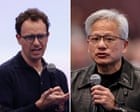
You are standing in the middle of a massive tech conference, watching a panel discussion, when the sitting president of the United States calls the keynote speaker on his cell phone.
That is exactly what happened when former Nvidia CEO Jensen Huang pulled out his phone on stage, put Donald Trump on speaker, and broadcasted a direct message to the tech world. The core message from the White House was loud and clear: existential fears about artificial intelligence are nothing more than a "hoax".
If you thought Washington was about to pump the brakes on the current technology boom, this phone call should change your perspective entirely.
The Politics Behind the Phone Call
Let us look past the theater for a second. Why did this happen? The timing wasn't an accident. Right before this public stunt, high-profile figures in the industry—including leadership at companies like Anthropic and OpenAI—had been urging the government to slow down the pace of frontier model development. They warned about safety, runaway intelligence, and the existential risks of building systems we cannot fully control.
Trump rejected that premise completely. On the live audio feed, he argued that pushing back against rapid development is just playing into the hands of political opponents and international rivals like China.
"The robots will not be taking over," Trump told the live audience through Huang's phone. "The AI will not be taking over the rest of the world. The whole thing is a hoax."
This stance aligns the administration firmly with the "build faster" camp. Instead of stringent oversight or federal moratoriums, the focus is squarely on maintaining America's competitive edge.
Why Data Centers Are the New Oil
While the conversation touched on doomsday scenarios, the real meat of the discussion was physical infrastructure. Trump didn't just dismiss robot takeovers; he hyped up data centers as the ultimate economic engine.
He labeled this physical buildout "the oil of the next 20, 25 years".
If you are wondering why local communities are suddenly fighting over zoning permits for massive server farms, this is why. These facilities require staggering amounts of power and water. Yet, the political mandate from the top is that they bring immense wealth to states and localities. Regulations or environmental pushback that slow down data center construction are viewed in Washington as a direct threat to economic dominance.
The False Choice Between Speed and Safety
Huang tried to thread a very specific needle during the appearance. On one hand, he praised whistleblowers and researchers who voice internal safety concerns, calling them courageous. On the other hand, he warned that the current level of panic creates a false choice between rapid innovation and absolute safety.
Here is what most commentary misses: distinguishing between philosophical panic and operational risk.
- Philosophical panic: Worrying about sentient superintelligence turning humanity into paperclips.
- Operational risk: Managing power grids, chip supply chains, and corporate governance.
When leaders label existential threats a hoax, they often conflate the two. They dismiss the sci-fi movie scenarios, which is fair, but it sometimes gives a free pass to ignore very real, mundane issues like algorithmic bias, grid strain, and cybersecurity vulnerabilities.
What This Means Moving Forward
You have to look at the practical fallout of this phone call. Chipmakers, cloud providers, and energy firms now have a green light from the executive branch to scale up aggressively. The fear of heavy federal handcuffs has receded, replaced by an urgent push to out-build global competitors.
If you are building a business or investing in tech, the regulatory environment in the US is favoring expansion over restriction. Expect the bottlenecks to be physical—like finding enough electrical substations and cooling equipment—rather than legal or legislative.
The debate over where artificial intelligence is taking us is far from settled, but the political willpower to slow it down has hit a massive wall.
Jensen Huang interview about Trump phone call
This video captures the exact moment the Nvidia CEO took the surprise call on stage, offering a firsthand look at how the administration's stance on artificial intelligence was broadcast to the tech sector.