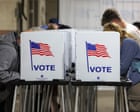
Every two years, political cable networks dust off the exact same headline. They frame American midterm elections as a simple up-or-down referendum on the sitting president. That framing is lazy, incomplete, and dangerously misleading. While Donald Trump’s presence in the White House undeniably dominates the national news cycle and drives intense voter emotion, treating the midterm elections solely as a personal scorecard misses the structural, economic, and hyper-local forces actually deciding control of Congress and statehouses across the country.
History shows that the president's party almost always loses ground in midterm cycles, a pattern stretching back to the Civil War with only rare exceptions like 1934, 1998, and 2002. Yet, attributing those losses strictly to personal approval ratings ignores the mechanics of modern turnout, gerrymandered district maps, and the divergent pressures facing Senate and House candidates. Voters do not walk into a booth in suburban Pennsylvania or rural Arizona simply to register a cosmic opinion on the commander-in-chief. They walk in carrying grocery receipts, mortgage statements, and deep-seated grievances about local governance that national pundits routinely overlook. Meanwhile, you can find other stories here: Why Uniting Behind Gadi Eisenkot Is a Trap That Keeps Benjamin Netanyahu in Power.
The Structural Trap of the Midterm Referendum
Political journalists love a clean story. A binary choice between supporting or rejecting a polarizing figure like Donald Trump makes for easy television graphics and effortless narrative arcs. However, that simplicity flattens a remarkably complex electoral map.
Consider the structural realities of the United States Congress. In the House of Representatives, aggressive redistricting over the past two decades has steadily shrunk the number of genuinely competitive swing districts. Out of 435 seats, fewer than forty typically see true two-party competition in a given cycle. When nearly ninety percent of House districts are drawn to safely favor one party or the other, the general election is rarely a referendum on anything. The real contest happened months earlier in low-turnout party primaries, where ideological purity tests matter far more than general election appeal. To understand the complete picture, we recommend the detailed report by USA Today.
The United States Senate operates under an entirely different set of constraints. Because Senate terms last six years, only one-third of the chamber faces voters in any midterm election. This creates wildly asymmetrical battlegrounds depending on the year. Sometimes the map forces Democrats to defend seats in deeply conservative states; other times, it puts Republican incumbents on defense in states trending blue. A wave election can certainly sweep away vulnerable incumbents, but the underlying geography of the Senate map often dictates the outcome before a single campaign ad airs.
Furthermore, the referendum theory assumes that voters treat federal, state, and local offices as interchangeable extensions of the White House. That assumption fails under scrutiny. Split-ticket voting has declined significantly since the 1980s, yet it persists in crucial pockets of the electorate, particularly in gubernatorial and state-level races. Voters frequently separate their views on national leadership from their evaluations of state management, local school boards, and municipal tax policies.
Economic Friction Versus Cultural Identity
If you ask ten political strategists what drives midterm turnout, five will point to the economy and five will point to cultural grievances. Both groups are half right. The interplay between pocketbook anxiety and cultural identity forms the real engine of American voting behavior, operating far beneath the surface of daily presidential headlines.
Economic indicators often tell a contradictory story during midterm seasons. Macro-level data might show steady gross domestic product growth, low unemployment rates, or cooling inflation. Yet, voters do not experience the economy through Bureau of Labor Statistics spreadsheets. They experience it through cumulative price increases over several years, the high cost of borrowing money for a car or a starter home, and the rising expense of healthcare and childcare.
When incumbent administrations point to positive macroeconomic trends, voters who feel financially squeezed often interpret those talking points as out-of-touch dismissal. Conversely, challengers who blame every economic headwind on the current occupant of the Oval Office are engaging in standard political theater, ignoring global supply chains, Federal Reserve interest rate policies, and corporate pricing strategies that operate largely independent of presidential executive orders.
At the same time, economic self-interest alone cannot explain why millions of working-class and suburban voters cast their ballots the way they do. Cultural alignment has become the primary sorting mechanism in American politics. Educational attainment, geographic density, and religious affiliation now predict voting patterns with far greater accuracy than income brackets.
A hypothetical voter in a rapidly growing exurban county might benefit directly from federal infrastructure spending or corporate tax policies, yet still vote against the party responsible for them because of deep disagreements over social issues, energy policy, or border enforcement. Conversely, a high-earning professional in a major metropolitan area might face higher personal taxes under one party's platform, yet vote for that party consistently out of alignment with its stance on reproductive rights, climate change, or institutional norms. Treating these deeply held identity markers as mere reactions to one man's personality misunderstands the last thirty years of American political realignment.
The Turnout Asymmetry Problem
Midterm elections are fundamentally contests of subtraction and mobilization. Unlike presidential years, when massive media saturation pulls occasional voters to the polls, midterms rely heavily on high-propensity voters—the citizens who show up every two years without fail.
Historically, this dynamic penalized the party holding the White House. Voters frustrated with the status quo possess a natural psychological urgency to register their anger. Voters satisfied with the direction of the country often grow complacent, assuming their preferred policies are secure. Political scientists call this the surge-and-decline theory, and it has governed midterm dynamics for generations.
However, the traditional turnout playbook has undergone massive disruption over the last decade. The coalition supporting Donald Trump relies heavily on irregular, working-class voters who turn out in massive numbers when his name is at the top of the ticket, but historically drop off at higher rates when he is not personally on the ballot. Meanwhile, the Democratic coalition has increasingly consolidated among college-educated suburbanites—a demographic group that exhibits exceptionally high turnout rates in off-year and special elections.
This demographic inversion creates a fascinating strategic dilemma for both parties during a midterm cycle:
- The Republican Challenge: GOP strategists must find ways to transfer the intense personal loyalty directed at Trump onto down-ballot candidates who often lack his populist charisma or media gravity. When candidates try to mimic his style without his unique political instincts, they frequently alienate moderate suburban swing voters without successfully motivating the irregular base.
- The Democratic Challenge: Democrats must capitalize on their structural advantage among high-propensity suburban voters while preventing catastrophic erosion among younger voters and working-class minorities, groups that often express frustration with institutional politics and incremental legislative results.
Because of these shifting coalitions, raw national polling averages—the very metrics used to measure a "referendum"—frequently fail to capture the localized turnout dynamics that determine close races. A generic ballot poll showing one party up by three points nationally tells you almost nothing about who will win a tight House race in central California or a Senate seat in the Rust Belt.
What Actually Moves the Needle in Swing Districts
To understand how midterm elections are actually won and lost, you have to leave Washington, D.C., and examine the trenches of battleground campaigns. Down-ballot races operate on distinct mechanics that rarely make the evening news.
Candidate Quality and Local Roots
In an era of extreme nationalization, it is tempting to believe that individual candidates no longer matter. That is false. While party labels establish a baseline floor and ceiling for any nominee, candidate quality routinely decides races within a three-to-five-point margin. Voters in swing districts still punish nominees who carry heavy personal baggage, utter extreme or unforced verbal gaffes, or demonstrate a glaring ignorance of local industries and community concerns. A disciplined candidate with deep roots in the district, a background in local business or military service, and a relentless focus on constituent services can consistently outperform the top of their party's ticket.
The Ground Game and Data Infrastructure
Modern campaigns spend hundreds of millions of dollars on television and digital advertising, much of which simply cancels itself out in saturated media markets. Where campaigns actually gain a measurable edge is in voter contact infrastructure. Identifying sporadic voters, tracking early and mail-in ballot returns in real time, and deploying targeted door-to-door canvassing operations can shift turnout by one or two percentage points. In races decided by a few thousand votes, that operational discipline is the difference between a concession speech and a swearing-in ceremony.
State-Level Ballot Measures
One of the most overlooked factors in modern midterms is the power of citizen-initiated ballot measures. Across multiple election cycles, proposals regarding minimum wage increases, marijuana legalization, abortion access, and voting rules have drawn millions of voters to the polls who might otherwise have stayed home. These measures bypass partisan filters, allowing voters to weigh in directly on concrete policies. Once those voters are in the booth, their presence alters the demographic composition of the electorate for every candidate listed alongside the ballot initiatives.
The Cost of Oversimplification
When major news outlets reduce an entire national election to a single personality test, they do more than just produce boring journalism. They actively distort how citizens understand their own government.
Framing the midterms strictly as a referendum on Donald Trump teaches voters to view Congress as a passive cheerleading squad or a pure obstruction machine, rather than a co-equal branch of government tasked with writing laws, overseeing federal agencies, and controlling the power of the purse. It absolves individual lawmakers of accountability for their own legislative records, their committee votes, and their responsiveness to the people they represent. If a representative can survive solely by pledging loyalty to—or fierce opposition against—the president, they have zero incentive to master the difficult, unglamorous work of actual governance.
Furthermore, this binary framing fuels perpetual post-election whiplash. When the president's party inevitably loses seats, pundits declare a massive ideological mandate for the opposition, even if the actual margin of victory across key districts was razor-thin. Two years later, when the pendulum swings back, the exact same commentators declare the previous mandate dead.
The truth is far less dramatic and far more stubborn. American politics is locked in a state of fierce, closely divided equilibrium. Neither party holds a durable, commanding majority across the country. Elections are decided at the margins by shifting economic anxieties, localized turnout operations, candidate discipline, and the slow, grinding evolution of demographic coalitions.
Until political coverage stops treating every midterm cycle as a reality television finale starring one man, voters will continue to be blindsided by outcomes that were hiding in plain sight all along.


