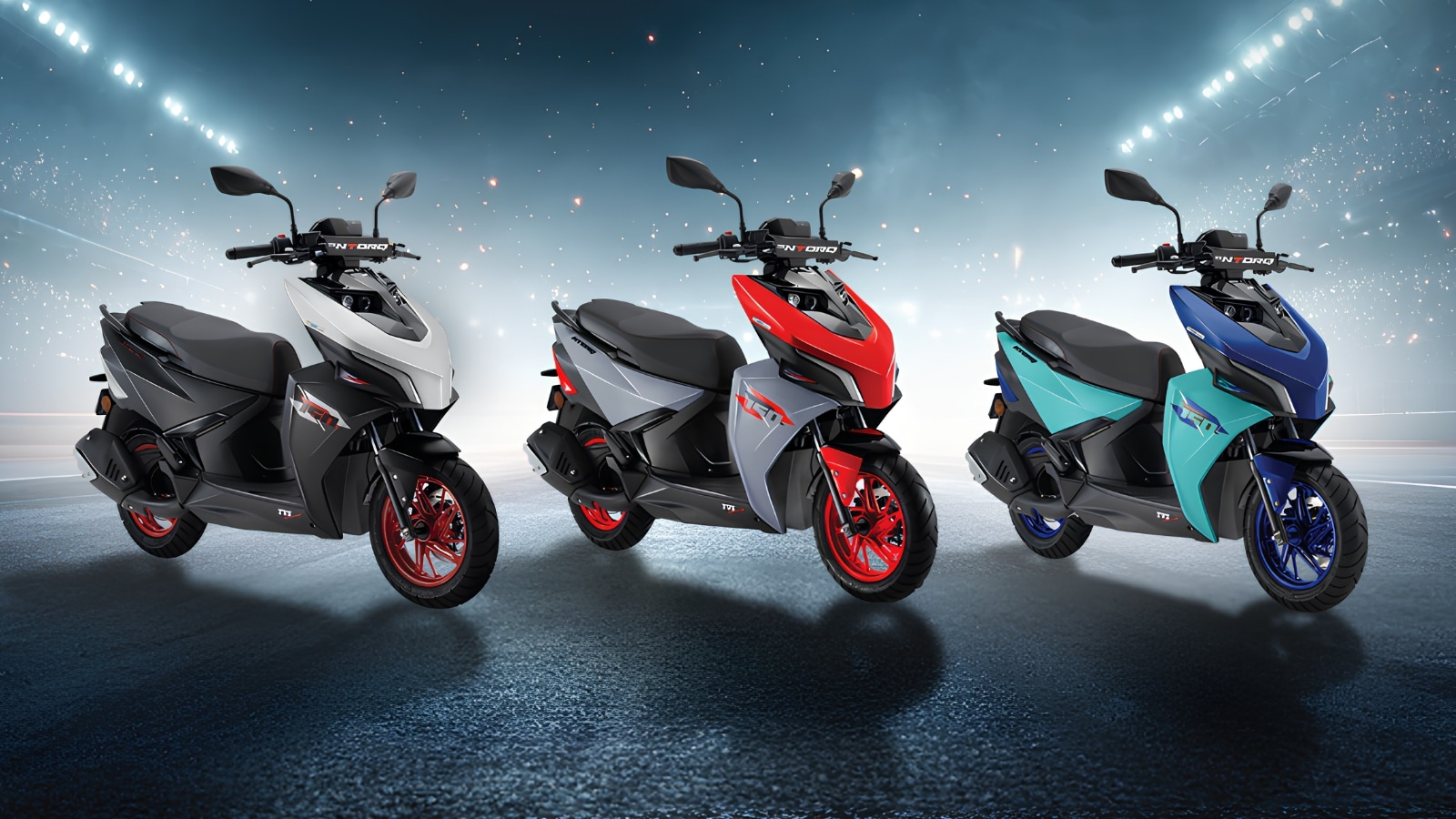
The arrival of the TVS Ntorq 150 in Nepal at an introductory price of NPR 3,69,900 is more than a routine inventory expansion by Jagdamba Motors. It is a calculated high-stakes maneuver in a market that has long treated scooters as mere utility boxes on small wheels. For years, the 125cc segment dominated the landscape of urban commuting across Kathmandu and Pokhara, balancing modest fuel economy with just enough grunt to haul two passengers up steep residential inclines. By punching the displacement out to 149.7cc and slapping a "hyper sport" badge on the front shield, TVS is testing a fundamental question. Are urban riders ready to pay motorcycle money for scooter convenience?
Underneath the aggressive composite bodywork and quad LED projector headlamps, the mechanical architecture tells a story of deliberate engineering choices. The engine is a 149.7cc single-cylinder, three-valve, air-cooled unit equipped with TVS's proprietary O3C technology, pushing out 13.2 PS at 7,000 rpm and 14.2 Nm of torque at 5,500 rpm. Those figures eclipse its predecessor, the Ntorq 125 XP, by a wide margin. More importantly, the torque curve peaks early. That characteristic matters immensely on the chaotic, stop-and-go inclines of Himalayan arterial roads where low-end grunt dictates whether a vehicle bogs down or pulls clean out of a hairpin turn.
What makes this release particularly fascinating from an industry perspective is the internal showroom cannibalization it invites. The top-tier Ntorq 125 XP sits at NPR 3,34,900. A buyer walking into a dealership faces a stark choice: spend 35,000 more Nepalese rupees—roughly a ten percent bump—to step into the 150cc displacement bracket. That narrow pricing delta is a psychological weapon. It essentially renders the high-end 125cc variant an awkward sell for anyone prioritizing raw performance. TVS is betting that the urban demographic, heavily populated by young professionals and university students who view their ride as an extension of their personal identity, will easily justify the extra investment for a machine that clocks zero to sixty kilometers per hour in 6.3 seconds.
Yet, raw acceleration figures look better on a brochure than they behave on broken asphalt. The Ntorq 150 rides on twelve-inch tubeless tyres wrapped around alloy wheels, paired with a telescopic fork up front and a single coil spring at the rear. While twelve-inch wheels grant phenomenal flickability in tight traffic gaps, they also expose the chassis to the brutal reality of unpaved urban construction zones and deep potholes. With a ground clearance of 155 millimeters, riders must exercise caution over aggressive speed breakers, especially when carrying a pillion passenger. The suspension is unapologetically stiff, tuned for high-speed stability rather than plush comfort, meaning long commutes across fractured roads will test lower backs long before they test fuel limits.
Safety additions deserve a closer look, particularly because scooter manufacturers have historically skimped on active aids in smaller displacement classes. The inclusion of single-channel ABS paired with a traction control system is a genuine industry milestone for this category in South Asia. On dust-skimming Kathmandu tarmac or during sudden monsoon downpours, rear wheel spin during hard acceleration and front wheel lockups under panic braking are perennial hazards. Traction control on a sub-120kg scooter sounds like overkill until a rider catches the back end stepping out on a greasy patch of wet oil and diesel residue. That single technological inclusion justifies the engineering leap far more than any lap timer or connected dashboard feature ever could.
The cockpit electronics reveal a stark philosophical split between variants. The base model makes do with a functional layout, but the top-spec variant houses a five-inch full-colour TFT display loaded with smartphone integration, ride stats, and Alexa voice support. For a demographic accustomed to seamless digital integration, features like last-parked location tracking and turn-by-turn navigation transform the daily commute from a chore into a connected experience. However, screens do not alter the physics of fuel consumption or braking distances. They are sticky software hooks designed to capture digital-native consumers who prioritize instrument panel graphics over mechanical simplicity.
Market reception in Nepal serves as an important bellwether for TVS's broader international export strategy. With export volumes climbing steadily across developing markets, proving out high-margin premium models in high-altitude terrain validates durability under extreme thermal and mechanical stress. If the Ntorq 150 can survive the punishing dust, altitude, and gradient shifts of the Nepali transport ecosystem while maintaining low warranty claim rates, it paves a clear regulatory and commercial pathway for similar introductions across Southeast Asia and Latin America.
The introduction price of NPR 3,69,900 is explicitly labeled as introductory, leaving a looming question about where the sticker price settles once the initial sales wave flattens. Competitors in the Japanese and domestic EV sectors are watching closely. While affordable electric options continue to nibble at the lower end of the daily commuter market, high-performance internal combustion engines still hold a distinct advantage for long-range reliability and high-speed highway transit where charging infrastructure remains sparse.
The rubber ultimately meets the road in daily usability. Shifting from a 125cc commuter to a hyper sport 150cc machine introduces a different cost of ownership, from higher consumable wear on brake pads to increased fuel consumption from the larger displacement. Riders who treat the throttle like an on-off switch will see the 5.8-liter fuel tank drain faster than expected.
Performance scooters live or die by their ability to make mundane errands feel slightly dangerous. By cramming traction control, smartphone pairing, and a punchy 150cc engine into a compact chassis, TVS has forced every other manufacturer selling two-wheelers in the region to rethink what a commuter machine can be.