The cabin of a Boeing 777 sitting on a tarmac is a unique kind of pressure cooker. The air conditioning hums with a hollow, metallic wheeze. Hundreds of strangers sit shoulder-to-shoulder, suspended in a state of collective limbo, watching the tiny digital airplanes on their seatback screens remain stubbornly static. For the passengers on Flight 226 out of John F. Kennedy International Airport, the delay started as a routine annoyance. A pilot’s voice, flat and unbothered, crackled over the intercom mentioning a "surface anomaly" on Runway 13R/31L.
Then the hours began to stack.
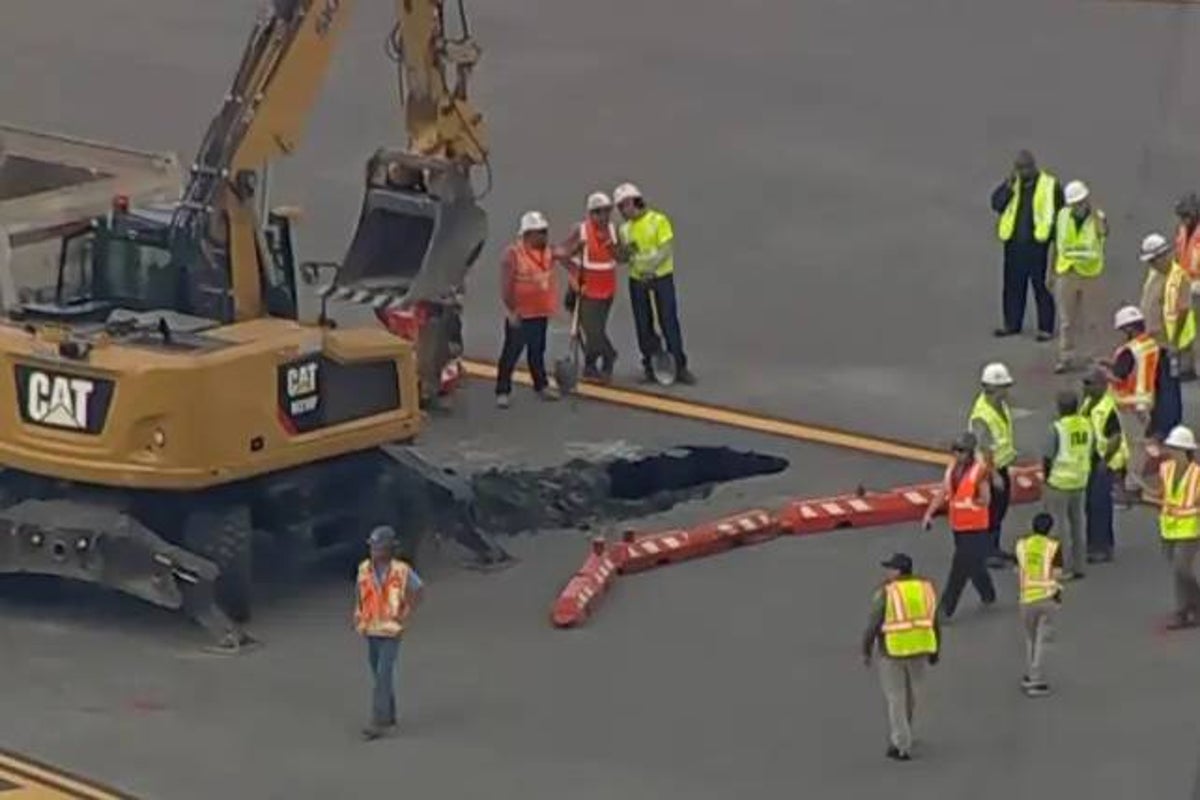
Outside the oval windows, the afternoon sun beat down on the sprawling asphalt of one of the busiest aviation hubs on the planet. Underneath that very asphalt, unseen and completely ignored by the frustrated travelers checking their watches, the earth was quietly giving way. It wasn’t a standard pothole. It wasn’t a routine maintenance patch. A massive sinkhole, measuring roughly twenty feet long and several feet deep, had opened up directly on the primary runway.
A jagged, subterranean jaw had opened up right in the middle of New York’s gateway to the world.
Airports are monuments to human precision. We calculate weights to the single pound, fuel to the gallon, and arrival times to the minute. Yet, all that sophisticated geometry relies on a simple, ancient assumption: that the ground beneath us will stay solid. When a major runway at JFK shuts down unexpectedly, the ripple effect is instantaneous, chaotic, and brutal. It is a stark reminder of how fragile our hyper-connected lives truly are.
Consider Sarah, a hypothetical but entirely accurate representation of the human collateral trapped in this logistical nightmare. She wasn’t thinking about civil engineering or geological erosion. Sarah was staring at her phone in Terminal 4, watching her connection to London dissolve into a flurry of red "Canceled" notifications. She had a job interview the next morning—a career-defining opportunity three months in the making. Near her, an elderly couple spoke in hushed, panicked tones about missing a cruise departure in Barcelona. Two gates over, a young father paced the carpet, trying to soothe a crying infant whose routine had been shattered by a six-hour delay.
These aren't just statistics on a departures board. They are the invisible stakes of infrastructure failure.
To understand why a single hole in the ground can paralyze international travel, you have to understand the anatomy of JFK Airport. Runway 13R/31L is not just a strip of pavement; it is a critical artery. At over 10,000 feet long, it is one of the primary strips used for heavy, long-haul international flights. When you take a piece of chess board like that off the table, the Federal Aviation Administration (FAA) is forced into a high-stakes game of musical chairs.
Imagine trying to funnel a four-lane highway into a single narrow alleyway during rush hour.
Incoming flights from Paris, Tokyo, and Los Angeles were suddenly forced into holding patterns, circling the Atlantic coast as fuel gauges ticked downward. Air traffic controllers, working in a high-stress environment where a single mistake can be catastrophic, had to frantically reroute dozens of aircraft to neighboring airports like LaGuardia and Newark. But those hubs were already operating at near-capacity. The result was an immediate, regional gridlock. Planes sat on taxistrips for hours, burning thousands of gallons of jet fuel, while thousands of passengers looked out at the New York skyline, so close yet utterly unreachable.
The engineering behind an airport runway is deceptively complex. It is easy to look out a terminal window and see a simple stretch of grey asphalt. In reality, a modern runway is a highly engineered, multi-layered sandwich of crushed stone, gravel, dense concrete, and specialized asphalt designed to withstand the immense, repeated violence of a 300-ton aircraft slamming into it at 150 miles per hour.
But even the most advanced engineering is at the mercy of the elements.
While the Port Authority of New York and New Jersey rushed heavy machinery and emergency repair crews to the site, speculation naturally turned to how this happened. Sinkholes are typically the product of hidden, long-term erosion. Underneath the concrete layers lies the subgrade—the natural soil. If water from heavy rains or a broken drainage pipe seeps into this layer, it can slowly, invisibly wash away the supporting dirt. The top layers of asphalt hold their shape for a while, creating a deceptive mask of solidity. Then, under the immense weight of passing aircraft, the hollow crust finally snaps.
It is a terrifying thought for anyone who flies. We place an immense amount of trust in the unseen teams who maintain these facilities. We board these metallic tubes assuming the path before us is immaculate.
The immediate response to the JFK sinkhole was a testament to the sheer willpower of airport ground crews. Massive floodlights illuminated the runway as the sun dipped below the horizon. The sound of jackhammers and heavy excavators replaced the roar of jet engines. Tons of compromised earth had to be dug out, the underlying water source managed, and quick-setting, high-strength concrete poured and cured before the runway could be deemed safe for operation. Every hour the runway remained closed cost airlines millions of dollars and compounded the human misery inside the terminals.
But the real problem lies elsewhere, far beyond the perimeter fences of JFK.
This incident is a symptom of a much larger, quieter crisis facing global aviation infrastructure. Many of the world's premier airports were built decades ago, designed for smaller planes, lighter loads, and less frequent traffic. Today, they are being pushed to their absolute limits. We demand more flights, cheaper tickets, and faster turnarounds, yet the literal ground we run these operations on is tired. It is a system strained to its breaking point, where a single structural failure can trigger a logistical butterfly effect felt thousands of miles away.
By the time the runway was finally cleared and declared safe for operations, the damage to the schedule had already been done. The backlog of delayed luggage, displaced crews, and canceled flights took days to fully untangle. For the airlines, it was a logistical headache settled with vouchers and rescheduled routing. For the passengers, it was a stolen weekend, a missed opportunity, or a night spent sleeping on an airport floor, wrapped in a thin, scratchy emergency blanket.
As the first planes finally began to roll down Runway 13R/31L again, their tires gripping the freshly patched asphalt, the airport returned to its frantic, noisy baseline. The wound in the earth had been closed. Travelers hurried to their gates, eyes glued to their phones, completely unaware of the massive operation that had just taken place beneath their feet.
We move through the world at incredible speeds, insulated by technology and comforted by routine. But every now and then, the earth opens up just enough to remind us of the fragile foundations upon which our modern lives are built.