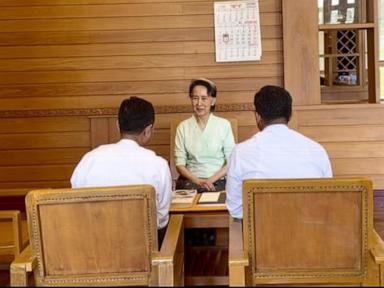
Paper rustles. A camera shutter clicks once, maybe twice, inside a room where time has been rationed by bars and armed guards for more than five years.
Look closely at the photographs released by Myanmar's authorities in October 2026. Aung San Suu Kyi sits speaking with Home Affairs Ministry officials in Naypyitaw, holding two volumes sent by Britain's King Charles III alongside a sealed envelope and diplomatic correspondence. At first glance, a dispatch about a detained Nobel laureate receiving books on soil and gardening sounds almost quiet, even domestic. Yet every image released from behind Myanmar's walls carries weight far heavier than ink and cardboard.
When authoritarian regimes hand over a photograph of a captive political figure, the frame is never innocent. Critics quickly warned that the images could serve as a calculated effort to ease Myanmar's diplomatic isolation after the February 2021 coup, the military-staged election, and coup leader Min Aung Hlaing's installation as president. At the same time, families and observers watching from abroad hold their breath for any proof of life, health, and voice—especially after years of near-total silence, a Red Cross visit in August 2026, and her son finally speaking with her again in October after five years apart.
How do you read a photograph when both the captors and the world are fighting over what it means?
The Photograph as a Battleground
To understand why two books—The Land Gardeners: Soil to Table and Soil: The World at Our Feet—became international news, you have to strip away the polite language of press releases. State media framed the October 19, 2026 handover neatly, naming the ministries involved and noting that officials delivered the books and sealed communications in Naypyitaw. Fact-checkers who examined the images found no signs of generative AI manipulation. Authenticity, however, does not settle intent.
Think of a stage curtain pulled back for thirty seconds during a long, windowless play. The audience sees the lead actor standing under bright lights, seemingly composed, while the scaffolding and locked doors remain out of sight. That image is a useful metaphor for what happens when an isolated prisoner appears in official handouts: you see presence, yet you do not see the conditions surrounding the room, the script of the visit, or the limits placed on every word spoken.
Since the military seized power in February 2021, Aung San Suu Kyi has spent years held under severe restrictions, serving an 18-year sentence across charges she denies—ranging from incitement and election fraud to corruption and state secrets violations—before being moved to house arrest in Naypyitaw in April 2026. For long stretches, the outside world knew almost nothing reliable about her daily routine or physical state. Against that backdrop, even an official photo operates on two tracks at once:
- The regime's track: Projecting order, administrative control, and a facade of normalcy to neighbors and foreign capitals after years of sanctions and international condemnation.
- The human track: Offering loved ones, supporters, and citizens a fleeting glimpse that she is alive and able to converse, without ending her arbitrary detention.
Neither track cancels out the other. A government can use a handover for political theater while a detainee's family still cherishes seeing her face upright in a chair. Pretending the situation is simple misses the cruelty of prolonged captivity; pretending the photo has zero political calculation misses how power works in Naypyitaw.
Inside the Quiet Rooms of Long Detention
I have spent enough time covering and studying protracted political crises to know how isolation warps ordinary human scale. Out in the noise of daily life, we measure weeks by errands, messages, and plans. Inside long detention, a single sheet of paper or a book with unfamiliar soil photographs can feel like an entire room opening up.
Consider a hypothetical scenario, clearly marked as a thought experiment to trace that inner shift. Imagine a woman who spent decades in public speeches, committee meetings, and political negotiations—someone whose life once moved to the rhythm of crowds and deadlines—now confined to a closely watched residence under an 18-year sentence. Months pass without ordinary news or casual conversation. One morning, officials walk in carrying two hardcover books about earth, roots, and cultivation alongside a sealed royal communication. Even before opening a cover, the object itself contains texture, weight, and a world beyond four walls.
That thought experiment is not a claim about what she felt in that exact moment; no outsider can step inside her mind. Yet it grounds why books on soil carry a poignant irony for a figure long associated with her country's political struggles. Soil takes years to build, crumbles when poisoned or stripped, and holds quiet life beneath the surface even when the top layer looks barren. King Charles III has long focused publicly on environmental stewardship and gardening, making the choice of titles feel distinctly personal even as Britain continues to condemn her detention as arbitrary and call for her unconditional release.
Still, there is a sobering honesty required here. Books do not unlock gates. A sealed envelope from abroad does not overturn court convictions or restore democratic rule. Anyone watching from afar can feel a surge of hope at a rare photograph and then feel a sharp ache ten minutes later when remembering she remains a prisoner. That tension—hope colliding with reality—is where genuine empathy lives, far away from easy slogans.
Why Isolation Still Matters Years Later
Some readers may wonder why a story from Myanmar's political crisis still commands attention years after the 2021 coup. When headlines shift rapidly from one global flashpoint to another, distant conflicts can start to blur into background noise.
There is a sharper reason to pay attention: how a state treats its most prominent political prisoner sets a benchmark for how it treats everyone else. If an internationally known Nobel laureate can be held for years, tried on charges she denies, moved between custody arrangements, and kept largely out of reach while regional neighbors expand diplomatic and trade engagement, imagine how little protection ordinary citizens, journalists, and activists receive out of sight.
| Moment in Detention | What Happened | What It Reveals |
|---|---|---|
| February 2021 onward | Military coup ousted the elected government; Suu Kyi detained and sentenced to 18 years across contested charges | Prolonged isolation became a central instrument of political control |
| April – August 2026 | Shifted to house arrest in Naypyitaw; Red Cross visit reported after years of limited access | Managed glimpses of access surfaced amid ongoing diplomatic pressure and military rule |
| October 19–20, 2026 | Rare photos released of her receiving two books on soil and sealed correspondence from King Charles III | Symbolism, diplomatic optics, and rare human contact collided in a single frame |
Look at how narrow the margin for human connection has been. Regional groupings like ASEAN and foreign governments have repeatedly pressed for her release and meaningful engagement toward resolving Myanmar's crisis, while the military-backed authorities have resisted those calls even as they seek broader regional acceptance. When her son spoke with her in October 2026 after five years without contact, he noted she sounded strong while remaining isolated. Strength in isolation is not freedom. Endurance is not justice.
I will admit openly how unsettling it is to watch events unfold from thousands of miles away when every piece of information arrives filtered through state channels, diplomatic statements, or brief family accounts. You want clean certainty—either a clear breakthrough or a simple explanation—and instead you get partial facts, contested motives, and lingering questions about what happens when the cameras leave the room.
Reading Between the Frames
So what should you carry away the next time you see a dramatic headline or a striking photograph from a closed-off crisis?
First, slow down before turning a single image into a complete verdict. A photograph can prove someone was in a room at a given time without proving they are free, safe, or speaking without constraint. Skepticism toward propaganda does not mean cynicism toward human beings; you can question a government's motives while still caring deeply about the person in the chair.
Second, notice what gets left out of quick summaries. Behind a headline about two books and a king's letter sit five-plus years of disrupted lives, separated families, ongoing conflict across Myanmar, and millions of people waiting for stability and rights. A book on soil speaks of patience and living things beneath the surface—a quiet reminder that deep roots endure even when winter stretches far longer than anyone planned.
In the Naypyitaw photograph, two books rest near a detained woman whose name once filled stadiums and parliaments. The cover of one speaks of the world beneath our feet—dark, unseen, holding every seed that might yet break through when the ground finally yields.