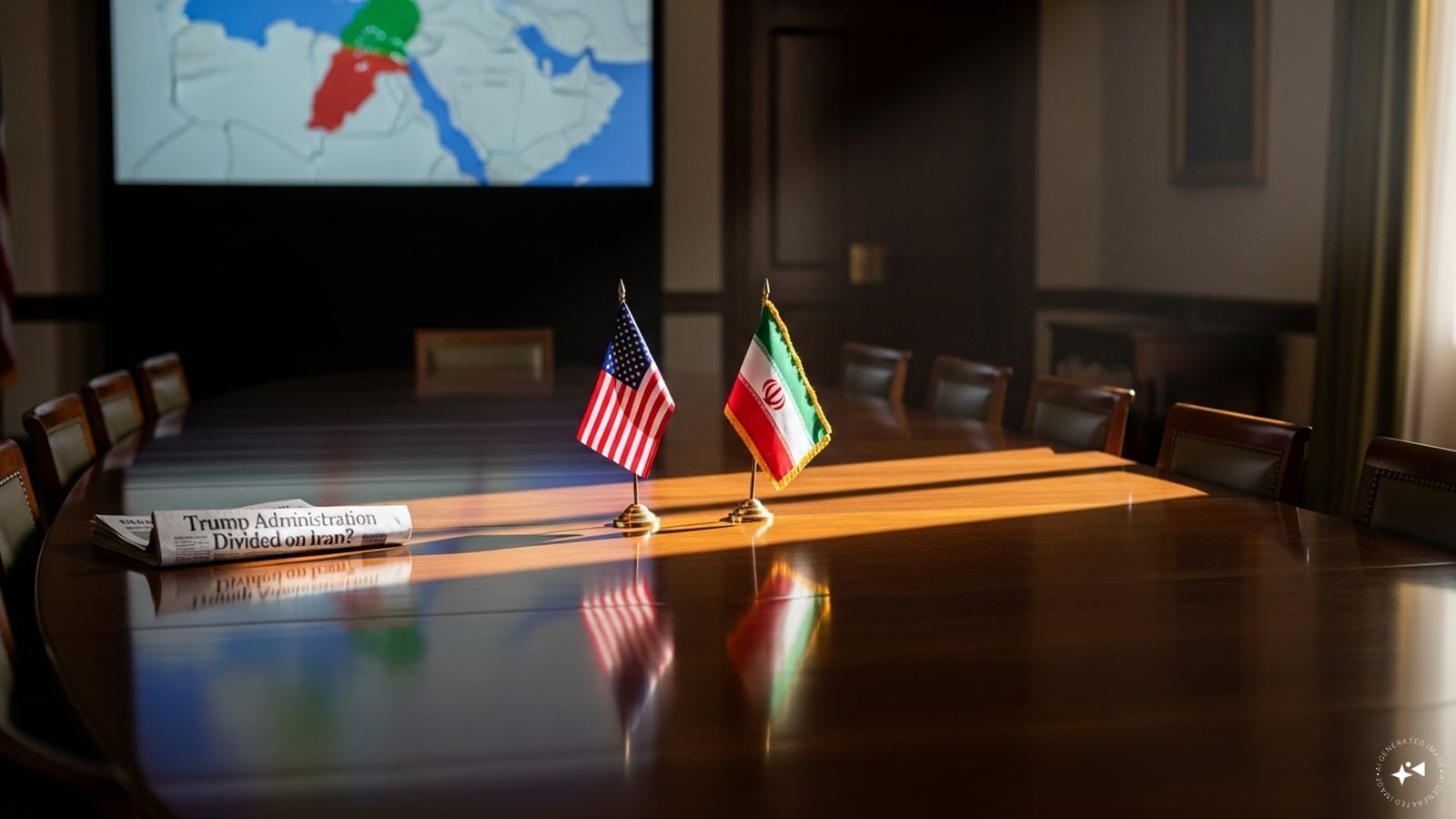
The air inside the Washington briefing room always smells faintly of stale coffee and industrial carpet cleaner. It is a sterile place designed to neutralize passion, to turn the burning realities of human conflict into neat, bloodless bullet points. On this afternoon, the focus is the Middle East. More specifically, the focus is Iran, a nation locked in a delicate, high-stakes dance of diplomacy with the West.
But the real drama isn't happening at the negotiating table. It is unfolding in the corridors of American power, where two men, both deeply loyal to the same political movement, look at the exact same map and see entirely different worlds.
JD Vance and Marco Rubio.
They are the intellectual architects of a new conservative foreign policy, yet their public statements reveal a profound, tectonic fracture. It is a disagreement that goes far beyond partisan bickering. This is a clash of fundamental philosophies, a quiet civil war over what it means for America to stand by its allies, and how far a superpower should go to keep the peace.
The Maverick and the Machine
To understand the divide, you have to look at where these men stand when the cameras are off.
Think of foreign policy as a high-stakes poker game. For decades, the traditional American approach—the one Marco Rubio champions—has been to stay at the table forever. You keep buying chips. You back your friends blindly. You outspend, out-threaten, and out-maneuver your rivals because you believe that if America walks away, the table collapses. Rubio, a veteran of the Senate Foreign Relations Committee, views the alliance with Israel through this classic, unyielding lens. To him, Israel is not just a partner; it is an existential outpost of American values in a hostile desert. If Iran threatens Israel, America must counter that threat with every ounce of economic and military pressure available. No hesitation. No nuance.
Then there is Vance.
Vance represents a different breed. He looks at the poker table and asks a question that makes traditionalists shudder: What is this game costing the folks back home? Vance’s worldview was forged in the hollows of Ohio and the dust of Iraq, where he served as a Marine public affairs coordinator. He saw firsthand the gap between Washington’s grand geopolitical promises and the reality of flag-draped coffins arriving at small-town airports. For Vance, American resources are finite. Every dollar spent propping up a foreign conflict is a dollar stolen from a crumbling Rust Belt town. When he looks at the ongoing talks with Iran and the escalating tensions with Israel, he sees a dangerous trap. He fears an endless entanglement that could drag America into another forever war, draining our blood and treasure while leaving our own borders vulnerable.
The Friction in the Facts
The current friction centers on how to handle a nuclear-adjacent Iran while maintaining support for Israel. The facts are stark, yet they are interpreted through these two wildly divergent lenses.
Consider what happens next if diplomacy fails.
Rubio argues for absolute deterrence. He believes that Iran only respects strength. In his view, any talk of easing sanctions or engaging in diplomacy while Tehran funds regional proxies is a betrayal of Israel. He advocates for a policy that leaves no doubt: an attack on Israel is an attack on the United States. It is a comforting, certain narrative. It relies on the historical belief that American might can freeze history in place.
But Vance looks at the exact same set of facts and deduces a different outcome. He has openly questioned whether America’s uncritical backing of every Israeli military objective serves long-term American interests. He isn't anti-Israel; rather, he is intensely pro-American focus. Vance argues that Israel is a wealthy, technologically advanced nation capable of defending itself. He suggests that by offering a blank check, Washington inadvertently discourages regional self-reliance and pulls the US deeper into a volatile quagmire.
It is a dizzying contrast. One man wants to double down on a historic doctrine; the other wants to tear up the script and write a new one based on cold, domestic calculation.
The Human Weight of Grand Strategy
It is easy to get lost in the jargon of statecraft. We talk about "proxies," "enrichment percentages," and "strategic ambiguity" as if we are playing a game of chess.
We forget the human element.
Imagine a young family in Tel Aviv, listening to the thrum of iron dome interceptors overhead, wondering if tonight is the night the deterrence fails. Now, flash across the ocean to a mother in a forgotten Michigan manufacturing town, watching the news with a hollow feeling in her stomach because her nineteen-year-old son just enlisted. Both are hostages to the decisions made by men like Vance and Rubio.
The debate between these two politicians isn't academic. It dictates whose children are placed in harm's way.
Rubio’s approach offers the certainty of an old alliance, but it carries the heavy risk of escalation. Vance’s approach offers the promise of domestic renewal, but it risks leaving long-term allies isolated in a brutal neighborhood. It is a terrifying, uncertain calculation, and honestly, it is entirely normal to feel conflicted watching it unfold. There are no easy answers here, only a choice between different kinds of risk.
The ongoing talks with Iran are a crucible. They are forcing a movement that prides itself on unity to confront its own internal contradictions. As the debate rages on, the old consensus is cracking. The future of American foreign policy is being rewritten in real-time, not by its enemies, but by the very men vying to lead it.
A lonely television screen flickers in an empty office, broadcasting footage of missiles cutting through a dark Middle Eastern sky, while thousands of miles away, a solitary security guard walks his rounds through a silent, darkened American factory.