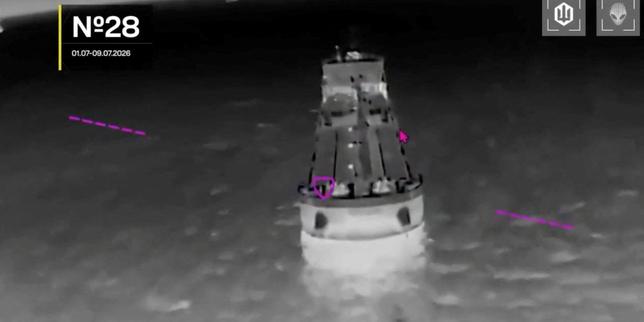
Ukraine is shifting its maritime strategy. After successfully forcing the Russian Black Sea Fleet to retreat from western Crimea, Kyiv is now aiming directly at Moscow's economic engine. The new target is the Sea of Azov. Specifically, Ukraine is going after the Russian transshipment tankers that keep the Kremlin's crude oil moving to global markets.
This is not just about sinking warships. It is a calculated economic blockade.
By targeting the vessel-to-vessel transfer operations in these shallow waters, Ukraine wants to make Russian oil too risky to transport and too expensive to insure. If you want to understand how this conflict is evolving, you have to look at the logistics of the Sea of Azov. It is dirty, complicated, and incredibly important to Vladimir Putin’s war machine.
The New Battleground for Russian Crude Oil
For a long time, the Sea of Azov was treated as a secondary theater. Russia controlled the coastline, the ports, and the Kerch Strait. It felt safe. Because of this, Moscow turned these waters into a massive logistics hub for both military supply lines and commercial oil exports.
But that sense of safety is gone.
Ukrainian military officials recently confirmed that their strategic focus now includes Russian transshipment tankers operating in the region. These are not standard cargo ships. They are the connective tissue of Russia's shadow fleet.
Ukraine is using a mix of long-range strike drones, modified Neptune missiles, and uncrewed surface vessels to reach deep into these previously protected waters. They want to disrupt the flow of crude before it ever reaches the wider Black Sea or the Mediterranean. The goal is simple. Cut the cash flow.
This strategy is highly practical. Russia relies on energy revenues to fund its military operations, purchase drone components, and pay its soldiers. If Ukraine can successfully choke off the Azov route, it forces Russia to find longer, far more expensive alternatives.
Why Ship to Ship Transshipment Matters to Moscow
To understand why this area is so vulnerable, you have to understand how Russian oil actually gets to market. Much of Russia’s southern oil transport relies on inland waterways. Small river-sea tankers load up at refineries deep inside Russia, travel down the Don River, and enter the Sea of Azov.
These small vessels cannot cross oceans. They are too small and structurally weak for deep-sea voyages.
Instead, they head to designated transshipment areas in the Sea of Azov or just south of the Kerch Strait. There, they pull up alongside massive, ocean-going tankers. They pump their oil directly from ship to ship. Once the giant tanker is full, it sails through the Bosporus Strait and out to buyers in Asia, Africa, or the Middle East.
This process is called ship-to-ship transshipment. It is the secret weapon of Russia's export economy.
It allows Russia to bypass shallow-water limitations and move millions of barrels of crude every week. Because these transfers happen in open water rather than at fixed ports, they are harder to monitor and even harder to sanction. The Kremlin has used this exact method to obscure the origin of its oil, blending different grades and transferring cargoes multiple times to keep Western investigators guessing.
By putting a bullseye on these transfer zones, Ukraine is striking at the exact point where the Russian supply chain is most fragile. A tanker sitting dead in the water while pumping highly flammable crude oil is an incredibly vulnerable target.
How Ukraine is Changing the Maritime Rules
We have seen this play out before. In the early days of the full-scale invasion, Russia dominated the Black Sea. They blockaded Ukrainian ports and threatened global food supplies.
Kyiv did not have a conventional navy to fight back. So, they built one out of jet ski engines, explosives, and satellite guidance systems.
The success of Ukraine's naval drone program is well-documented. They damaged the Kerch Bridge, sank multiple landing ships, and forced Russia's modern frigates to hide in distant ports like Novorossiysk. Now, Ukraine is applying those same asymmetrical tactics to the economic war.
When Ukrainian forces target a transshipment tanker, they are not just trying to cause a physical explosion. They are aiming for systemic friction.
First, there is the insurance problem. No legitimate maritime insurance company will cover a vessel operating in a war zone where tankers are actively being targeted. If a tanker cannot get insurance, it cannot enter international ports or transit critical choke points like the Suez Canal. This forces Russia to rely even more heavily on its shadow fleet of aging, uninsured, and poorly maintained vessels.
Second, there is the crew issue. Sailors are brave, but they are not suicidal. If the Sea of Azov becomes a shooting gallery, shipping companies will struggle to find crews willing to run these routes. Wages will spike, shipping rates will climb, and Russia's profit margins will shrink.
Inside the Drone Warfare Tactics in the Sea of Azov
How does Ukraine actually pull this off? The geography of the Sea of Azov is challenging. It is a semi-enclosed sea, highly monitored by Russian radar, air defenses, and coastal patrol boats.
To bypass these defenses, Ukraine relies on low-profile, high-speed maritime drones. These vessels ride extremely low in the water, making them incredibly difficult for Russian radar to detect, especially in choppy seas.
These drones are often paired with aerial reconnaissance. Ukraine uses intelligence from its own long-range aerial drones, combined with western surveillance assets operating in international airspace over the Black Sea, to pinpoint the exact coordinates of transshipment operations.
Once a target is acquired, the attack is executed.
Sometimes it is a coordinated swarm attack, designed to overwhelm the defensive machine guns of Russian patrol ships. Other times, Ukraine uses long-range missile strikes. The domestically produced Neptune missile, which was famously used to sink the cruiser Moskva, has been modified for land and sea targets at much longer ranges.
These attacks do not need to sink every tanker to be successful. Even minor damage to a ship's hull or its pumping equipment can halt transshipment operations for weeks. Repair facilities in the region are limited, and Western sanctions make it difficult for Russia to source specialized replacement parts for tanker valves, pumps, and navigation systems.
The Economic Reality of Targeting Russian Tankers
It is easy to get caught up in the military drama, but this is fundamentally an economic chess game. Russia’s federal budget is deeply dependent on oil and gas taxes.
While the G7 price cap on Russian oil was designed to limit Moscow's revenues, the shadow fleet has largely allowed the Kremlin to ignore it. Russia has been selling crude above the $60 cap by managing its own logistics from end to end.
Ukraine's drone campaign is the first real physical challenge to this shadow network.
If Russia is forced to abandon the Sea of Azov transshipment routes, the logistical alternatives are painful. They would have to reroute oil via rail to distant ports, or rely entirely on overland pipelines that are already running at maximum capacity. Every detour adds dollars to the cost of transport for every single barrel.
When transport costs go up, the net profit that flows back to the Russian state budget goes down. It is a war of attrition measured in dollars per barrel.
There is also the domestic political cost. The Russian public has been largely shielded from the economic realities of the war. But burning tankers, rising shipping costs, and disruptions at southern ports are highly visible signs of vulnerability that the Kremlin cannot easily hide or explain away.
What This Means for Global Energy Markets
Any disruption to oil transit routes raises eyebrows in Washington, Brussels, and Beijing. The global oil market is highly sensitive to supply shocks.
Some critics argue that targeting Russian tankers could drive up global energy prices, leading to inflation in Western countries. This is a delicate balance that Kyiv must navigate.
However, Ukraine's strategy appears carefully calibrated. They are not targeting random global shipping. They are focusing specifically on Russian-owned or Russian-contracted vessels operating in disputed or occupied waters.
By keeping the focus on the Sea of Azov and the Kerch Strait, Ukraine is targeting the domestic Russian supply chain rather than the broader international oil trade. This limits the risk of a massive global price spike while still inflicting maximum financial pain on Moscow.
Furthermore, the environmental risks are real. The Sea of Azov is a shallow, delicate ecological system. An oil spill here would be catastrophic for local coastlines and marine life. This is a point of concern for environmental groups and neighboring countries, and it is a risk that Ukraine must weigh heavily as it plans these high-stakes operations.
Ultimately, this maritime offensive shows that Ukraine refuses to accept a frozen conflict. By taking the fight to the Sea of Azov, Kyiv is proving that no Russian asset, no matter how far behind the front lines, is truly safe. The war is no longer confined to trenches in the Donbas. It is being fought on the ledger sheets of global oil traders and in the shallow waters where Russia's economic lifeline is currently exposed.