You can't protect a thousand miles of airspace with pure hope. Russia is finding that out the hard way. When long-range Ukrainian drones slammed into facilities far past the border, they didn't just smash metal and start fires. They punctured the illusion of domestic invulnerability that Moscow has relied on since day one.
President Volodymyr Zelenskyy confirmed that the Bashneft-Novoil refinery in Bashkortostan and the Slavneft-Yanos plant in Yaroslavl took direct hits. We aren't talking about border skirmishes here. Bashkortostan sits roughly 1,300 kilometers from the front lines. Yaroslavl is about 700 kilometers away. These distances used to mean safety. Not anymore. Meanwhile, you can read similar developments here: The Cost of Silence When the Shelves Are Empty.
The Math Behind the Long-Range Drone Strategy
Why target oil refineries instead of frontline trenches? It comes down to simple economics. Russia runs on petrodollars. Every ruble spent repairing a cracked distillation column is a ruble not heading toward artillery shells or infantry paychecks.
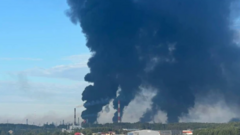
Let's look at the targets. The Slavneft-Yanos refinery in Yaroslavl faced what local governor Mikhail Yevrayev called the largest enemy drone attack the region had ever seen. Residents woke up to massive plumes of black smoke. Video footage verified multiple impact points and raging fires across storage tanks. To understand the bigger picture, we recommend the detailed report by Al Jazeera.
When you strike deep into Russian territory, you force military planners into an impossible choice. Do they move expensive air defense batteries away from active combat zones to shield civilian refineries? Or do they leave critical energy infrastructure wide open? You can't be everywhere at once. Physics and finite resources dictate that something has to give.
Shattering the Myth of Russian Air Defense
Moscow claimed its systems intercepted hundreds of drones across various regions. Yet, satellites and smartphones don't lie. Plumes of thick smoke rising over Yaroslavl tell a very different story from official state press releases.
Air defense isn't a magical shield. It's an economic equation. If a cheap, domestically engineered drone forces a country to expend million-dollar interceptor missiles, the defender is losing even when they successfully shoot it down. Ukraine has mastered this asymmetry. They are scaling up domestic production of long-range UAVs specifically to exploit these gaps.
Russian regional officials scrambled to manage the fallout. Traffic restrictions went up near Moscow. Debris sparked secondary fires in residential areas. Panic spreads faster than flames, and these strikes bring the reality of the war right to the doorsteps of citizens who previously thought they were insulated from the conflict.
Moving Beyond the Front Lines
The strategy extends past stationary targets on land. Kyiv also reported successful hits on military patrol boats and shadow fleet vessels in the Black Sea. Those tankers keep Moscow's oil exports flowing past Western sanctions. Taking them out chokes off the alternative cash flows that fund the invasion.
Military analysts have watched this shift with intense interest. Traditional front-line combat is a grinding stalemate. Artillery duels eat up ammunition without shifting maps. By taking the fight to industrial nodes thousands of kilometers away, Kyiv bypasses the heavily fortified trenches entirely.
Russia has responded with its own brutal barrage against Ukrainian railways, energy grids, and urban centers. Entire cities like Kherson faced blackouts after critical infrastructure took direct hits. The conflict has settled into a brutal contest of national endurance.
You cannot bomb your way to economic stability while your primary export refineries burn from the inside out. Kyiv's message is loud and clear. If the war continues, the fire will keep spreading further east.