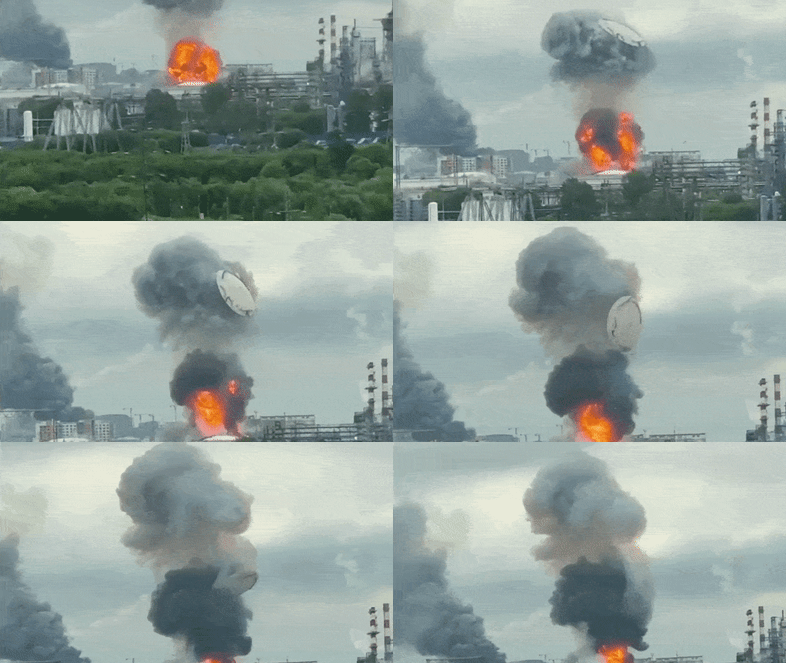
You can't expect one side to take a beating indefinitely without swinging back at the wallet of the aggressor. That is exactly what happened when black clouds of smoke rolled over southeastern Moscow.
Ukraine just hit the massive Moscow Oil Refinery in Kapotnya for the second time in a single week. It is part of a punishing, record-setting swarm of hundreds of drones that choked Russian airspace, grounded commercial flights, and brought the physical reality of a four-year war directly to the doorsteps of the Russian elite. Moscow Mayor Sergei Sobyanin scrambled to claim air defenses knocked down nearly 200 drones near the capital, but social media footage told a totally different story. Videos caught the exact moment a storage tank lid blew sky-high, sending flames roaring into the morning air just nine miles from the Kremlin. For a closer look into similar topics, we recommend: this related article.
Ukrainian President Volodymyr Zelensky did not mince words about the operation, calling the deep strikes a fully justified response to Russian attacks on Ukrainian cities and communities. He framed the exploding infrastructure as domestic, long-range sanctions designed to physically cripple the facilities that sustain the Kremlin war machine. If you want to understand why this shift in strategy is happening right now, you have to look at the math, the money, and the brutal reality on the ground.
Striking the Wallet of the War Machine
For a long time, Western allies worried about escalation, urging Kyiv to keep its weapons inside its own borders. But traditional economic sanctions have holes, and Russia keeps finding ways to patch them. By using homegrown drone tech to physically dismantle the energy infrastructure funding the invasion, Ukraine is bypassing diplomatic red tape entirely. To get more context on this development, in-depth coverage can be read on The Washington Post.
The Kapotnya facility is not just some random fuel depot. Operated by Gazprom Neft, it is the largest refinery in the Moscow region, responsible for processing over 11 million tons of crude oil annually. It literally supplies more than a third of the entire fuel market for the capital city. Knocking a plant like this offline causes immediate, systemic friction.
- Refining Capacity Drops: Intelligence estimates indicate that Ukraine's aggressive deep-strike campaign has knocked out roughly 10% of Russia's total oil refining capacity in recent months.
- Economic Chain Reactions: You can't just store infinite amounts of unrefined crude. When refineries stop pumping, state energy companies are forced to shut down oil wells upstream, starving the state budget.
- Deficit Pressures: The economic strain is bleeding into the Kremlin ledger. Russia's state budget deficit for the first part of the year has already blown past full-year projections, leaving multiple regional governments effectively broke.
Retaliation for the Destruction of Culture
This specific escalation did not happen in a vacuum. Zelensky tied the fiery strikes directly to recent Russian aerial barrages that tore through civilian infrastructure in Kyiv. Earlier in the week, a devastating Russian missile and drone assault hit the Dormition Cathedral, a priceless historic site inside the UNESCO-listed Kyiv-Pechersk Lavra monastery complex, leaving at least 11 people dead.
Kyiv's message to ordinary Russians is simple, direct, and incredibly uncomfortable: if Ukraine burns, Moscow will burn too.
The psychological impact of these strikes matters just as much as the destroyed oil tanks. For years, the Kremlin worked hard to project a sense of absolute stability to everyday residents in the capital, treating the invasion as a distant specialty operation. Now, with airports shutting down, air defense systems rattling windows at 5:00 AM, and the pungent smell of burning petroleum hanging over the city center, that illusion of safety is totally gone.
Perfect Timing on the Diplomatic Stage
The timing of this massive drone swarm shows a high level of strategic calculation. The strikes hit right as Vladimir Putin was preparing to host prime ministers and presidents from Southeast Asian nations at an ASEAN summit in Kazan.
While Putin was attempting to show off Russia's economic stability and pitch a new international order to regional leaders, his own capital's airspace was locked down. The contrast could not be sharper. It forces foreign partners to recognize that Russia cannot even protect its core economic hubs, let alone guarantee long-term stability.
At the exact same time, Western leaders at a recent G7 summit in France signaled renewed solidarity with Kyiv, agreeing to unlock more air defense systems, boost interceptor supplies, and grant licenses to ramp up military production inside Ukraine. Reports also suggest that Russia is facing severe shortages of specific interceptor missiles because they are burning through inventory trying to swat down low-cost Ukrainian drones.
What Happens From Here
The era of Ukraine fighting with one hand tied behind its back is over. To keep momentum, Kyiv is leaning heavily into its domestic weapons manufacturing sector to maintain this high-tempo pressure.
If you are tracking the economic or geopolitical realities of this conflict, keep your eyes on the following shifts. Watch the regional fuel prices inside Russia, as localized shortages of gasoline and diesel are already creeping up around major hubs and occupied territories like Crimea. Track the shipping data for Russian unrefined crude; as domestic refineries burn, Russia will try to export more raw oil, testing the limits of Western maritime price caps. Finally, watch the air defense layout. The Kremlin is being forced to pull elite missile batteries away from the front lines just to shield factories and refineries deep inside its own borders.
By forcing the civilian population and state budget to pay the direct costs of the invasion, Ukraine is reshaping the leverage dynamics of the entire war.


