Salt.
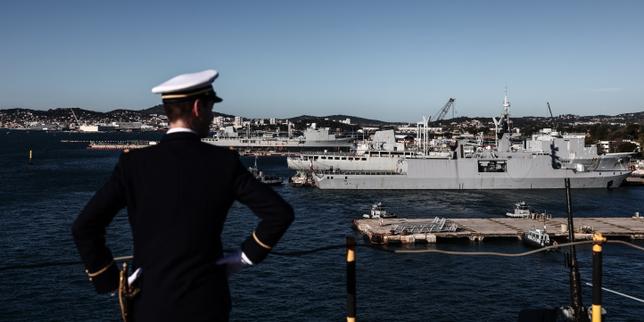
That is the first thing you notice standing near the water along the southern French coast—the sharp, mineral bite carried in off the Mediterranean before you even see the gray hulls of warships resting behind steel perimeters.
Watchkeepers.
They stand at the edge of high-security zones where every light pole, concrete barrier, and radar sweep exists for a reason, listening to the low hum of diesel engines, harbor currents, and wind rattling through rigging while trying to separate routine coastal noise from something that has no business being there.
According to France's marine nationale (the French Navy), unauthorized drones have flown over the naval base at Toulon as well as other military sites—a report that arrives on paper as a brisk, administrative notice, yet carries an unsettling weight the moment you picture a small unmanned aircraft slipping into restricted airspace above vessels, docks, and personnel. Because no external source details were provided beyond that headline, I treat the specific flight paths, timestamps, and technical attributions of those incidents as unverified outside the navy's acknowledgment, and I will clearly mark any hypothetical scene or comparison metaphor as such so the story never confuses imagination with official record.
Why does a few hundred grams of carbon fiber, lithium battery, and quiet rotors rattle a major military port built to withstand serious threats?
Because military security has long been designed around scale, signature, and intent. A warship approaching without clearance looks like a warship. An aircraft entering restricted airspace without a transponder lights up screens and triggers clear escalation rules. A consumer or modified small drone—compact, low-flying, sometimes dimly lit or dark against coastal hills—blurs the line between harmless curiosity, reckless flying, and deliberate reconnaissance.
What Happens When the Sky Above a Base Goes Quietly Unpredictable
Imagine a hypothetical watch officer on a late shift along the perimeter of a Mediterranean naval installation. This character and scene are purely hypothetical, constructed to show the human tension behind an airspace alert rather than depict a documented event.
In this hypothetical scene, the harbor is mostly still. A cooling breeze comes off the water, carrying faint diesel exhaust and the metallic clink of halyards against masts. The officer's eyes sweep a sector where nothing large is supposed to move without prior clearance—no low-flying twin-engine plane, no unauthorized launch boat, no obvious intruder. Then comes a faint, high-pitched whirr that does not belong to a gull or a distant scooter on a public road. A tiny set of blinking or unlit points moves across the dark sky above restricted ground, small enough that from fifty meters away it looks almost like a trick of fatigue.
Now comes the hardest part of modern perimeter defense: deciding what to do in thirty seconds without creating a worse problem.
Opening fire over a densely built port city or an active naval base carries immediate risks—falling debris, stray rounds, collateral harm, or misidentifying a lawful flight. Jamming or electronic countermeasures can interfere with legitimate communications, navigation equipment, or nearby civilian systems if not tightly controlled. Even tracking a tiny drone visually in coastal wind and shifting light tests human eyesight to its limit.
A small unmanned aircraft turns a perimeter from a clear line into a three-dimensional question mark.
That question mark is the real friction point. Traditional defense often thinks like a castle wall: thick stone, clear sightlines, heavy gates. A small drone behaves more like a mosquito near a porch light—annoying, hard to pin down, capable of getting close before you decide whether to swat or watch where it lands. That comparison is a metaphor for detection and response geometry, not a literal description of any military system.
Why Unauthorized Flights Keep Happening Around Sensitive Sites
When people read that unauthorized drones flew over a naval base and other military facilities, their minds usually jump straight to espionage or sabotage. Sometimes espionage or probing is a real concern, and security forces take every overflight seriously. Yet in real-world airspace incidents around sensitive infrastructure globally, the causes often fall into overlapping buckets that are surprisingly hard to tell apart in the moment.
Some flights come from casual operators who bought an off-the-shelf quadcopter, ignored geofencing warnings or restricted-zone maps, and launched just outside a fence to get a dramatic sunset shot of ships or coastal cliffs. Others come from thrill-seekers testing how close they can get before someone notices. And some may involve deliberate intelligence gathering, testing response times, or probing security procedures.
Notice how blurry those motives look from the ground. A hobbyist flying out of sheer carelessness and an operator testing a perimeter's reaction can produce a remarkably similar blip in the sky. You cannot read intent from rotor wash.
That ambiguity puts pressure on everyone involved:
- Security and naval personnel must treat unapproved overflights seriously because ignoring a pattern invites greater risk, even when many incidents stem from careless or unlawful civilian flying.
- Local authorities and investigators face the painstaking work of tracing where a small aircraft launched and landed, often with minimal physical clues left behind.
- Law-abiding flyers feel the tightening squeeze of stricter rules, public suspicion, and narrower places to fly whenever irresponsible operators treat restricted zones like open parks.
To make sense of why this feels so disorienting, it helps to look at how technology moved faster than everyday habits. For decades, flying anything meant heavy machinery, licensed pilots, air traffic control, and loud engines you could hear miles away. Today, capable flight controllers and quiet electric motors fit inside a backpack. A tool that once belonged exclusively to aviation professionals now sits in ordinary hands—and sometimes above places where nobody outside the base belongs.
The Invisible Stakes Behind a "Minor" Airspace Breach
"It's just a drone."
You hear variations of that phrase whenever someone treats a small unmanned aircraft as a toy rather than an aviation or security issue. That dismissal misses two concrete realities: safety and sensitivity.
First is physical safety. Even a lightweight drone spinning carbon-fiber or plastic blades at high speed carries kinetic energy, especially if a battery fails or wind pushes it down over people, vehicles, fuel storage, or moving equipment. Over a busy military port—where cranes lift heavy loads, crews work near water and machinery, and vessels maneuver in tight quarters—an uncoordinated object in the air creates an avoidable hazard.
Second is operational and security sensitivity. Military bases are not static museums; they are working hubs where schedules, maintenance, deployments, communications, and routines matter. Even if a specific overflight gathers nothing classified, repeated unauthorized appearances force teams to divert attention, verify security posture, and investigate incidents. Over time, small disruptions accumulate.
There is also a quieter psychological toll on people doing security work. Constantly scanning dark skies for something small, fast, and potentially silent wears on attention. If every false alarm triggers maximum drama, people burn out; if every incident gets shrugged off as "probably just a tourist," the one time it is not a tourist catches people off guard.
Consider what happens next when a military branch publicly acknowledges unauthorized drones over a naval base and other sites:
Public confirmation signals transparency and awareness, letting the public know the issue is recognized rather than swept under the rug. At the same time, officials rarely share every sensor detail or investigative lead in an initial statement, which leaves room for speculation—and reminds readers that verified facts and rumor are not the same thing.
Reading the Headlines Without Losing Your Bearings
When stories like this break, readers often swing between two extremes. One extreme shrugs and assumes drones are everywhere now, so nothing can stop them. The other extreme treats every headline as proof of an imminent crisis.
Reality usually sits in the middle—messier, more technical, and more human than either extreme suggests.
Securing wide coastal perimeters and multiple military sites against small unmanned aircraft is an ongoing engineering and operational challenge, not a switch you flip once. Detection methods—radar tuned for small slow targets, radio-frequency sensors, acoustic listeners, electro-optical cameras—each have strengths and blind spots depending on terrain, weather, and urban surroundings. Countermeasures have to fit legal frameworks, safety rules, and the realities of populated areas around ports like Toulon.
At the same time, basic rules around restricted airspace exist for clear, practical reasons: keeping aircraft away from critical infrastructure, protecting people on the ground, and preserving safe separation in shared skies. A drone is not "just a camera with propellers" once it enters controlled or prohibited airspace over a military installation; it becomes an uncoordinated aircraft in a sensitive zone.
I find myself wondering how many people still buy a drone on impulse, tap "agree" on a screen without reading airspace boundaries, and never think about what happens when their flight path crosses something guarded. That gap between how easy it is to launch a drone and how serious a restricted zone is remains one of the sharpest friction points of modern aviation.
What Lingers After the Rotors Fade
Stand back near that Mediterranean shoreline at dusk, long after the day's harbor bustle slows and the hills behind the coast turn deep indigo.
A small light crosses high above the water—a commercial airliner on a scheduled route, predictable and far away. Down closer to the ground, harbor lights reflect in dark ripples, steel structures hold their quiet guard, and people whose job is watching the edge keep their eyes open for whatever comes next.
A few quiet rotors in the dark can test an entire perimeter's patience, precision, and resolve—and remind us that even the smallest object in the sky can carry oversized stakes when it flies where it was never invited.