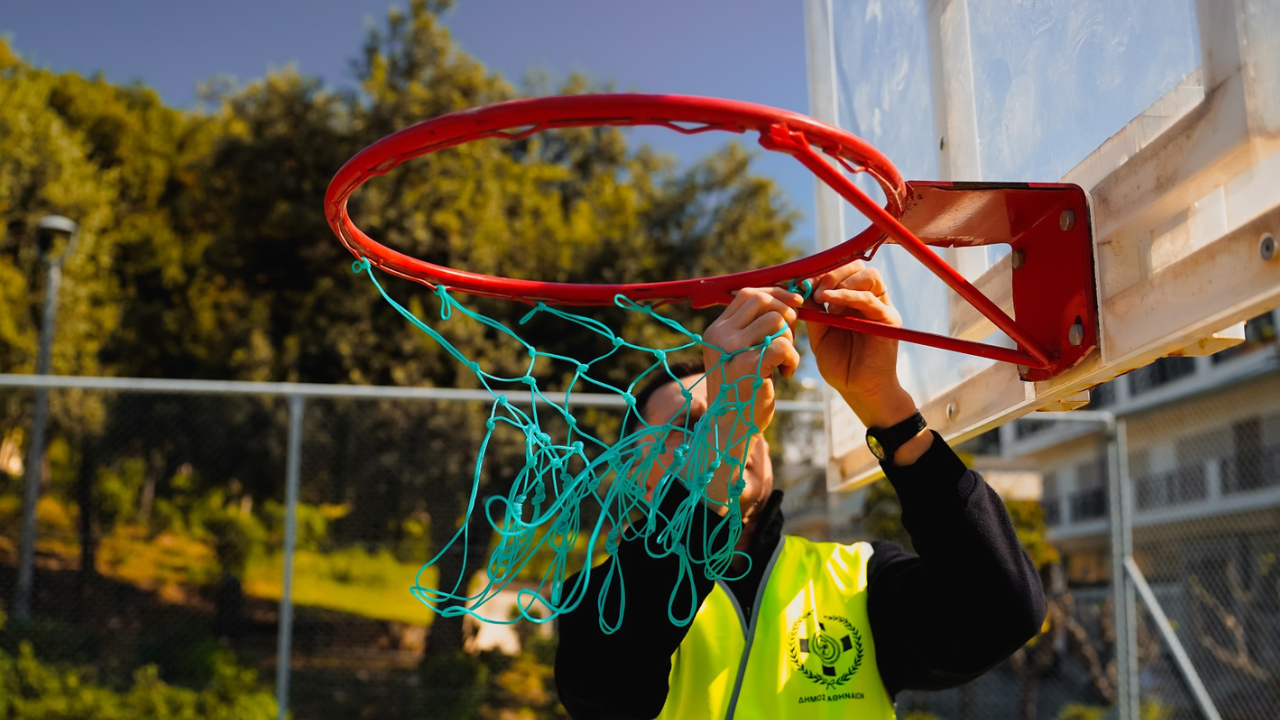
Municipal sports infrastructure in urban centers faces a chronic maintenance defect: public outdoor basketball courts experience near-total failure rates of high-wear soft components within months of deployment. Steel rims and acrylic backboards withstand environmental decay, but nylon mesh netting decays rapidly under ultraviolet exposure, mechanical shear, and vandalism. The resultant infrastructure deficit degrades the utility of public recreational spaces.
The initiative between the Charles Antetokounmpo Family Foundation (CAFF) and Greek marine conservation organization Enaleia targeting 80 Athens courts isolates this exact vulnerability. By intercepting end-of-life maritime nylon fishing gear—ghost nets—and re-engineering it into dense, weather-resistant athletic netting, the project creates a closed-loop municipal supply chain.
Evaluating this initiative through supply chain economics, material science, and municipal utility math reveals the operational mechanics beneath high-visibility social impact partnerships.
The Reverse Logistics Framework
The unit economics of ocean-bound plastic remediation typically fail due to collection and sorting overhead. Raw waste management requires high capital expenditure to recover dispersed material. Enaleia bypasses this cost ceiling by building a reverse logistics network that leverages existing maritime assets.
[Commercial Fishermen / Port Depots]
               │
               ▼ (Piggyback Logistics & Co-Collection)
[Enaleia Collection Hubs (Keratsini / Regional Ports)]
               │
               ▼ (Sort & Standardize: PA6 High-Density Nylon)
[Mechanical Recycling & Filament Extrusion]
               │
               ▼ (High-Tensile Braiding & Structural Knotting)
[Municipal Deployment: 80 Public Courts Across Athens]
- Piggyback Scrap Harvesting: Rather than operating dedicated retrieval vessels—a capital-intensive model with low yield per hour—Enaleia integrates direct collection protocols into commercial fishing fleet operations. Fishermen deposit recovered ghost gear and retired nets directly into port consolidation points. This shifts the primary transportation cost from variable operational expenditure to marginal local labor.
- Polymer Isolation: Netting recovered from marine ecosystems consists primarily of Polyamide 6 (PA6) and Polyethylene (PE). PA6 possesses exceptional tensile strength (up to 80 MPa) and high resistance to repetitive mechanical shock. Isolating high-purity PA6 from contaminated marine debris requires systematic sorting at port depots before thermal degradation occurs.
- Upcycling Extrusion: Recovered PA6 is washed, shredded, and pelletized into secondary polymer feedstocks. This recycled resin is re-extruded into high-denier monofilament or multifilament cords, specifically engineered with UV-stabilizing additives to prevent photo-oxidation—the primary breakdown mechanism of standard poly-nylon court nets.
Material Durability and Structural Performance
Standard commercial basketball nets are manufactured from polyester or low-grade spun nylon, optimized for low unit production cost ($0.50 to $1.50 per unit) rather than environmental longevity. In high-use urban environments, standard nets exhibit structural failure along three failure vectors:
- Ultraviolet Photolysis: Solar UV-A and UV-B radiation cleaves polymer chains in low-grade nylon, reducing tensile strength by over 60% within 120 days of outdoor exposure.
- Frictional Abrasion: Repeated high-velocity contact with basketball surfaces causes micro-tears along unbonded fibers, inducing fraying at tension points.
- Hydrolytic Degradation: Ambient moisture combined with urban airborne particulates accelerates fiber breakdown during freeze-thaw cycles.
Extruded maritime-grade nylon net strands derived from commercial fishing gear feature tensile thresholds designed to withstand deep-sea drag loads exceeding several tons. When re-braided into 12-loop athletic netting specifications, the structural characteristics shift dramatically:
| Performance Metric | Standard Commercial Nylon Net | Upcycled Marine-Grade PA6 Net |
|---|---|---|
| Material Base | Spun Polyester / Low-Denier Nylon | Recycled High-Density Polyamide 6 |
| Tensile Strength | ~150–250 N | >800 N |
| UV Resistance Half-Life | ~90–120 Days | >750 Days |
| Mechanical Failure Rate (Annual) | >80% | <5% |
| Primary Failure Mechanism | Photo-oxidative chain scission | Structural anchor wear |
By deploying heavy-duty PA6 polymer structures across 80 municipal courts, the operational replacement cycle extends from a quarterly intervention to a multi-year durability baseline.
Economic Mechanics of Municipal Value Creation
Local governments consistently under-allocate funds to soft-infrastructure maintenance. Municipal budgeting logic prioritizes major civil engineering over recurring micro-repairs. Consequently, public courts remain unusable or degraded, diminishing the return on investment of the original capital expenditure spent constructing the hard asset (concrete, asphalt, steel posts, and backboards).
The partnership model between a philanthropic anchor (CAFF) and a circular economy operator (Enaleia) alters the asset economics.
[Hard Infrastructure CapEx] (Courts, Rims, Backboards)
            │
            ├─► Without Maintenance: Utility Decay (Depreciated Asset)
            │
            └─► With Upcycled Net Deployment (Targeted OpEx Injection)
                     │
                     ▼
        [Restored Infrastructure Utility]
This intervention yields three distinct economic outcomes:
- Asset Utility Maximization: A basketball rim lacking a net reduces player satisfaction and alters target feedback dynamics, leading to lower facility utilization rates. Restoring functional netting across 80 urban assets fully reactivates the public utility value of the underlying municipal investment without requiring municipal capital outlay.
- Negative Externalities Internalized: Unused fishing nets discarded at sea generate severe negative externalities via marine ecosystem destruction and navigation hazards. Diverting this waste into civic infrastructure transforms an ongoing environmental risk into a fixed social asset.
- Scalable Circularity Blueprints: The project establishes a operational proof-of-concept for urban sports infrastructure. Municipalities can replicate this model to convert local industrial or marine waste streams into municipal assets, reducing procurement costs while meeting sustainability targets.
Execution Bottlenecks and Structural Limitations
Despite the operational elegance of upcycling marine waste into civic infrastructure, scaling this system across larger municipal grids exposes three structural bottlenecks:
- Supply Volatility and Sorting Friction: Marine plastic collection yields highly non-uniform raw inputs. Nets are frequently contaminated with bio-foul, organic decay, metals, and mixed polymers. The manual labor required to isolate usable PA6 creates a cost baseline that requires external philanthropic subsidies to remain competitive with virgin polymer production.
- Manufacturing Conversion Scaling: Transforming raw filament into finished sports netting requires specialized industrial braiding machines capable of processing high-denier recycled polymers. The manufacturing layer remains fragmented, operating on batch production rather than continuous automated runs.
- Municipal Governance Inertia: Institutionalizing this model requires public procurement policies that prioritize recycled material certifications over lowest-cost bidding mandates. Bureaucratic delays in municipal permitting often stall inventory deployment across municipal assets.
The Operational Blueprint
To institutionalize circular material procurement for public urban spaces, municipal authorities and athletic foundation partnerships should execute a four-stage deployment strategy:
- Establish Local Waste Interception Agreements: Formalize direct partnerships with commercial port authorities and regional fishing cooperatives to secure consistent, pre-sorted inflows of high-density PA6 fishing gear.
- Standardize Material Processing: Standardize the extrusion process with fixed ratios of recycled PA6 and UV-stabilizing compounds to ensure uniform tensile and environmental performance across production batches.
- Implement Preventive Public Maintenance Protocols: Pair infrastructure upgrades with local civic management groups to audit court conditions quarterly, replacing worn anchor points before full structural failure occurs.
- Expand Material Application Scope: Re-engineer the recovered polymer supply stream beyond basketball nets to include soccer goal netting, protective perimeter fencing, and impact-absorbing athletic surface tiles.