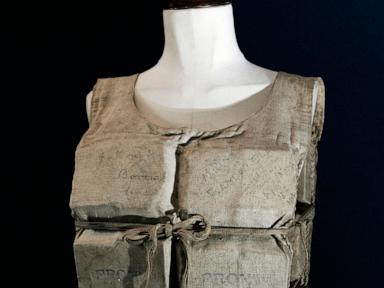
The $900,000 acquisition of a life jacket worn by a Titanic survivor represents more than a transaction of morbid curiosity; it is a clinical demonstration of how scarcity, provenance, and historical trauma interact to create a non-replicable asset class. While casual observers view the price tag through the lens of sensationalism, the valuation is driven by a measurable convergence of historical scarcity and the extreme emotional resonance of the 1912 sinking. This specific artifact functions as a physical manifestation of a systemic failure, making its market value a reflection of the "Titanic Premium"—a phenomenon where objects associated with this specific event command prices exponentially higher than contemporaneous maritime artifacts.
The Scarcity Architecture of Titanic Relics
The valuation of any high-end collectible is governed by the volume of surviving material. In the case of the Titanic, the distribution of artifacts follows a rigid hierarchy of availability:
- Deep-Sea Recoveries: Items salvaged from the debris field by commercial entities. These are subject to intense legal scrutiny and ownership disputes, often limiting their liquidity in the private market.
- Surface-Recovered Debris: Woodwork or equipment found floating by recovery ships like the Mackay-Bennett.
- Survivor-Linked Assets: Personal effects carried off the ship. This category represents the highest tier of private ownership because the items possess a continuous chain of custody starting from the moment of the disaster.
Of the approximately 3,500 life jackets originally on board, only a fraction survived. The vast majority were either buried with the victims or discarded as biohazardous waste during the recovery efforts in April 1912. The presence of a life jacket with a verified link to a survivor—rather than one found floating unoccupied—adds a layer of "human testimony" to the asset. This shifts the item from a piece of safety equipment to a biographical relic.
The Provenance Multiplier
In the high-stakes auction environment, the price is not paid for the physical object—a mass-produced cork and canvas vest—but for the documentation verifying its history. The "Provenance Multiplier" functions as a risk-adjustment tool. Without an airtight chain of custody, the asset’s value collapses to near zero due to the prevalence of fakes in the maritime memorabilia market.
The record-breaking $900,000 price point suggests a flawless provenance, likely tracing back to a specific lifeboat and a specific family lineage. Investors and collectors use three primary metrics to verify this:
- Temporal Proximity: How soon after the event was the item documented?
- Corroborative Evidence: Does the item appear in period photography or survivor testimonies?
- Physical Forensic Consistency: Does the degradation of the cork and the weave of the canvas match the manufacturing specifications of the British Board of Trade circa 1911?
The cost of authenticating such an item is high, creating a barrier to entry that ensures only institutional-grade collectors participate. This concentration of capital at the top of the market drives the price upward, as the asset is viewed as a "safe haven" for wealth within the alternative investment sector.
The Psychology of the Tragedy Premium
The Titanic remains the definitive case study in maritime disaster valuation because it occupies a unique space in the collective consciousness. This "Tragedy Premium" is calculated based on the intersection of three psychological variables:
The Technological Hubris Factor
The Titanic was marketed as the pinnacle of Edwardian engineering. Its failure represents a "Black Swan" event—an outlier with extreme impact that was rationalized only after the fact. Artifacts like life jackets are the literal symbols of the breakdown of that technology. They represent the point where engineering failed and individual survival became a matter of chance and class.
The Rarity of the Narrative
Unlike military shipwrecks, which are often viewed through the lens of combat and duty, the Titanic is viewed as a civilian drama. The objects recovered are domestic—clocks, jewelry, clothing—which allows the collector to bridge the gap between their own reality and the historical event. A life jacket is the most visceral of these connections; it is the boundary between the victim and the sea.
Global Brand Recognition
The "Titanic" brand is globally ubiquitous. Unlike the Empress of Ireland or the Lusitania, which had similar loss of life but lower cultural penetration, the Titanic has been reinforced by decades of cinema, literature, and research. This creates a liquid global market. A collector in Shanghai, London, or New York all recognize the value of the asset, ensuring high demand and competitive bidding.
The Physics of Decay and Asset Preservation
From a strategic management perspective, owning a 114-year-old life jacket is an exercise in material science. The asset is composed of organic materials—cork, linen, and cotton—that are under constant threat from environmental degradation.
The $900,000 valuation includes an implicit cost of maintenance. To prevent the "oxidation of history," the owner must maintain:
- Strict Humidity Control: Maintaining a constant 45-50% relative humidity to prevent the cork from becoming brittle or the linen from molding.
- UV Shielding: Total protection from light-induced fading, which can destroy the structural integrity of the fibers over time.
- Structural Support: Custom-molded mounts that prevent the weight of the cork from tearing the fragile canvas straps.
The failure to maintain these conditions results in "Asset Bleed," where the physical deterioration of the item leads to a direct and irreversible loss of market value. Collectors at this level often treat these items with the same rigor as a museum curator, employing professional conservators to perform periodic health checks on the artifact.
Market Positioning: Relic vs. Commodity
The auction of this life jacket signals a shift in the Titanic market from "hobbyist collection" to "high-net-worth portfolio diversification." We are seeing the commodification of history. In this framework, the life jacket is no longer a historical curiosity; it is a speculative asset.
The logic follows that as the wreck of the Titanic itself disappears—consumed by Halomonas titanicae bacteria—the value of surface-bound artifacts will rise. The physical site is decaying at an exponential rate; within decades, the debris field will be unrecognizable. This creates a "Terminal Scarcity" model. When the source is gone, the existing inventory becomes the only remaining evidence of the event.
Strategic Forecast for Historical Asset Allocation
Investors entering the maritime artifact market must recognize that the $900,000 sale is a benchmark, not an anomaly. As global wealth increases and traditional markets face volatility, capital will continue to flow into "tangible history." However, this market is bifurcated. Items with generic associations will stagnate, while "A-list" artifacts—those directly tied to the survival or death of known individuals—will see continued aggressive appreciation.
The strategic play for the next decade is the acquisition of assets that possess "Cross-Sector Appeal." A Titanic life jacket appeals to maritime historians, textile collectors, and generalists interested in 20th-century icons. This breadth of appeal provides a floor for the asset’s value, protecting the investor against a downturn in any single niche market.
The ultimate value of the $900,000 life jacket lies in its status as a "Primary Source" of a global myth. It is one of the few physical objects that can move the needle of history while simultaneously serving as a high-performance financial instrument. Future valuations will likely exceed the million-dollar threshold as the 120th and 125th anniversaries of the sinking approach, driving a new wave of commemorative demand. Owners should focus on cementing provenance and investing in museum-grade preservation to ensure the asset survives both the elements and the scrutiny of the next generation of buyers.