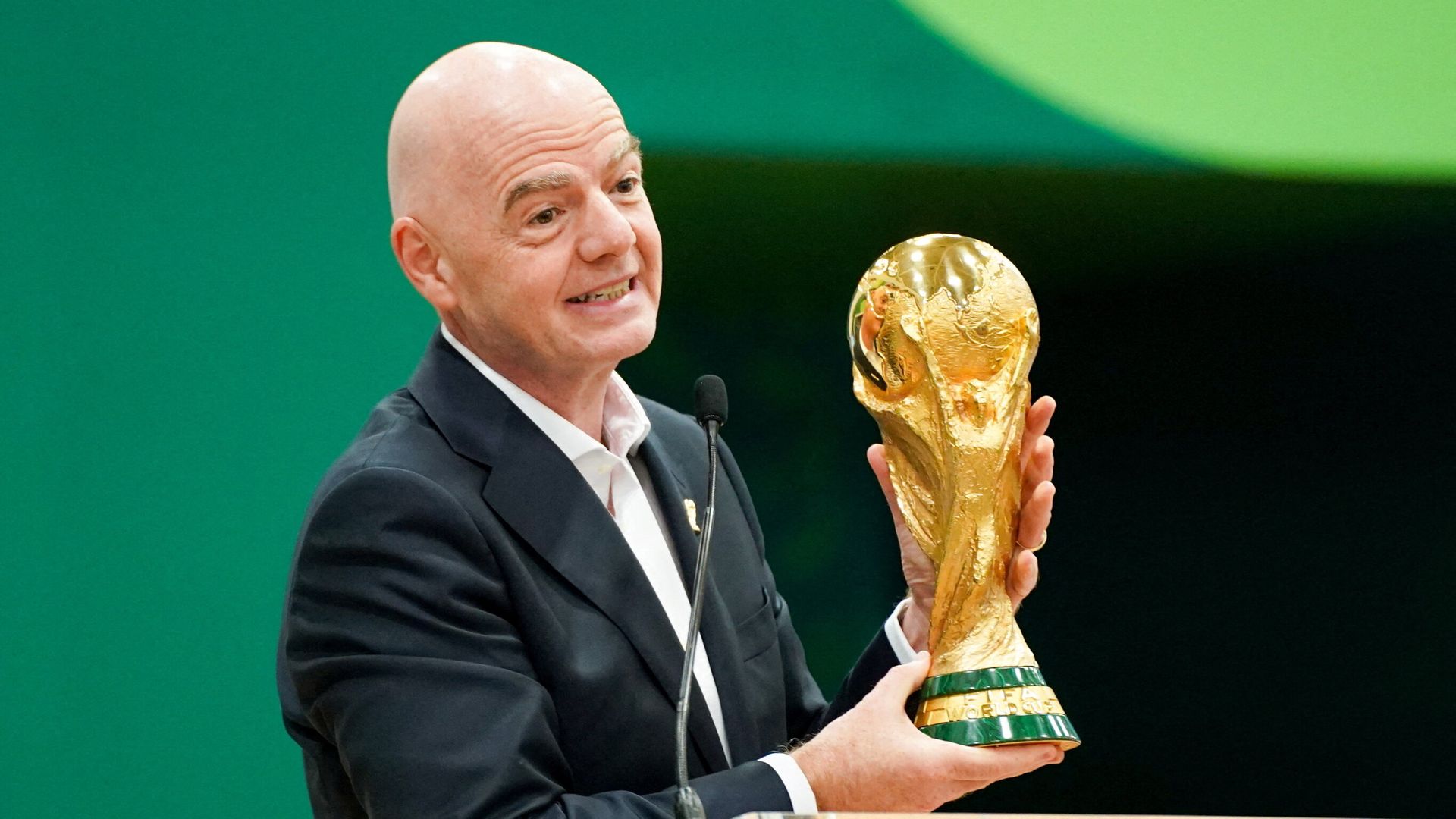
The recent structural maneuver by global soccer governance to spin off its primary commercial assets into a dedicated corporate entity valued at twenty billion dollars marks a fundamental break from traditional non-profit sports administration. By initiating the creation of FIFA Forward Enterprise to centralize revenue generation and court minority private equity backers, leadership has triggered an immediate institutional schism with regional confederations, most notably UEFA. This conflict is not merely political posturing. It represents a systemic collision between traditional sports federation governance and aggressive corporate capitalization models designed to extract liquidity from international match calendars.
Evaluating this restructuring requires examining the underlying mechanics of how international soccer monetization functions. For decades, world governing bodies operated under a mutualized model where tournament revenues directly funded global development programs through internal redistribution. Introducing private capital through non-controlling equity stakes fundamentally alters this equation.
The Three Pillars of Commercial Restructuring
The proposed architecture relies on distinct financial mechanisms designed to maximize valuation multiples from the men's World Cup and associated properties.
- The Asset Consolidation Mechanism groups marquee international tournaments under a single corporate umbrella to establish predictable, recurring cash flows that appeal to institutional investors.
- The Minority Equity Placement targets up to 4.2 billion dollars in external capital, utilizing financial partners such as JPMorgan and specialized investment funds to monetize future broadcast and sponsorship upside.
- The Governance Firewall intends to separate commercial execution from sporting regulation, preserving FIFA's exclusive authority over match calendars, rule enforcement, and regulatory frameworks.
This division creates an inherent structural tension. While the governing body insists that regulatory power remains strictly partitioned from commercial ownership, minority equity holders inherently demand growth vectors that maximize return on invested capital. This requirement exerts direct upward pressure on match frequencies, tournament expansions, and commercial inventory.
The Cost Function of Capital Expansion
When a non-profit governing body introduces private equity into its core revenue-generating assets, the internal cost function shifts immediately. Traditional federations optimize for broad geographic participation and developmental redistribution. Private investors optimize for internal rate of return, multiple expansion, and cash flow predictability.
To justify a twenty billion dollar valuation, the newly formed corporate vehicle must accelerate top-line growth beyond historical organic trajectories. This imperative explains the continuous pressure to expand tournament formats, increase match counts, and commercialize unexploited international windows. Each expansion introduces negative externalities that are systematically externalized onto domestic leagues and club sides. Player workload metrics spike, injury risk functions compound, and the physical degradation of elite athletes accelerates.
UEFA's fierce resistance stems directly from this economic reality. European clubs and leagues bear the operational costs of player development and wage liabilities, yet they capture zero equity upside from global tournament monetizations. When international governing bodies increase match density to satisfy private equity growth targets, domestic leagues absorb the productivity losses while the governing body captures the capital gains.
The Mechanics of Inter-Institutional Conflict
The public condemnation issued by European leadership highlights a deeper breakdown in stakeholder alignment. By stating that the soul of the sport is not an asset to trade, regional administrators are articulating a defense of the traditional rent-seeking hierarchy. Under the status quo, regional confederations maintain localized monopolies over continental club competitions, generating billions in annual television rights without direct global equity interference.
FIFA's pivot bypasses traditional dependency pathways. By offering minority stakes to its 211 member associations alongside private investors, leadership attempts to construct a coalition of smaller federations that benefit from immediate cash distributions funded by external capital. This strategy fractures unified continental opposition by aligning the financial incentives of developing federations with the central governing body's commercial ambitions.
Systemic Vulnerabilities in Private Equity Integration
Deploying private capital into international sports tournaments introduces severe structural vulnerabilities that standard financial models often underestimate.
- Regulatory Capture Risk arises when commercial partners acquire financial leverage over tournament structures, complicating independent disciplinary or regulatory interventions.
- Valuation Sensitivity remains acute, as global broadcast revenues face saturation risks in mature western markets, forcing heavy reliance on volatile sponsorship and digital rights growth.
- Stakeholder Fragmentation deepens as elite clubs, player unions, and continental confederations explore breakaway legal and operational frameworks to protect their proprietary economic interests.
The assumption that minority investors remain passive participants ignores the core fiduciary duties of private equity funds. Capital deployment of this magnitude requires active strategic oversight, performance benchmarking, and aggressive revenue optimization strategies that inevitably intersect with sporting integrity.
Execute the reallocation of commercial rights by establishing binding consensus protocols with domestic leagues before finalizing equity placements, or face permanent structural bifurcation of elite international competition.