Walk into the Pavilion of Carriages at the Vatican Museums, and you are supposed to feel a sense of reverent awe. At least, that is what the mainstream travel press and standard Vatican press releases want you to feel. They frame the exhibition of papal vehicles since 1930 as a charming, linear progression of automotive design—a whimsical parade of chrome, white paint, and custom engineering celebrating the Church’s embrace of the modern world.
They are completely missing the point.
Viewing these vehicles as mere historical curiosities or automotive milestones is the laziest possible interpretation of what is sitting inside that museum. The Popemobile is not a car. It is a rolling geopolitical barometer, a tactical security apparatus, and the single most revealing physical artifact of the Catholic Church’s existential struggle between divine accessibility and mortal vulnerability.
When you look past the glossy paint of the 1930 Graham-Paige Type 837 or the modified Mercedes-Benz G-Class models, you aren't looking at a car show. You are looking at a century-long crisis management timeline.
The Lie of the "Unbroken Tradition"
The prevailing narrative pushed by museum guides and surface-level articles is that the Popemobile represents a continuous, unbroken tradition dating back to 1930. This is factually sloppy and historically misleading.
For centuries before the internal combustion engine, popes traveled via the sedia gestatoria—a portable throne carried on the shoulders of twelve footmen in red damask. The sedia was not designed for comfort; it was designed for theological projection. It elevated the pontiff above the crowd so he could be seen by thousands, reinforcing the visual hierarchy of the Church.
When Pope Pius XI accepted the Graham-Paige in 1930—following the 1929 Lateran Treaty that established Vatican City as an independent sovereign state—it wasn't just a fleet upgrade. It was a diplomatic flex. The Vatican was suddenly a modern nation-state, and a modern nation-state needed motorized transport rather than medieval palanquins.
However, calling a 1930s luxury sedan a "Popemobile" is pure anachronism. Those early vehicles were standard, albeit heavily customized, black luxury limousines from manufacturers like Fiat, Citroën, and Mercedes-Benz. They were enclosed, private, and fundamentally indistinguishable from the cars used by secular heads of state and European industrialists.
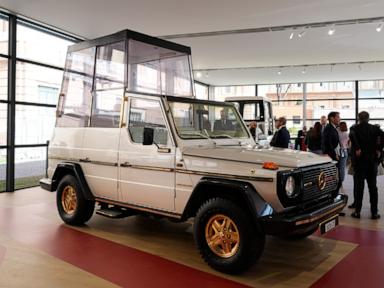
The actual "Popemobile"—defined by its elevated viewing platform, open-air design, and signature white livery—did not exist until the late 1970s. Lumping a 1930 Graham-Paige into the same conceptual bucket as the 1980 Mercedes-Benz 230 G is like comparing a horse-drawn mail coach to a fiber-optic cable because they both deliver messages. It flattens the history and erases the exact moment the Vatican realized its public image was failing.
The 1981 Pivot From Theology to Ballistics
If you want to understand the true engineering behind the vehicles in the Vatican exhibition, ignore the horsepower and look at the glass.
In the late 1970s, Pope John Paul II fundamentally broke the mold of papal travel. Recognizing the power of television and mass spectacle, he ditched the enclosed limousines and the sedia gestatoria in favor of open-top off-road vehicles—most famously the Polish-built FSC Star truck used during his 1979 visit to Poland, and later the modified Mercedes-Benz G-Wagen. The goal was radical proximity. He wanted to stand up, wave, touch hands, and kiss babies. The vehicle was designed to erase the barrier between the shepherd and the flock.
Then came May 13, 1981. Mehmet Ali Ağca fired four shots at John Paul II in St. Peter’s Square from an open-top Fiat Campagnola.
That single afternoon permanently altered automotive engineering for heads of state worldwide. Overnight, the Popemobile transformed from a parade float into a tactical armored personnel carrier disguised as a greenhouse.
I have spent years analyzing historic vehicle collections and diplomatic transport protocols, and the shift visible in the Vatican’s post-1981 fleet is staggering. Engineers at Mercedes-Benz and Land Rover were suddenly tasked with solving an impossible physics problem: how to maintain 360-degree visibility for millions of onlookers while encasing the passenger in a ballistic-grade capsule capable of stopping high-velocity rifle rounds and withstanding explosive blasts.
Consider the sheer mechanical absurdity of the post-1981 Popemobiles:
- The Glass Box: The iconic transparent dome wasn't an aesthetic choice; it was a ballistic compromise. Early iterations used multi-layered polycarbonate and armored glass so thick it required dedicated air conditioning units just to keep the Pope from suffocating under the magnifying-glass effect of the Roman sun.
- Suspension Overload: Adding thousands of pounds of steel plating and laminated glass to the top-heavy frame of a utility vehicle destroys its center of gravity. Engineers had to completely rebuild the chassis, brakes, and suspension systems just to keep the vehicles from tipping over during sharp turns at parade speeds.
- Acoustic Isolation: The ballistic glass was so effective that it completely severed the Pope from the crowd. He couldn't hear them, and they couldn't hear him. External microphones and speaker systems had to be wired into the chassis just to simulate the human connection the glass had destroyed.
When curators present these post-1981 armored rigs simply as "vehicles popes have used," they sanitize the reality. Those cars are monuments to paranoia and survival. They represent the exact moment the Vatican accepted that modern mass visibility comes with an unavoidable target painted on the passenger's back.
The Corporate Sponsorship Engine Nobody Talks About
Another massive blind spot in standard coverage of the Vatican exhibition is the commercial machinery operating behind the scenes. The articles read as if automakers simply donate these vehicles out of pure religious devotion.
Let's be serious. The Popemobile is the highest-ROI product placement in global marketing history.
When Mercedes-Benz, Fiat, Renault, or Jeep builds a custom Popemobile, they aren't performing an act of charity; they are executing a masterstroke of brand positioning. Think about the media impressions generated every time a pope steps out of a vehicle during an international apostolic journey. Billions of people—Catholic and non-Catholic alike—watch live broadcasts of papal arrivals. You cannot buy that kind of uninterrupted, reverent global airtime at the Super Bowl or the World Cup.
Even more brilliant is the brand association. By placing the badge of an automaker on the grille of the Popemobile, the manufacturer implicitly aligns itself with concepts of trust, permanence, safety, and moral authority.
Look at the strategic pivot of the last decade. When Pope Francis rejected the bulletproof Mercedes-Benz M-Class upon his election in 2013—calling the armored glass box a "sardine can" and opting instead for a modest Ford Focus, a 1984 Renault 4, and open-air Jeeps and Isuzus—it wasn't just a statement of personal humility. It was a massive PR reset for the Vatican, and a goldmine for mass-market automakers.
Suddenly, luxury German engineering was out, and accessible, working-class brands were in. When Francis rode in a custom electric Fisker Ocean or an all-electric Mercedes-Benz G-Class, the Vatican wasn't just catching up on fleet maintenance; it was using the Popemobile as a rolling press release for Laudato si', Francis’s encyclical on environmental stewardship. Every vehicle in that exhibition is a calculated PR weapon, chosen specifically to broadcast the ideological priorities of the papacy at that exact moment in history.
Dismantling the Common Myths About the Popemobile
If you are planning to visit the Vatican Museums or researching the history of papal transport, forget the sanitized trivia you find on standard tourism blogs. Here is the reality behind the questions people actually ask about these vehicles.
Is the Popemobile actually bulletproof today?
Most people assume every Popemobile is an impenetrable tank. That is false. While the Vatican maintains heavily armored vehicles in its active fleet—featuring ballistic glass, reinforced undercarriages, and run-flat tires—Pope Francis systematically dismantled the standard security protocol. He repeatedly insisted on using open-air vehicles without glass barriers during major public appearances, famously stating that at his age, he had little to lose and refused to greet people from behind a wall. Security personnel from the Vatican Gendarmerie Corps hate it, because it turns crowd control into an absolute nightmare, proving that papal ideology frequently overrides basic tactical common sense.
What happens to old Popemobiles when they are retired?
They do not go to a junkyard, and they are rarely sold on the open market. Because a vehicle used by a pope is considered a de facto second-class relic by many faithful—and presents a massive security and brand-image liability if bought by a private eccentric—retired Popemobiles are tightly controlled. Many are permanently housed in the Vatican’s Pavilion of Carriages. Others are returned to the manufacturers for their corporate museums (such as the Mercedes-Benz Museum in Stuttgart), or gifted to local dioceses in the countries where they were used during specific papal visits. You cannot buy a retired Popemobile at Barrett-Jackson, and the Vatican legal team will bury anyone who tries to fake one.
Does the Popemobile have its own license plate?
Yes, and it is one of the most deliberate pieces of branding on the vehicle. Every official Vatican vehicle carries the prefix SCV, which stands for Stato della Città del Vaticano (Vatican City State). The primary vehicle used by the reigning pontiff always carries the registration SCV 1. Contrary to popular urban legends, SCV does not stand for Se Cristo Vedesse ("If Christ could see"), a sarcastic joke Romans have told for decades whenever a cardinal speeds past in a luxury sedan.
How to Actually Experience the Vatican Exhibition Without Falling for the Hype
If you walk through the Pavilion of Carriages relying solely on the museum placards, you will walk out twenty minutes later having learned nothing beyond dates, chassis numbers, and engine displacements. To actually understand what you are looking at, you have to strip away the museum framing and analyze the vehicles through a completely different lens.
- Ignore the luxury sedans and study the utility trucks. The 1930s and 1960s limousines (like the Mercedes-Benz 600 Pullman) are beautiful, but they tell you nothing unique about the papacy. They are just rich-man cars with flags on the fenders. Spend your time examining the modified Land Rovers, the Fiat Campagnola, and the early Mercedes G-Wagens. Look at the welds on the grab bars, the non-slip flooring, and the height of the rear seats. That is where you see the physical mechanics of modern mass-media religion being invented in real time.
- Compare the horses to the horsepower. The Pavilion of Carriages isn't just cars; it houses the ornate, gold-leafed horse-drawn carriages of the 18th and 19th centuries alongside the motorized fleet. Do not treat them as separate eras. Look at the Grand Gala Berlin carriage built for Pope Leo XII in 1826, and then turn around and look at the 2002 Mercedes-Benz ML 430. The propulsion changed, and the gold leaf was replaced by white paint and polycarbonate, but the core architectural purpose is identical: both are mobile stages designed to frame a single human being as the center of the universe.
- Look at the driver's compartment, not the back seat. Everyone stares at the papal throne in the rear. Look at the front cab instead. Notice the communication arrays, the reinforced bulkheads, and the sightlines. The Popemobile is one of the few vehicles on earth engineered to be driven at a sustained walking pace—around 3 to 5 miles per hour—for hours on end without overheating the engine or burning out the transmission, while simultaneously being capable of hitting highway speeds in seconds if an extraction is required.
There is an undeniable downside to viewing the Vatican’s automotive collection through this cold, analytical lens: it completely ruins the fairy tale. If you go into the Vatican Museums looking for a heartwarming story about faith on wheels, dissecting the ballistic glass tolerances, corporate PR strategies, and tactical crowd-control engineering will feel overly cynical. It strips away the pageantry and forces you to look at the machinery behind the curtain.
Good. The pageantry is a distraction anyway.
The next time you see a headline celebrating the charming history of the Popemobile, remember what those vehicles actually represent. They are not quaint relics of a bygone era, nor are they simple modes of transportation. They are custom-engineered survival pods forged out of assassination attempts, Cold War geopolitics, and ruthless corporate branding—proof that even when an institution claims its kingdom is not of this world, it still needs four-wheel drive and three inches of bulletproof glass to navigate it.