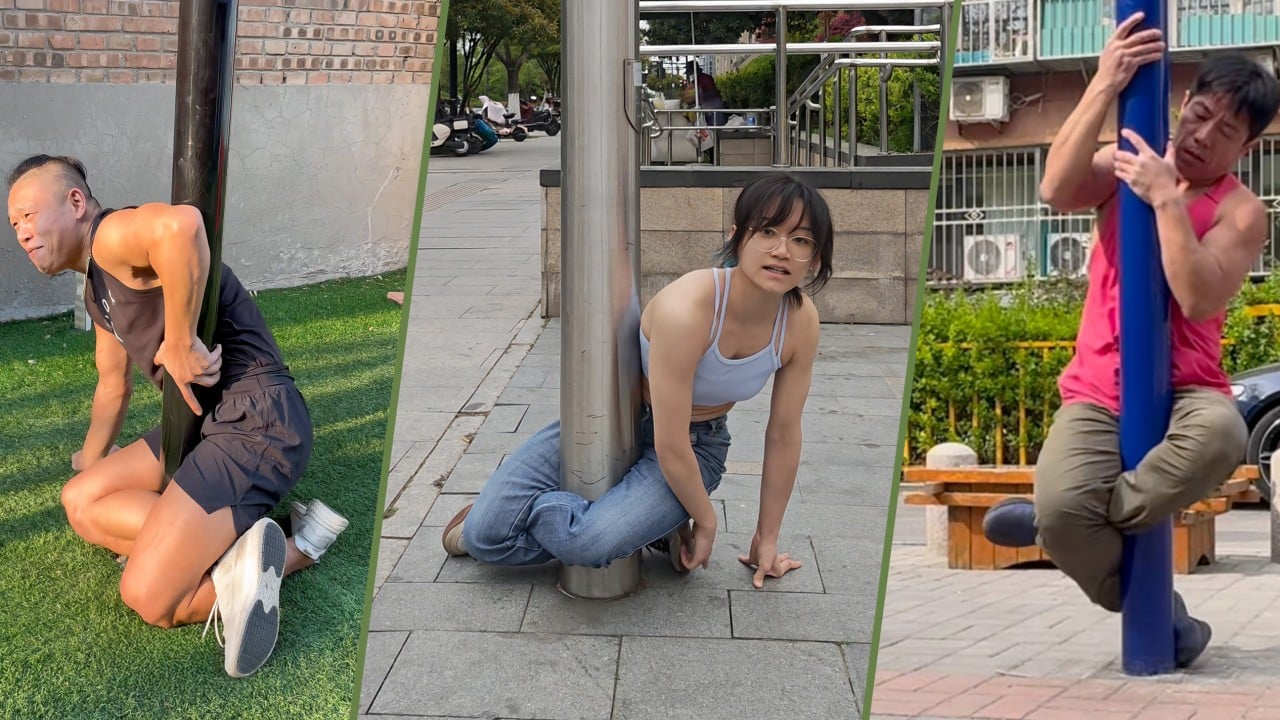
The metal is cold, unforgiving, and exactly four inches wider than a human grip can comfortably circle.
Xiao Chen doesn't think about the physics of friction as he presses his thighs against the galvanized steel of a street lamp in Hangzhou. He isn't thinking about the structural integrity of the pole or the fact that his center of gravity is currently hovering eight feet above a concrete sidewalk. He is thinking about the framing of his smartphone camera, perched precariously on a tripod below. He is thinking about the "double-tap" hearts that will bloom across his screen like digital cherry blossoms once he uploads the footage.
This is the "Cross-Legged Lamp Post Challenge." It sounds like a playground game. It looks like a circus act. But for the thousands of young people across China currently attempting to shimmy up public infrastructure, it is a high-stakes bid for relevance in an attention economy that is increasingly starved for novelty.
The premise is deceptively simple: climb a smooth, vertical pole using only your limbs, then lock your legs in a meditative, cross-legged "lotus" position while suspended mid-air. No harness. No safety net. Just the strength of your adductor muscles and a desperate hope that your jeans provide enough grip.
The Gravity of the Scroll
We live in an era where the digital world demands physical proof of our worth.
Consider a hypothetical office worker named Jia. She spends ten hours a day under fluorescent lights, her spine curving into the shape of a question mark as she stares at spreadsheets. Her life feels horizontal. Monotonous. Invisible. Then, she opens her phone and sees a peer—someone who looks just like her—defying gravity on a city street. The climber looks powerful. They look free.
The impulse to mimic isn't just about vanity. It’s a primal scream against the mundane. When the world feels like it's closing in, going up feels like the only direction left.
But gravity doesn't care about your aesthetic. Over the last several months, Chinese fire departments have seen a spike in a very specific, very bizarre type of emergency call. The "stuck climber."
It usually happens the same way. The ascent is fueled by adrenaline. The pose is struck. The photo is taken. But then, the body betrays the mind. Muscles that were clenched in a frantic isometric hold suddenly refuse to fire. Lactic acid floods the thighs. The climber realizes that the downward journey requires a different set of mechanics—ones they haven't practiced. They are physically "locked" to the pole, paralyzed by the fear that letting go means a bone-shattering drop to the pavement.
When the Rescue Becomes the Content
There is a profound irony in the rescue operations. Firefighters arrive with ladders and heavy-duty hydraulic lifts to detach a trembling teenager from a lamp post, only to find a crowd of onlookers filming the rescue. The failure becomes more viral than the success.
The authorities are not amused. Beyond the obvious risk of personal injury—broken ankles, spinal trauma, or internal bleeding from the sheer pressure of the grip—there is the issue of public resources. Every time a specialized rescue squad is dispatched to peel a social media influencer off a light fixture, they are unavailable for a house fire or a car accident.
The stakes are invisible until they are absolute.
We often talk about "online safety" in terms of data privacy or cyberbullying. We rarely discuss it in terms of the physical toll. The lamp post challenge is a literal manifestation of the lengths we will go to be seen. It is a bridge between the digital desire and the physical consequence.
The Anatomy of a Trend
Why this? Why now?
To understand the vertical fever, you have to understand the pressure of the "996" work culture (working 9 am to 9 pm, six days a week) that has come to define much of urban Chinese life. When your daily existence is hyper-regulated, the act of climbing something you aren't supposed to climb is a micro-insurrection. It is a way to reclaim a public space that usually only asks you to move through it, never to inhabit it.
The lamp post becomes a pedestal. For thirty seconds, the climber is the highest point in the immediate vicinity. They are the center of the world.
However, the physics of the human body are not designed for this. Human skin and denim on polished metal create a low-friction environment. To stay up, you must exert a crushing amount of force inward. This can lead to "compartment syndrome," where pressure builds up in the muscles to dangerous levels, potentially cutting off blood flow. There have been reports of participants experiencing deep tissue bruising that lasts for weeks—a hidden bruise for a public boast.
The trend has also highlighted a growing disconnect between generations. To the older residents of cities like Shanghai and Chengdu, seeing a young person clinging to a street lamp is a sign of a society losing its grip on reality. To the participants, it’s just another Tuesday in the race for engagement.
The Cost of the Click
There is a specific kind of silence that happens when a climber realizes they can't get down.
I spoke with a young man who attempted the challenge outside a shopping mall in Beijing. He asked to remain anonymous because of the "social death" that comes with being mocked online. He reached the six-foot mark, crossed his legs, and felt a surge of triumph. Then, his left foot fell asleep.
"The world went very quiet," he told me. "I could hear the cars, but they sounded miles away. I looked at my hands and realized they were shaking too much to grip the pole again if I moved my legs. I stayed there for ten minutes, praying no one would notice I was stuck. Eventually, I had to slide down. I ruined my favorite pair of trousers and skin-galled my inner thighs so badly I couldn't walk properly for three days."
He didn't post the video.
This is the reality of the viral landscape. We see the one percent of successful, graceful climbs. We don't see the thousands of failed attempts, the torn clothing, the bruised egos, or the frantic calls to emergency services. We see the peak, never the climb.
The Search for Solid Ground
The government has begun issuing stern warnings. Social media platforms have started tagging the videos with "Dangerous Act: Do Not Imitate" banners. But the cat is out of the bag, or rather, the climber is up the pole.
As long as the algorithm rewards the spectacular, people will continue to risk the spectacular. The lamp post is merely the latest stage for a performance that has no end. It represents our collective vertigo—a dizzying need to rise above the crowd, even if we have no plan for how to get back down.
Next time you see a video of a person suspended in a lotus pose against a city sky, look past the grace. Look at the white knuckles. Look at the way the metal vibrates. Notice the shadow they cast on the ground below—the ground that is waiting, patiently and inevitably, for them to return.
The most difficult part of any ascent isn't reaching the top. It's finding a way to stand on your own two feet once the camera stops recording.