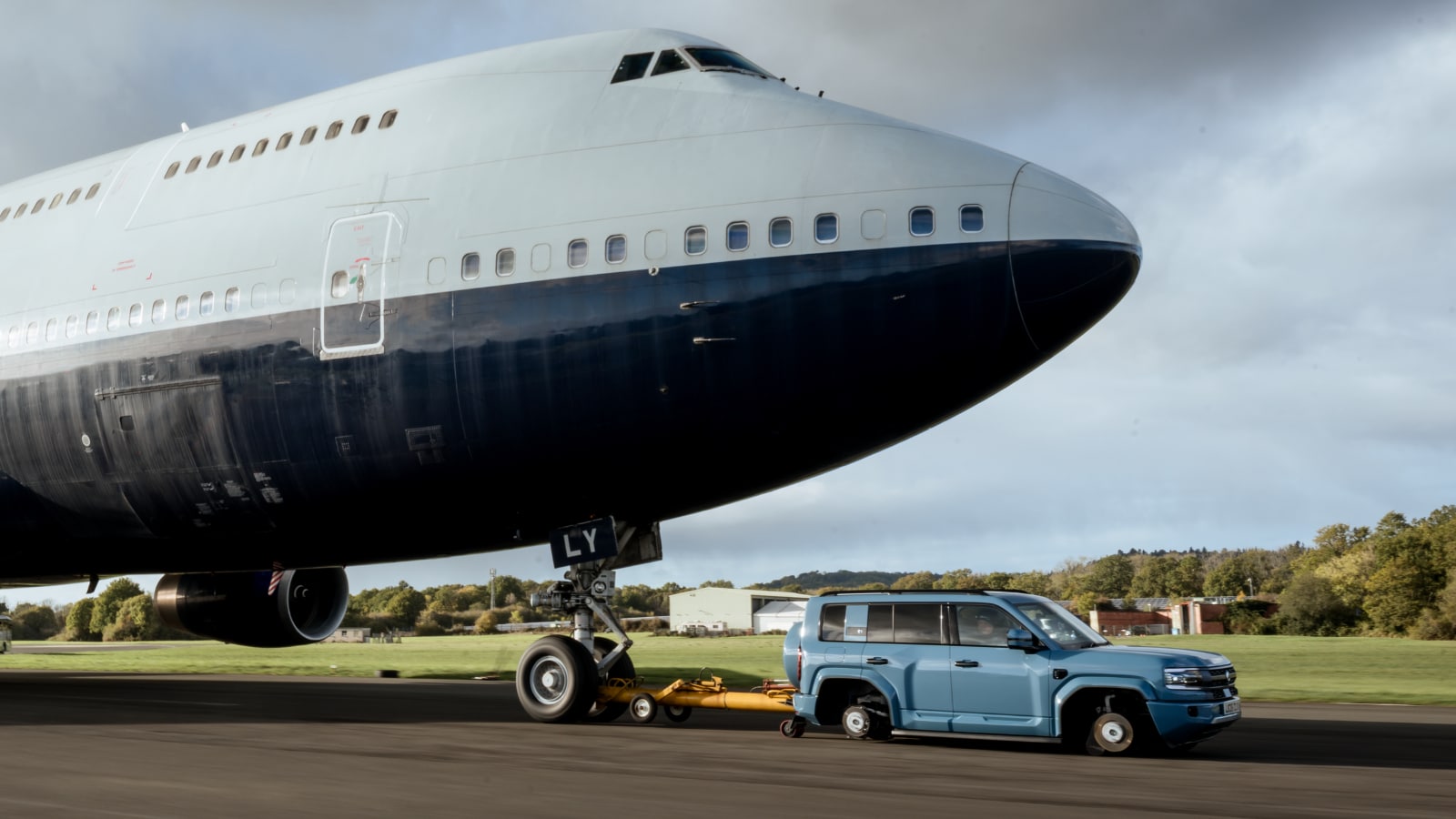
Every few months, an automotive marketing department rents an empty runway, hooks a consumer SUV to a commercial airliner, and watches the internet lose its collective mind.
The latest viral spectacle features a luxury electric SUV pulling a 180-tonne Boeing 747 across flat tarmac on just two driven wheels. Automotive blogs immediately swallowed the press release whole, treating this stunt like a historic triumph of battery engineering over internal combustion.
They got played.
If you understand seventh-grade Newtonian mechanics, you know this stunt is the automotive equivalent of a magician pulling a tablecloth out from under a set of dishes. It looks impossible to the untrained eye. To anyone who has ever spent time in a powertrain dynamometer cell or a vehicle dynamics lab, it is entirely trivial.
The Illusion of the 180-Tonne Pull
When people hear that a passenger vehicle pulled 180 tonnes, their brains default to lifting weight. They picture an SUV deadlifting a skyscraper.
Towing on level ground has almost nothing to do with lifting weight. It is entirely a battle against rolling resistance and static friction.
Let’s do the math that the PR agency conveniently left out of the press kit. On dry, level asphalt, a commercial airliner’s tires have a coefficient of rolling resistance ($C_{rr}$) of roughly 0.01 to 0.015. To calculate the horizontal force required to keep a 180-tonne (180,000 kg) Boeing 747 rolling at a steady walking pace, you multiply the mass by gravity ($9.81 \text{ m/s}^2$) and the rolling resistance coefficient:
$$F = 180,000\text{ kg} \times 9.81\text{ m/s}^2 \times 0.015 \approx 26,487\text{ Newtons}$$
Convert those Newtons into pounds-force, and you get roughly 5,950 lbf.
A mid-range, gasoline-powered pickup truck generates that much tractive effort at the contact patch in first gear without breaking a sweat. In fact, a single fit human being wearing a harness can pull a 180-tonne airliner across a flat runway. Guinness World Records has documented strongmen doing it for decades. In 2009, Kevin Fast pulled a CC-177 Globemaster III weighing nearly 189 tonnes by himself.
If a guy from Ontario can do it with two legs and a good breakfast, a multi-ton electric luxury vehicle with a high-output permanent magnet motor isn't exactly rewriting the laws of thermodynamics.
Why Two-Wheel Drive Actually Helped
The headline-grabbing hook of this particular stunt was that the SUV did it using only two wheels—specifically, engaging a single axle rather than relying on all-wheel drive.
This sounds like a handicap. In reality, it is a clever bit of weight-transfer manipulation.
When an electric SUV is hitched to a massive load via a tow bar, the geometry of the hitch point sits above the axle centerline. As the vehicle pulls forward, the resistance of the jet creates a rotational moment that pushes the rear suspension down and lifts the front suspension up.
- Rear-wheel bias: If the vehicle is operating in rear-wheel-drive mode, that massive downward force pins the rear tires into the tarmac.
- Traction multiplication: Friction is simply the normal force multiplied by the coefficient of friction ($\mu$). By shifting weight onto the driven rear axle, the engineers maximized the normal force precisely where the torque was being applied.
- Zero wheelspin: Because electric motors can modulate torque down to the millisecond—far faster than a combustion engine managing throttle plates, fuel injectors, and torque converters—the traction control computer held the tires right at the threshold of slip without breaking traction.
It is a neat calibration trick. It demonstrates that the vehicle's inverter software is well-tuned. It does not mean the car possesses supernatural strength.
What Marketing Departments Hide From You
I have sat in countless product launch meetings where engineers have to bite their tongues while brand managers dream up absurd validation tests. Years ago, I watched a major automaker burn through seven figures orchestrating a high-altitude towing stunt in the Rockies, only to quietly replace two cooked transmissions in the support tent between camera takes.
Stunts are designed to hide weaknesses by isolating a single metric—peak low-end torque—and ignoring everything else that matters in the real world.
Instant Torque Is Not Continuous Power
Electric motors are famous for producing 100% of their rated torque at zero RPM. For moving a stationary Boeing 747 three hundred feet at two miles per hour, this is ideal. You need a massive initial shove to overcome static friction, followed by a tiny amount of sustained force to maintain momentum.
Now take that same luxury EV, hitch it to a 7,000-pound Airstream trailer, and drive it up the Eisenhower Tunnel grade on I-70 at 65 miles per hour.
Suddenly, peak torque at zero RPM is irrelevant. You are now fighting aerodynamic drag—which scales with the square of velocity—and continuous gravitational pull. In this scenario, the powertrain isn't operating for 45 seconds on a flat runway; it is dumping massive amounts of electrical current continuously for twenty minutes straight.
- Thermal derating kicks in: Copper windings in the stator heat up. Permanent magnets lose magnetic flux density as temperatures climb. The battery management system sees cell temperatures spiking and throttles power output to prevent permanent degradation.
- Aerodynamics destroy efficiency: A Boeing 747 moving at 3 mph experiences zero aerodynamic drag. A boxy travel trailer moving at 70 mph acts like a parachute.
- Energy density hits a wall: A gallon of diesel holds roughly 36 kilowatt-hours of chemical energy. Even accounting for the dismal thermal efficiency of an internal combustion engine, a 30-gallon tank delivers more usable mechanical work to the wheels than a massive 100-kWh lithium-ion battery pack—and you can refill it in four minutes.
The Hitch Pin Reality Check
There is another glaring truth buried beneath the viral footage: the tow hitch itself.
A standard Class IV receiver hitch on a luxury SUV is rated for roughly 7,000 to 10,000 pounds of gross trailer weight, with a maximum tongue weight of around 1,000 pounds. If you actually tried to take that 180-tonne Boeing 747 down a public highway—assuming you somehow found a lane wide enough—the very first time you touched the brake pedal, that 400,000-pound aircraft would crumple the SUV like an aluminum soda can.
Towing capacity ratings from SAE J2807 (the industry standard developed by the Society of Automotive Engineers) have almost nothing to do with how much weight a vehicle can get moving on a flat surface. SAE J2807 tests measure:
- Thermal management on the Davis Dam grade in Arizona at 100°F+ ambient temperatures with the air conditioning blasting at full capacity.
- Braking performance and fade resistance during repeated hard stops.
- Chassis stability and sway control during evasive lane-change maneuvers.
- Structural integrity of the frame rails and hitch mount under dynamic shock loads.
A runway pull tests zero of these criteria. It is the equivalent of bragging that you can bench-press 500 pounds because you un-racked the bar and held it motionless for two seconds.
The Questions Buyers Should Actually Be Asking
When consumers see headlines about electric SUVs pulling jumbo jets, they start asking the wrong questions. They type things into search bars like, "Can an electric SUV replace a heavy-duty diesel truck?" or "How much can an electric SUV really tow?"
Let’s dismantle the premise of those questions immediately.
Can an electric SUV replace a heavy-duty truck for towing?
No. Not today, and not with current lithium-ion chemistry. If your lifestyle involves hauling a horse trailer across state lines or pulling a 30-foot boat to a lake two hundred miles away, buying a luxury electric SUV based on a runway stunt is financial self-sabotage.
Your range will drop by 50% to 60% the moment you hitch up a boxy load. Worse, charging infrastructure is overwhelmingly designed like parking spaces, not pull-through fuel islands. Every time you need to charge from 10% to 80%, you will have to unhitch your trailer in a crowded supermarket parking lot, block two spaces, charge for forty minutes, and hitch back up. Do that three times in a single day and the novelty of instant electric torque evaporates entirely.
Why do automakers keep doing airplane tow stunts?
Because it works on shareholders and casual buyers.
We saw Volkswagen do it with a diesel Touareg pulling a 155-tonne Boeing 747 in 2006. We saw Porsche do it with a Cayenne pulling an Airbus A380 in 2017. We saw Land Rover do it with a Discovery Sport pulling a 100-tonne train. We saw Ford do it with an electric F-150 prototype pulling over a million pounds of railcars in 2019.
Notice a pattern? Every single major manufacturer goes back to this exact well whenever they need to convince skeptical buyers that a downsized engine, a unibody chassis, or an electric powertrain isn't "weak." It is a psychological crutch designed to overcome buyer anxiety.
Where Electric Powertrains Actually Dominate
Criticizing a silly marketing stunt does not mean dismissing the underlying engineering. To be completely fair, modern electric luxury SUVs possess capabilities that make traditional internal combustion engines look agricultural—just not in the way the press release claims.
If you want to understand why high-end EV architecture is genuinely impressive, ignore the airplane and look at how the vehicle handles low-speed off-road articulation and dynamic chassis control.
- Millisecond torque vectoring: By controlling motor speed directly through inverter frequency rather than relying on mechanical differentials and brake-based traction control, an electric axle can react to a slip event roughly 100 times faster than a gas powertrain. When one tire hits ice or loose shale, the motor adjusts torque before the wheel completes a fraction of a rotation.
- Regenerative braking control: Descending a steep mountain pass with a moderate trailer behind an EV is a revelation. Instead of riding your friction brakes until the rotors glow orange and the fluid boils, the electric motor acts as a generator, absorbing kinetic energy and feeding it back into the battery pack while holding the vehicle at a rock-steady speed.
- Center of gravity: Packing 1,500 pounds of battery cells into the floor pan drops the center of gravity below the wheel hubs. For a tall, heavy luxury SUV, this eliminates body roll without requiring rock-hard suspension dampers that ruin ride quality.
These are real, tangible engineering wins. They make daily driving safer, smoother, and vastly more refined. They just don't make for dramatic thumbnail photos on YouTube.
How to Evaluate Tow Ratings Without Getting Fooled
If you are actually shopping for an electric or hybrid SUV and plan to hook something to the back of it, throw the marketing brochures in the trash. Use this checklist instead.
- Demand the SAE J2807 certification: Never trust a manufacturer's "up to" towing figure unless it explicitly states compliance with SAE J2807. This guarantees the vehicle survived thermal, braking, and structural testing rather than just a theoretical drivetrain calculation.
- Calculate your frontal area, not just weight: Weight matters when accelerating and climbing hills. Frontal area—the width and height of your trailer—dictates your highway range. A low-profile flatbed trailer carrying 5,000 pounds of bricks will consume vastly less battery energy at 70 mph than an empty, 2,500-pound enclosed cargo trailer.
- Check the payload sticker on the door jamb: Luxury EVs are already heavy because of their batteries, which eats into their Gross Vehicle Weight Rating (GVWR). Subtract the curb weight from the GVWR. Once you put four adults, luggage, and 700 pounds of trailer tongue weight in the vehicle, you will often exceed your legal payload limit long before you reach your maximum towing limit.
- Ignore single-axle heroics: Whether a vehicle pulls a jet in rear-wheel drive or all-wheel drive on a closed airport runway tells you zero about how it behaves when a crosswind hits your trailer on an elevated highway bridge. Always prioritize wheelbase length, curb weight ratio, and integrated trailer sway control over peak motor output.
Stop letting automakers dazzle you with rolling resistance parlor tricks on flat runways. Look at the thermal cooling capacity, check the door-jamb payload sticker, and make your buying decisions based on physics rather than PR.