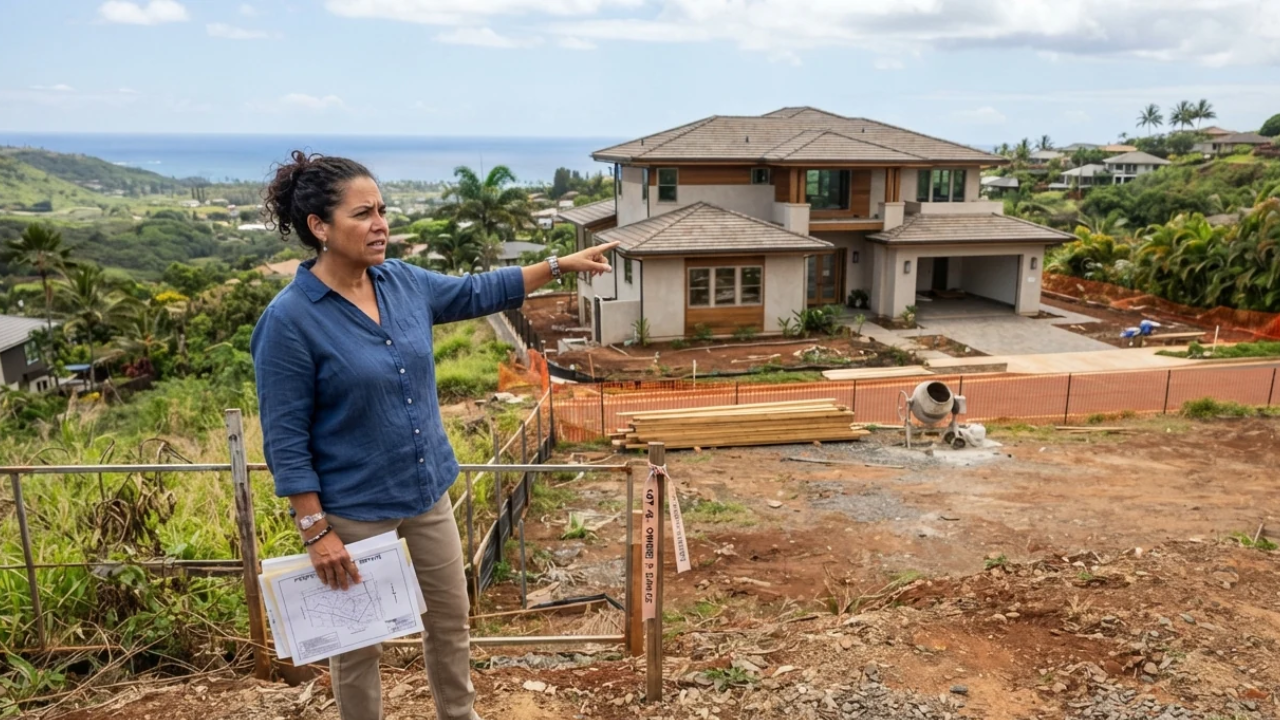
Everyone loves a David-versus-Goliath real estate fairy tale, which is why the internet lost its mind over the woman who bought a $22,500 plot in Hawaii only to find a $500,000 luxury home built on it without her permission. The armchair lawyers on social media immediately declared her a half-million-dollar winner. They cheered. They drafted imaginary eviction notices. They assumed property law works like a game of Monopoly where landing on the wrong square forces the developer to hand over the deed.
They are completely wrong. Building on this idea, you can also read: The Quiet Fight to Keep North America From Breaking Apart.
That viral narrative misses the brutal reality of real property law, equity doctrines, and modern title litigation. If you think finding an accidental mansion on your vacant dirt is a lottery ticket, you are walking straight into a financial woodchipper. I have watched landowners burn through six figures in legal retainers chasing windfalls from boundary encroachments and mistaken improvements, only to end up with a forced sale at raw land value or a massive lien slapped onto their own title.
The Myth of the Automatic Windfall
The lazy consensus in every viral write-up of this Hawaiian Puna district debacle—and the dozens of similar cases from Texas to Florida—relies on an ancient common law rule called accession. Under strict, old-school English common law, anything permanently affixed to the land becomes part of the land. Build a shed on your neighbor's lot, and it belongs to your neighbor. Build a three-bedroom custom home in Hawaiian Paradise Park because a surveyor misread a stake, and the lot owner supposedly gets a free house. Analysts at CNBC have shared their thoughts on this matter.
That rule died a quiet death in most American jurisdictions decades ago.
Modern courts hate unjust enrichment almost as much as they hate trespass. When a developer, contractor, or innocent third-party buyer sinks $500,000 into vertical construction on the wrong parcel, judges do not simply hand the keys to a landowner who paid $22,500 for overgrown lava rock and never visited the site. Instead, courts invoke equitable remedies—specifically the doctrine of mistaken improvers or betterment statutes.
Here is what actually happens when these cases hit a courtroom instead of a TikTok comment section:
- Forced Buyouts at Unimproved Value: The court orders the landowner to sell the dirt to the builder at its fair market value before the house was built. The landowner gets their $22,500 (maybe $30,000 with appreciation), minus whatever they just paid their litigation attorney.
- Equitable Liens for the Value Added: If the landowner insists on keeping the property, the court slaps a judicial lien on the house in favor of the builder for the value the structure added to the land. Try paying off a $475,000 lien when you only budgeted for a $22,500 vacant lot.
- Mandatory Structure Removal: In rare cases where the builder acted in bad faith, the court orders the developer to demolish or physically move the house and restore the dirt. You do not get a mansion; you get a dusty lot and two years of court dates.
The landowner in the Hawaii case—Annaleine Reynolds, who bought the one-acre parcel at a county tax auction in 2018—did not walk away with a free vacation home. She walked into a multi-party lawsuit involving the developer (Keaau Development Partnership), the construction firm (PJ's Construction), the real estate brokers, and the neighbors. By the time the legal dust settles in Hilo circuit court, the only people guaranteed a payout are the litigators billing $450 an hour.
Why Rural Subdivisions Are Breeding Grounds for Title Disasters
To understand how a crew pours a concrete slab and frames a $500,000 house on the wrong lot, you have to look at the mechanics of speculative land subdivisions. Places like Hawaiian Paradise Park on the Big Island were carved up in the 1950s and 1960s into thousands of narrow, rectangular one-acre lots. There are no street signs on half the intersecting roads. There are no utility poles marking lot lines. Thick ohia forest and volcanic brush swallow wooden survey stakes within six months.
Contractors routinely cut corners to save $2,500 on a licensed boundary survey. They count telephone poles from the corner, pace off the frontage, and start clearing brush.
Imagine a scenario where a developer owns twelve non-contiguous lots scattered across a four-block grid in an unzoned rural subdivision. The excavator operator miscounts the utility poles by one span. The framing crew follows the cleared pad. The county building inspector checks the setback from the front road—which is identical on every lot—and signs off on the framing and electrical. Nobody checks the tax map key against GPS coordinates until the house hits the Multiple Listing Service and a title company runs a pre-closing survey.
By then, the drywall is painted, the quartz countertops are installed, and an out-of-state absentee owner suddenly discovers their $22,500 tax-deed investment has a circular driveway.
The Tax Auction Trap Nobody Mentions
Notice how the Hawaii parcel was acquired: a county tax auction. Absentee buyers love snapping up cheap parcels at tax sales because the entry price looks like a rounding error. What they ignore is that absentee ownership is the single biggest catalyst for boundary disputes, adverse possession claims, and mistaken construction.
When you buy raw land sight unseen and leave it unmonitored for five years, you create an information vacuum. You have no boots on the ground. You have no perimeter markers. You are relying entirely on county GIS maps that carry explicit legal disclaimers warning you that parcel overlays can be off by thirty to fifty feet.
What Happens When You Find an Unauthorized Building on Your Land
If you ever pull up to your vacant property—or open a certified letter from a panicked title insurance underwriter—and discover someone built a structure on your dirt, your instincts will betray you. Every move that feels satisfying in the moment will destroy your leverage in court.
1. Do not step inside or change the locks.
The moment you enter the structure, change the deadbolts, or move personal property inside, you expose yourself to liability for conversion and constructive eviction—even if you hold the fee-simple deed to the dirt underneath it. In the Hawaii dispute, squatters moved into the unoccupied home while the lawsuit dragged on, creating a secondary nightmare of premises liability and property damage claims between the landowner and the builder. If someone trips on the front steps while you claim ownership of the house, your personal assets are on the line.
2. Do not demand the full market value of the house.
Demanding $500,000 for a house you did not pay to build signals to a judge that you are operating in bad faith to extract an inequitable windfall. Judges in equity courts have broad discretion. If you look like an opportunist trying to extort a contractor for an honest surveying error, the bench will bend over backward to craft a remedy that strips away your leverage.
3. Weaponize the title insurer, not your own bank account.
If the developer already sold—or is under contract to sell—the house to an innocent buyer, there is a title insurance company sitting behind that transaction. Title underwriters exist to make problems disappear quietly with cash. Your target is not the broke subcontractor who misread the lot stakes; your target is the underwriter holding a $500,000 policy commitment.
The Real Questions Landowners Should Be Asking
When stories like this trend, people flood search engines asking how to claim a house built on their land by mistake. That is the wrong question. The right question is how to force a rapid, cash-positive settlement before litigation eats the equity of the underlying dirt.
Can you force the builder to tear the house down?
Technically, yes, if you can prove willful trespass or gross negligence. If the builder knew they were on the wrong lot—or ignored a cease-and-desist letter while continuing to pour concrete—courts will treat them as a bad-faith improver. Bad-faith improvers lose all equitable protections. You can force them to demolish the structure at their own expense and pay damages for restoring the soil.
The catch? Proving willful intent requires emails, text messages, or testimony showing the contractor knew the boundary lines and built anyway. Simple incompetence—misreading a plat map or relying on a crooked wooden stake—is classified as a good-faith mistake, which shields the builder from total forfeiture.
Who pays the property taxes while the lawsuit drags on?
You do. County tax assessors do not pause billing cycles because two parties are fighting in civil court. Once the county assessor's satellite imagery or building permit records flag a new 2,000-square-foot residence on your Tax Map Key, your property tax bill spikes immediately from vacant-land rates to residential-improved rates. If you refuse to pay the inflated tax bill on a house you didn't build, the county will slap a tax lien on your parcel and foreclose on you while your lawyers are still arguing motions for summary judgment.
Does adverse possession apply to a mistaken house?
Not immediately, because adverse possession requires continuous, open, and hostile occupation for a statutory period—seven years in Florida, ten in Texas, twenty in Hawaii. However, a mistaken structure starts the clock ticking. If an absentee owner ignores their land for a decade while a neighbor's garage, septic field, or guest house sits across the line, the owner wakes up one morning to discover the encroacher now owns the dirt outright under state law.
How to Bulletproof Vacant Land Against Encroachment
If you hold raw acreage or infill lots, stop treating the deed in your filing cabinet like a force field. Deeds are pieces of paper; bulldozers do not read them.
- Commission a Staked Boundary Survey Upon Closing: Never waive the survey to save $1,500 at closing. Require the surveyor to set capped iron rebar at every corner and tie brightly colored surveyor's tape to trees or T-posts along the sightlines.
- Post High-Visibility Boundary Markers: Install metal T-posts every 100 feet along road frontage with stamped aluminum tags listing the Parcel ID (APN/TMK) and a contact phone number. When an excavator operator sees a metal post with an APN stamped into it, they stop and call the office before dropping the blade.
- Set Up Automated County Permit Alerts: Most county building departments allow property owners to register for email alerts whenever a permit application, variance request, or deed transfer is filed against their parcel number.
- Hire a Local Drone Operator Twice a Year: If you own land out of state, pay a local Part 107 drone pilot $150 every six months to fly the perimeter and send you dated, geotagged photos. Catching a land-clearing crew on day one costs you a phone call. Catching them after the roof trusses go up costs you three years in civil court.
The downside to this defensive posture is obvious: it adds friction and carrying costs to an asset class people buy precisely because it is supposed to be passive. Paying for surveys, metal posts, and semiannual inspections cuts into the yield of cheap speculative dirt. You will feel foolish spending $2,000 to monitor a $20,000 lot in the middle of nowhere.
Do it anyway, because the alternative is spending $80,000 in legal fees to argue with a judge over why you shouldn't have to pay for a house you never wanted. Stop cheering for viral real estate accidents, get a licensed surveyor on your dirt, and mark your corners before someone else pours concrete over them.