Geology is not a charity. The popular narrative—that volcanic eruptions are a "hidden air conditioner" saving us from our own carbon footprint—is a comforting fairy tale for people who want to believe the planet has a self-correcting immune system. It doesn’t.
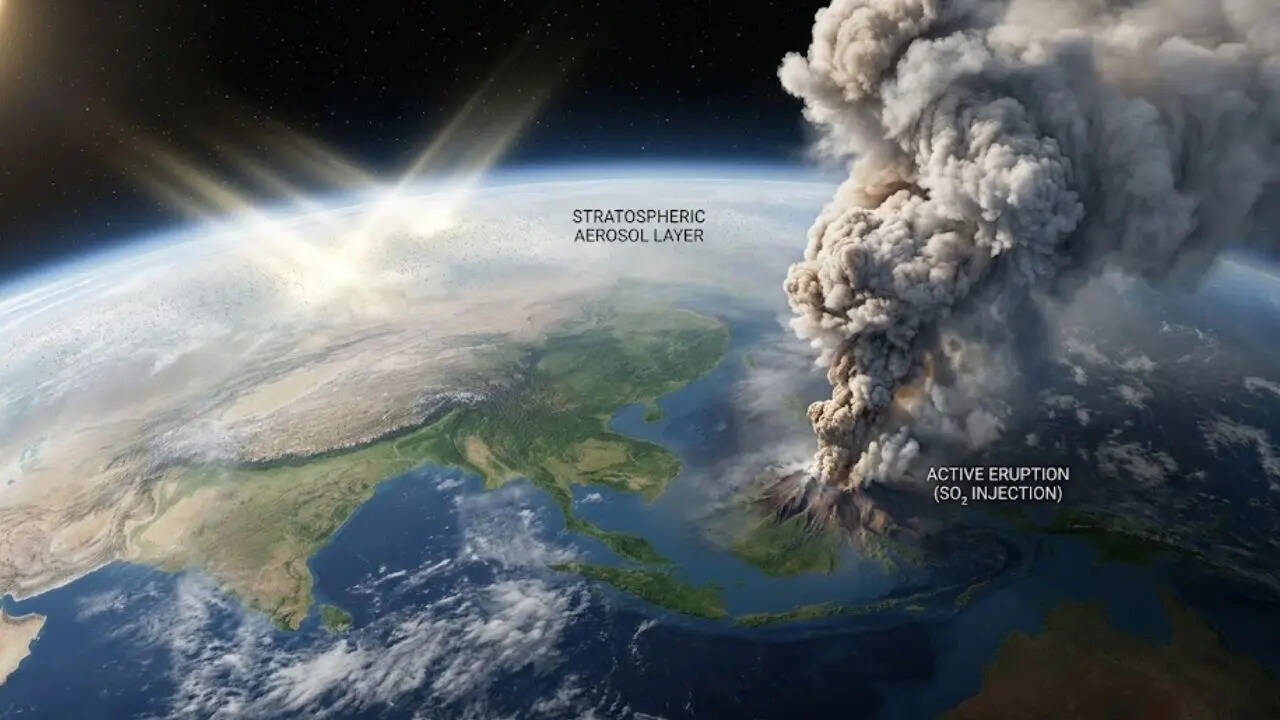
The idea is simple enough to fit on a cocktail napkin: a big volcano blows, it shoots sulfur dioxide into the stratosphere, that sulfur turns into aerosol droplets, and those droplets reflect sunlight back into space. Global temperatures drop. Problem solved, right?
Wrong.
This isn't a cooling system. It’s a violent, unpredictable metabolic shock. Treating a volcanic eruption as a climate "hack" is like trying to fix a fever by jumping into a frozen lake. You might stop the sweating, but the cardiac arrest will kill you just as fast.
The Pinatubo trap
Most climate optimists point to the 1991 eruption of Mount Pinatubo. It pumped roughly 20 million tons of $SO_{2}$ into the atmosphere and dropped global temperatures by about $0.5°C$ for nearly two years.
The data is real. The interpretation is a disaster.
The "cooling" provided by Pinatubo was a transient blip, not a structural shift. While the surface temperature dipped, the heat didn't vanish; it was merely masked. More importantly, the cooling was uneven. While the global average dropped, certain regions experienced record-breaking winters, while others saw massive disruptions in precipitation.
If you think a $0.5°C$ drop is a win, ask the farmers in the Sahel or South Asia who watched their monsoons fail. Volcanic aerosols don't just block heat; they wreck the hydrological cycle. When you cool the atmosphere, you reduce evaporation. When you reduce evaporation, you kill the rain.
You aren't "fixing" the temperature. You are trading a heatwave for a famine.
The aerosol fallacy
We need to stop pretending that $SO_{2}$ is the hero of this story. Sulfur aerosols are short-lived. They fall out of the sky within one to three years. Carbon dioxide, the primary driver of our current warming, stays in the atmosphere for centuries.
$CO_{2}$ is the structural foundation of the house. $SO_{2}$ is a cheap coat of white paint on the windows.
The physics of this "AC unit" are incredibly messy. To maintain the cooling effect of a single Pinatubo-scale event, you would need a massive eruption every few years. In the real world, that doesn't happen. Instead, you get a sharp, jagged spike of cooling followed by an even sharper "rebound" warming as the aerosols dissipate and the underlying greenhouse effect takes back control.
This "termination shock" is the part the "Earth's AC" crowd ignores. When the aerosols clear, the temperature doesn't just go back to normal. It surges. It’s a whiplash effect that biological systems—including our crops—are not evolved to handle.
The carbon hypocrisy of the "Green" volcano
There is a persistent myth that volcanoes emit more $CO_{2}$ than humans. It’s a favorite talking point for people who want to shift the blame away from industrial activity.
Let’s look at the actual math.
According to the United States Geological Survey (USGS), subaerial and submarine volcanoes combined produce about 0.13 to 0.44 gigatons of $CO_{2}$ per year. Human activities, primarily fossil fuel burning, emit roughly 35 gigatons per year.
- Volcanoes: ~0.3 GT/year
- Humans: ~35.0 GT/year
We are out-gassing the planet’s entire volcanic network by a factor of at least 100. To claim that volcanoes are the "real" drivers of climate change—either as heaters or coolers—is a mathematical hallucination.
When a volcano erupts, it is a rounding error in the global carbon budget. The cooling effect is real but temporary; the heating effect is negligible compared to the 100 million barrels of oil we burn every single day.
The ozone cost nobody talks about
If volcanoes are an air conditioner, they are one that leaks toxic coolant into your bedroom.
Stratospheric aerosols provide a surface for chemical reactions that destroy the ozone layer. After Pinatubo, we saw significant ozone depletion at mid-latitudes. The aerosols accelerate the ability of man-made chlorofluorocarbons (CFCs) to strip away the $O_{3}$ molecules that protect us from ultraviolet radiation.
You might be cooler for eighteen months, but you’re also being hammered by UV rays that increase skin cancer rates and damage phytoplankton—the very base of the oceanic food chain.
Is that a "hidden AC," or is it a systemic failure?
Geoengineering is a desperate gamble
The reason the "volcanic cooling" narrative is being pushed so hard right now isn't because we love geology. It’s because it provides the scientific justification for Solar Radiation Management (SRM).
SRM is the idea that we can mimic a volcano by flying a fleet of planes into the stratosphere and intentionally spraying sulfur. It’s "Pinatubo on demand."
I’ve seen how these models work. They are built on the assumption that we can control a chaotic system with a single lever. We can't. If we start injecting sulfur to cool the planet, we are committing ourselves to a permanent, high-stakes maintenance program. If we ever stop—due to war, economic collapse, or a change in political will—the resulting "termination shock" would see global temperatures rise by decades' worth of warming in just a few years.
It would be the end of modern agriculture.
The wrong question
People ask: "Can volcanoes save us from global warming?"
It’s the wrong question. It assumes the planet is a machine with a thermostat we can just tweak. The right question is: "How do we stop changing the atmospheric chemistry that we depend on for survival?"
Volcanoes aren't a secret weapon. They are a reminder of how fragile our climate balance actually is. A single large eruption can disrupt global food supplies for years. Expecting that same mechanism to "save" us is the height of human arrogance.
The cooling from a volcano isn't a gift. It’s a warning. It shows us that the atmosphere is incredibly sensitive to particulate matter and that minor shifts in composition have massive, lethal consequences for life on the ground.
Stop looking at the mountains for a miracle. The "AC" is broken, it's leaking, and it's about to catch fire. No amount of volcanic ash is going to change the fact that we are the ones holding the matches.
The planet doesn't have a backup plan. Neither do we.