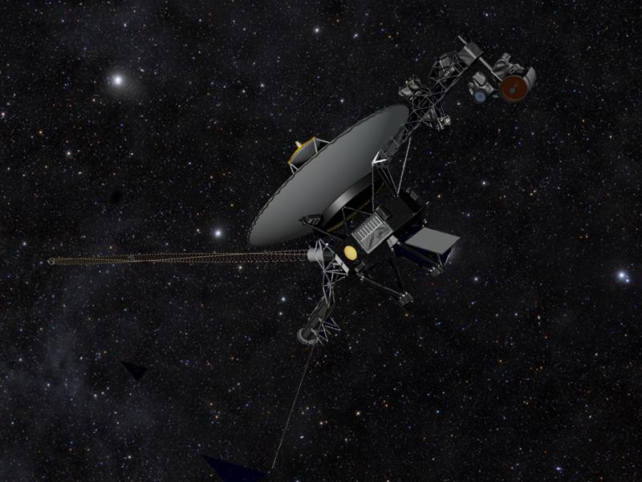
In November 2026, NASA’s Voyager 1 spacecraft crosses a boundary no human-made object has ever touched. Roughly 25.9 billion kilometers—or 16.1 billion miles—away from Earth, a radio signal traveling at the universal speed limit takes a full 24 hours to bridge the gap between the probe and the dishes listening for it in California, Spain, and Australia.
One light-day.
On paper, the milestone reads like a clean triumph of 1970s aerospace engineering. In reality, it is a grueling, high-wire survival act played out on a 48-hour communications delay, aboard a decaying machine running on dwindling plutonium and a fraction of the memory found inside a modern car key fob. While headlines celebrate the raw distance, engineers at the Jet Propulsion Laboratory are fighting a quiet, relentless battle against freezing propellant lines, failing attitude thrusters, and a power budget that shrinks by roughly four watts every single year.
To understand what crossing the light-day threshold actually means, you have to strip away the romanticism of interstellar exploration and look at the cold physics of deep-space operations.
The Brutal Math of a 48-Hour Conversation
Light moves fast. At roughly 299,792 kilometers per second, a photon covers the distance from Earth to the Moon in just over a second and reaches the Sun in about eight minutes. When Voyager 1 launched from Cape Canaveral on September 5, 1977, engineers could talk to it in near real-time.
Today, every command sent from NASA’s Deep Space Network is a message in a bottle thrown across an abyss.
If an engineer at JPL transmits a line of code at 9:00 AM on a Tuesday, that signal does not reach Voyager 1 until 9:00 AM on Wednesday. If the spacecraft executes the instruction and immediately beams back telemetry confirming the change, that confirmation does not hit Earth until 9:00 AM on Thursday.
Two full days just to ask a question and hear the answer.
This lag completely changes how spaceflight works. There is no joystick. There is no real-time troubleshooting. When an anomaly strikes, the spacecraft has to survive on its own primitive fault-protection routines while humans wait two days just to diagnose what went wrong.
That reality hit home between November 2023 and June 2024, when Voyager 1 suffered a catastrophic telemetry glitch. Instead of sending back legible science and engineering data, the probe’s Flight Data Subsystem began transmitting a repeating, nonsensical pattern of ones and zeros. Because of the light-time delay—which was already hovering around 22.5 hours each way at the time—diagnosing the fault took months of painstaking detective work.
Engineers eventually traced the failure to a single corrupted chip responsible for storing part of the subsystem’s memory. They could not repair the hardware. Instead, they had to slice up the affected code, relocate it to different sections of the remaining memory, and rewrite the system to work around the dead silicon. Every single test required waiting nearly two full days to see if the patient survived. Crossing the one light-day mark pushes that operational buffer into unprecedented territory, making every future software patch an exercise in extreme patience.
Inside the Machine That Refuses to Quit
Modern spacecraft are packed with redundant processors, solid-state drives, and automated self-healing architectures. Voyager 1 has none of that.
The probe’s onboard computers operate with roughly 69.63 kilobytes of memory across all three dual-redundant computer systems combined. To put that into perspective, a single high-resolution smartphone photograph contains more data than Voyager 1’s entire digital brain. Its instructions were originally written in assembly language, and the team keeping it alive today relies on digitized copies of decades-old paper manuals, schematics, and institutional memory passed down from retired engineers.
| Subsystem | Original Design Specification | Current Operational Reality |
|---|---|---|
| Power Source | Three Radioisotope Thermoelectric Generators (RTGs) producing ~470 watts at launch | Output has dropped by more than half due to plutonium-238 decay and thermocouple degradation |
| Propulsion | Hydrazine thrusters for trajectory correction and attitude control | Primary thrusters degraded; spacecraft now relies on backup sets with clogged fuel lines |
| Memory | ~69.63 KB total across three computer systems | Operating with patched workarounds after permanent hardware chip failure |
| Communications | 23-watt S-band and X-band transmitters | Signal arrives at Earth at a fraction of an attowatt, requiring 70-meter dishes to detect |
The spacecraft’s survival hinges on its Radioisotope Thermoelectric Generators, or RTGs. Because sunlight at 16 billion miles is far too weak to power solar panels, Voyager 1 carries three cylindrical canisters packed with plutonium-238. As the radioactive isotope naturally decays, it generates heat, which thermocouples convert into electricity.
That physics comes with an expiration date. Plutonium-238 has a half-life of 87.7 years, and the thermocouples themselves degrade over time. Since 1977, Voyager 1 has lost roughly half of its electrical power.
To keep the main transmitter and remaining science instruments online, mission managers have systematically turned off everything deemed non-essential. They shut down the cameras in 1990 right after taking the famous "Pale Blue Dot" portrait of Earth. Since then, they have switched off instrument heaters, tape recorders, and individual sensors one by one.
Turning off heaters in interstellar space carries massive risk. Out beyond the heliopause, ambient temperatures plunge toward absolute zero. Without internal warmth, electronics risk cracking, and the liquid hydrazine fuel used to keep Voyager 1’s high-gain antenna pointed directly at Earth risks freezing solid in its lines.
The Thruster Crisis Nobody Saw Coming
Pointing accuracy is everything. Voyager 1’s 3.7-meter dish antenna must stay locked onto Earth with fraction-of-a-degree precision. If the spacecraft drifts off target by even a tiny margin, its 23-watt signal misses Earth completely, and the mission ends instantly.
To maintain that lock, Voyager 1 fires tiny puffs of hydrazine gas from attitude-control thrusters. Over nearly five decades, tiny amounts of silicon dioxide—a byproduct dissolved in the fuel—have accumulated inside the microscopic propellant tubes, slowly choking them off.
By 2017, the primary attitude thrusters had degraded so severely that engineers made a radical decision. They fired up a set of trajectory-correction thrusters that had not been used since Voyager 1 flew past Saturn in November 1980. After sitting dormant in deep freeze for 37 years, those thrusters worked.
Then those tubes began clogging too.
In late 2024, engineers had to switch back to the original primary thruster branch—a maneuver that required warming up freezing propellant lines without draining the meager battery reserves needed to keep the computer running. Every thruster swap burns precious engineering hours and introduces mechanical stress to valves that were designed to last four years, not fifty.
Why Interstellar Space Is Not Empty
A common misconception is that once Voyager 1 crossed the heliopause in August 2012—leaving behind the protective bubble of solar wind inflated by our Sun—it entered an empty void.
It did not.
Voyager 1 is currently plowing through the interstellar medium, a turbulent sea of plasma, cosmic rays, magnetic fields, and gas blown off by ancient supernovae. For the first time in history, humanity has a working weather station taking direct, in-situ measurements outside the solar system’s magnetic shield.
Four primary science instruments remain active aboard Voyager 1, feeding irreplaceable data back across the light-day divide:
- Cosmic Ray Subsystem: Measures high-energy particles originating from outside our solar system, revealing how effectively the Sun’s magnetic bubble blocks galactic radiation.
- Low-Energy Charged Particle Instrument: Tracks ions and electrons moving through the boundary regions between solar and interstellar plasma.
- Magnetometer: Maps the strength and orientation of the interstellar magnetic field, showing how it drapes around our solar system like water flowing around a boulder.
- Plasma Wave Subsystem: Detects oscillations in the surrounding electron gas, allowing scientists to calculate the density of interstellar space.
The discoveries from these aging sensors have repeatedly overturned astrophysical models. Scientists expected the magnetic field direction to shift dramatically once Voyager 1 crossed the heliopause. Instead, the interstellar magnetic field aligned remarkably closely with the solar magnetic field inside the bubble. The probe also detected a persistent, faint "hum" of plasma waves vibrating through interstellar gas even when no solar shockwaves were present, proving that the space between stars is far more dynamic than textbooks suggested.
No other spacecraft can replicate this work anytime soon. Voyager 2 trails behind at a slower pace and along a different trajectory. NASA’s New Horizons probe, which flew past Pluto in 2015, is moving slower than Voyager 1 and will not reach the interstellar boundary for decades. Even if a space agency launched a brand-new interstellar probe tomorrow with the most powerful rocket available, it would take roughly 30 to 40 years just to catch up to where Voyager 1 is right now.
The Economics of Hearing a Whisper
Catching Voyager 1’s signal on Earth requires pushing radio astronomy to its absolute physical limits.
By the time the spacecraft’s 23-watt transmission crosses 25.9 billion kilometers of space, the radio wave has spread out so thin that the power hitting a receiving dish on Earth is measured in attowatts—billionths of a billionth of a watt. That is roughly 20 billion times less power than it takes to run a standard digital wristwatch.
To pull that whisper out of the background static of the universe, NASA has to point its largest 70-meter dishes at the exact patch of sky where Voyager 1 sits, often arraying multiple 34-meter antennas together to boost sensitivity. Even then, the data trickles down at a glacial 160 bits per second. Downloading a single megabyte of data at that speed takes over 14 hours.
This creates an intense resource bottleneck. The Deep Space Network is heavily oversubscribed, juggling dozens of active missions from Mars rovers and the James Webb Space Telescope to asteroid interceptors and lunar landers. Every hour a 70-meter dish spends listening to Voyager 1 is an hour it cannot spend downloading high-definition imagery or telemetry from a multi-billion-dollar flagship mission closer to home.
Yet NASA continues to allocate the dish time because Voyager 1’s data cannot be bought at any price. You cannot simulate interstellar plasma physics with complete certainty; you have to measure it.
The Inevitable Silence
Crossing the one light-day milestone is not a finish line. It is a marker on a countdown clock that cannot be reset.
Within the next few years—likely around 2030—power generation on Voyager 1 will drop below the minimum threshold required to run even a single science instrument alongside the main transmitter. At that point, mission managers will shut down the remaining sensors, turning the probe into an engineering-only beacon sending back basic heartbeat telemetry.
Soon after, the plutonium will cool to the point where the computer can no longer maintain attitude lock, or the transmitter will lose the voltage required to beam a coherent signal across the void. One day, a 70-meter dish in Goldstone or Madrid will turn toward the constellation Ophiuchus, listen for the familiar carrier wave, and hear nothing but cosmic background noise.
Voyager 1 will not stop. Moving at roughly 17 kilometers per second—over 38,000 miles per hour—relative to the Sun, it will continue coasting outward into the Milky Way indefinitely. In about 40,000 years, long after its electronics have frozen solid and its golden record sits untouched in the dark, it will pass within 1.6 light-years of a star named Gliese 445. Until then, every faint bit of data that survives the 24-hour journey back to Earth remains humanity’s only direct window into the ocean between the stars.


