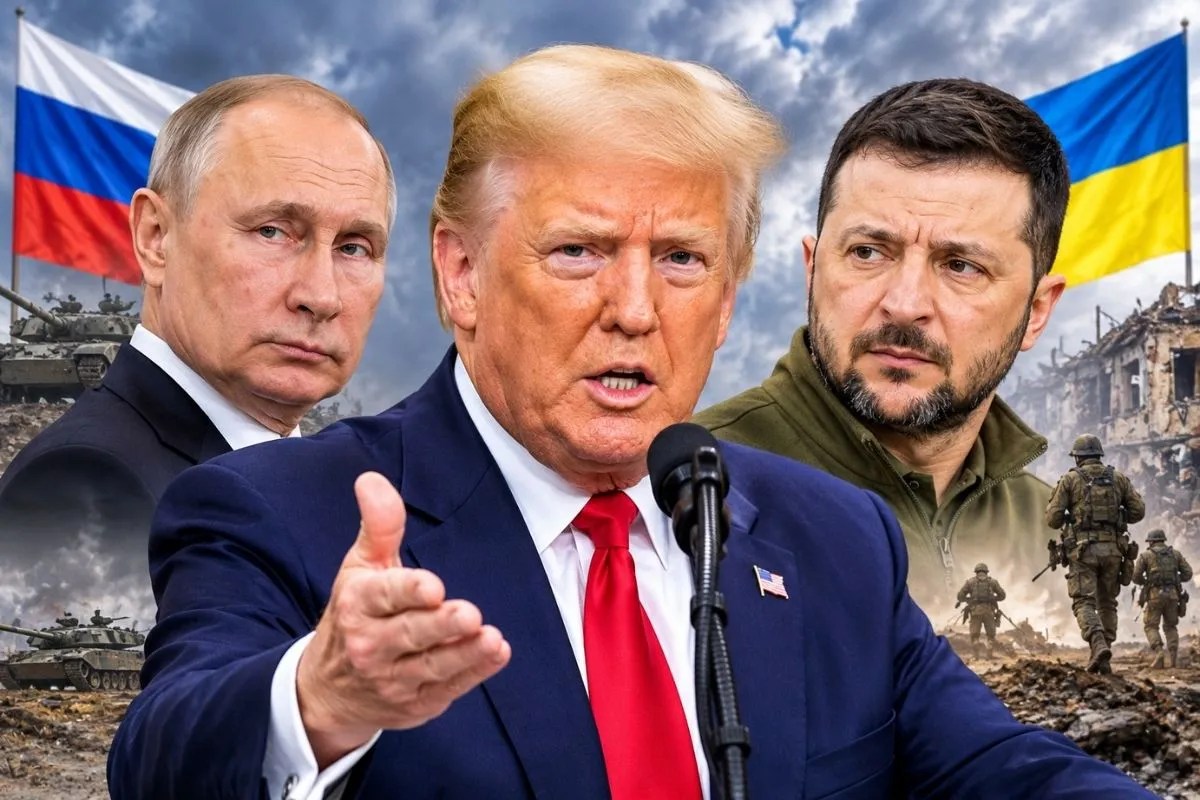
Counterfactual claims that a different American president would have prevented the Russia-Ukraine war confuse deterrent signaling with structural security dilemmas, while framing the conflict primarily around personal hostility between Volodymyr Zelenskyy and Vladimir Putin ignores deeper territorial, alliance, and sovereignty imperatives. A rigorous analysis requires separating public assertions from verifiable mechanics: what a leader claims versus how deterrence actually operates, how bilateral animosity interacts with institutional interests, and why negotiations stall even when leaders profess a desire for peace.
Standard news coverage of statements like "if I were president, the war would never have started" treats the remark as a self-contained political soundbite. It rarely tests the underlying causal chain. When a political leader asserts that the war would not have occurred under their presidency, they are making a counterfactual claim about deterrence—the belief that an adversary's cost-benefit calculation would have shifted decisively enough to keep troop movements on paper rather than crossing borders. Treating personal animosity between Zelenskyy and Putin as the primary engine of prolonged warfare makes a parallel error: it reduces a multi-year interstate conflict to interpersonal psychology while sidelining competing political survival constraints. Read more on a related topic: this related article.
The Deterrence Counterfactual and Its Missing Variables
In international relations theory, deterrence depends on two factors that must hold simultaneously: capability and credibility. Capability refers to the material power a state or coalition can bring to bear; credibility refers to whether an adversary believes that power will actually be used at a price worth paying.
A counterfactual claim about war prevention rests on an educated hypothesis: that an adversary perceived a specific combination of resolve, unpredictability, or transactional leverage that raised expected costs above expected gains. Yet counterfactuals cannot be observed directly. Once a war begins, analysts cannot run a controlled experiment holding all other variables constant. Additional analysis by Associated Press explores similar views on the subject.
Several structural variables sit outside any single president's personal posture:
- Pre-existing territorial disputes: Fighting in eastern Ukraine and the seizure of Crimea predated the 2022 full-scale escalation, creating entrenched grievances, military positions, and domestic political stakes on both sides.
- Alliance alignment and security guarantees: Questions surrounding Ukraine's long-term security ties with Western institutions touch on core regime narratives in Moscow and survival imperatives in Kyiv.
- Domestic political incentives: Leaders on all sides weigh how concessions or escalations affect their standing at home, where appearing weak carries severe political penalties.
- Information and miscalculation: States frequently misjudge an opponent's resolve, military readiness, or willingness to absorb economic and human costs before fighting starts.
The first limitation of any "would never have happened" claim is evidential. Even if an adversary later tells a counterpart—or a counterpart reports that an adversary said—that they would have refrained under different leadership, postwar or mid-war statements carry strategic incentives. Flattering a negotiating partner or shifting blame onto a predecessor costs nothing once events have unfolded.
Consider a simplified bargaining model between two states over disputed territory. Each side estimates the cost of fighting versus the value of holding out for a favorable settlement. If one side believes the balance of power favors swift gains—or fears that waiting will permanently weaken its position—deterrence fails unless the perceived penalty exceeds the perceived gain. Personal rapport between two capitals may alter tone or timing, yet it does not automatically erase conflicting core objectives.
Deconstructing the Personal Animosity Thesis
Public commentary frequently highlights personal hostility between Zelenskyy and Putin as a central obstacle to ending the war. In strategic terms, interpersonal animosity acts as a friction multiplier rather than a root cause.
When leaders harbor deep distrust or personal resentment, two operational problems emerge in crisis bargaining:
- Higher verification costs: When trust is near zero, every concession looks like a trap or a sign of desperation. Both sides demand stricter enforcement mechanisms, slowing or halting agreements even when mutual exhaustion rises.
- Audience costs and signaling: Leaders who have staked their legitimacy on resisting an adversary face steep domestic backlash if they appear to yield to someone they have publicly cast as an existential threat.
The second limitation of focusing on personal hostility is analytical misattribution. Even if two leaders disliked each other intensely, a settlement could still become attractive if objective military or economic conditions shifted sharply enough. Conversely, even if two leaders maintained cordial or transactional rapport, a durable deal would still fail if neither could accept the underlying terms on sovereignty, borders, or security guarantees.
High-level diplomacy often stalls on concrete questions that have nothing to do with personal feelings: Who controls specific territory? What security assurances prevent a future attack? How are sanctions, reconstruction costs, or cease-fire violations monitored? Treating personal animosity as the main barrier can tempt observers into assuming that a change of personalities—or a shift in mediation style—automatically unlocks a settlement.
The Cost Function of Stalled Negotiations
Why does a war persist when political leaders publicly say they want it to end? Bargaining theory points to a gap between the theoretical "bargaining range"—the set of deals both sides prefer over continued fighting—and the practical path to reaching one.
In principle, war is costly for everyone involved: lives are lost, infrastructure is destroyed, economies strain, and military stocks deplete. Because war destroys value, a negotiated settlement should theoretically exist that leaves both sides better off than continuing to fight. In practice, three mechanisms keep that settlement out of reach:
- Commitment problems: A deal struck today is only as durable as each side's confidence that the other will honor it tomorrow once forces pull back or sanctions ease. If either side fears future betrayal, holding territory or continuing military pressure can seem safer than signing an agreement.
- Asymmetric stakes: A state fighting over what it views as core sovereignty or national survival places a very different value on concessions than an external mediator or a distant power whose direct exposure is lower.
- Process exclusion: When negotiations bypass or sideline a party directly affected by the outcome, friction rises rather than falls. A deal that lacks buy-in from the combatants on the ground struggles to hold over time.
This creates a bottleneck in mediation. External pressure can accelerate talks or force hard choices onto the table, yet external leverage has boundaries. If a proposed agreement is seen by one side as a prelude to future vulnerability, resistance stiffens regardless of how quickly mediators want a deal signed.
Evaluating Claims Against Observable Evidence
Readers evaluating bold political statements about war origins and peace prospects need a practical filter. Rather than taking assertions at face value or dismissing them out of hand, analysts separate claims into three buckets:
- Verifiable facts: Documented statements made by officials, dates of diplomatic exchanges, public disagreements over negotiation formats or leadership, and visible military or economic actions.
- Educated hypotheses: Arguments about how a specific deterrent posture, economic measure, or diplomatic sequence might have influenced an adversary's calculations.
- Unfalsifiable assertions: Claims that an entire conflict definitely would or would not have occurred under hypothetical conditions that never materialized.
Applying this filter prevents two common mistakes. The first is treating a politician's prediction or retrospective claim as settled history. The second is ignoring real shifts in diplomatic leverage, burden-sharing debates, or negotiation dynamics simply because the rhetoric around them is abrasive or contested.
Strategic Action for Decision-Makers and Analysts
Anyone tracking diplomacy or assessing geopolitical risk should stop treating public claims about war prevention as proof of a guaranteed peace formula; instead, track verifiable shifts in commitment guarantees, territorial bargaining positions, and direct party inclusion in talks to judge whether a durable settlement is actually becoming plausible.