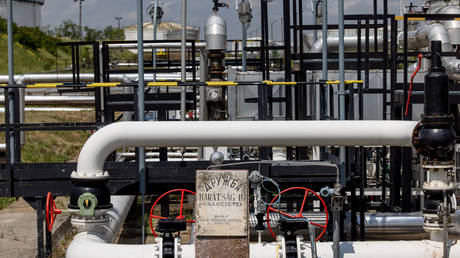
Washington’s decision to allow Hungary to continue purchasing Russian oil and natural gas is not a diplomatic surrender to Budapest, nor is it an accidental loophole in Western sanctions architecture. It is a calculated geopolitical trade-off designed to keep Central Europe’s refining infrastructure from collapsing while preserving NATO’s fragile eastern flank. While Brussels and Washington have spent years pressuring European Union member states to sever ties with Moscow’s energy sector, landlocked nations like Hungary operate under physical and financial constraints that cannot be solved by political declarations alone. By granting exemptions and avoiding punitive secondary sanctions on Hungarian energy flows, the United States is prioritizing regional stability and alliance cohesion over total economic isolation of the Kremlin.
The mechanics of this exemption are rooted in cold geography. Unlike Western European nations with deep-water ports capable of receiving liquefied natural gas carriers and seaborne crude tankers, Hungary has no coastline. For decades, its entire energy grid was engineered around Soviet-era pipelines running east to west. For an alternative look, consider: this related article.
The Plumbing of Central European Power
To understand why the White House blinked, you have to look at the pipes. The Druzhba pipeline—literally translated as "Friendship"—remains the primary artery feeding crude oil into Hungary’s Danube Refinery in Százhalombatta, operated by the Hungarian oil and gas giant MOL Group.
Refineries are not plug-and-play machines. They are precision chemical plants calibrated to process specific grades of crude oil. The Danube Refinery was built specifically to handle Urals blend, a heavy, sour crude exported from Russia. Switching a complex refinery from heavy sour crude to light sweet crude—such as Brent or West Texas Intermediate—requires massive capital expenditure, hundreds of millions of dollars in re-engineering, and months of offline maintenance. Similar coverage on this trend has been published by Reuters.
If Washington were to suddenly enforce strict secondary sanctions on financial transactions tied to Druzhba deliveries, the Danube Refinery would face immediate feedstock starvation. The result would not just be higher gas prices in Budapest. It would trigger severe fuel shortages across Slovakia, parts of Austria, and northern Croatia, all of which rely on refined products exported from Hungary’s processing facilities.
Natural gas presents an even tighter chokehold. Hungary receives the vast majority of its gas via the TurkStream pipeline extension running through Bulgaria and Serbia. While European leaders have championed interconnectors linking Hungary to neighboring grids in Romania, Croatia, and Slovakia, those routes lack the sheer volume capacity and competitive pricing needed to replace Russian flows overnight. Washington’s policymakers know that forcing an abrupt cutoff would bankrupt Hungarian industrial consumers and hand Prime Minister Viktor Orbán domestic political ammunition to blame Western allies for an economic recession.
The Silent Bargain Behind Closed Doors
Diplomacy rarely happens at podiums. In the corridors of the State Department and the Treasury’s Office of Foreign Assets Control, sanctions enforcement is treated as a scalpel rather than a sledgehammer. When the European Union carved out an exemption for pipeline-delivered Russian crude during its sixth sanctions package, Washington backed the move quietly.
The unspoken agreement rests on a simple transactional reality. Hungary gets to keep its discounted Russian energy supplies, ensuring domestic price stability and keeping its state-subsidized utility caps intact. In exchange, Budapest is expected to stop blocking critical collective security measures, defense aid packages, and NATO operational deployments in Eastern Europe.
Critics argue this rewards obstructionism. They point out that Orbán has repeatedly used Hungary’s veto power in Brussels to delay financial assistance to Ukraine and stall accession talks, effectively weaponizing his country's energy dependence for geopolitical leverage. From a hawkish perspective, every euro Budapest sends to Gazprom or Lukoil directly funds Moscow’s war machine.
Yet veteran diplomats see a different calculus at work. Pushing a NATO member into an acute energy crisis risks fracturing the alliance from within. If Hungarian citizens face rolling blackouts or triple-digit inflation at the pump, public sentiment could turn sharply anti-NATO and anti-EU, creating a permanent wedge state right in the heart of Europe. Washington’s tolerance for Hungary’s Russian energy imports is the price paid to keep Budapest inside the Western tent, however grudgingly it behaves once inside.
Follow the Money in Budapest
There is an economic layer to this story that rarely makes front-page news. Buying Russian crude is not just a matter of necessity for Hungary; it is massively profitable.
Because Western sanctions forced Russia to sell its Urals crude at a steep discount compared to global Brent benchmarks, MOL Group has enjoyed windfall refining margins. By purchasing discounted Russian oil and selling refined diesel and gasoline at standard European market prices, the company generated record revenues. The Hungarian government, in turn, taxed those excess profits through special windfall levies to plug gaping holes in its national budget.
Consider a hypothetical scenario to see how this arbitrage works in practice. Suppose Brent crude trades at eighty dollars a barrel while sanctioned Urals crude sells for sixty dollars. A refinery equipped to process Urals pockets a twenty-dollar-per-barrel raw material advantage before a single drop of fuel reaches a retail pump. Multiply that margin across tens of millions of barrels annually, and the financial incentive to delay diversification becomes obvious.
Washington is acutely aware of this dynamic. Treasury officials track the spread between Urals and Brent closely. While they tolerate the physical flow of oil to prevent regional fuel shortages, pressure has steadily mounted on Budapest to show tangible progress toward decoupling. The green light comes with an invisible timer.
The Infrastructure Bottleneck Nobody Wants to Fund
If diversification is the obvious long-term answer, why hasn't Hungary built the pipelines to make it happen? The answer comes down to who pays the bill.
The primary alternative to the Druzhba pipeline is the Adria pipeline (JANAF), which runs from the Croatian port of Omišalj on the Adriatic Sea up into Hungary. On paper, Adria has enough spare capacity to supply both Hungary and Slovakia with seaborne crude from the Middle East, North Africa, or the United States.
In reality, the route is bogged down by bitter commercial disputes and technical friction. MOL Group has repeatedly accused the Croatian pipeline operator of charging exorbitant transit fees—several times higher than European averages—and refusing to sign long-term capacity contracts. Zagreb counters that Hungary is exaggerating technical hurdles to justify sticking with cheap Russian oil.
Meanwhile, upgrading the Danube Refinery to handle non-Russian blends requires roughly five hundred million to seven hundred million dollars in capital investment, alongside a multi-year construction timeline. Budapest has demanded that the European Union foot the bill for this infrastructure overhaul, arguing that Brussels created the crisis by imposing sanctions. Brussels has largely refused to hand over blank checks, citing ongoing rule-of-law disputes and concerns over corruption in Hungarian public procurement.
Caught between Croatian transit fees, refinery retrofitting costs, and frozen EU cohesion funds, Hungary chose the path of least resistance. Washington, recognizing that it cannot force private banks or European institutions to finance a half-billion-dollar pipeline upgrade overnight, opted not to blow up the status quo.
The Nuclear Wildcard
Oil and gas dominate the headlines, but the quietest part of Washington’s permissive stance involves nuclear power. Hungary is currently expanding its Paks Nuclear Power Plant, which generates roughly forty percent of the country’s electricity. The expansion project, known as Paks II, is being built and financed largely by Rosatom, Russia’s state-owned atomic energy corporation.
Despite sweeping sanctions against Russian banks, oligarchs, and defense contractors, the United States and the European Union have consistently avoided placing full blocking sanctions on Rosatom. The reason is uncomfortable but undeniable: the global nuclear supply chain remains heavily dependent on Russian uranium enrichment and fuel fabrication services. Even American utilities rely on Russian-enriched fuel to keep domestic reactors running while Western enrichment capacity slowly ramps back up.
Sanctioning Paks II would cripple Hungary’s long-term electricity security and invite immediate Russian retaliation in global nuclear fuel markets. By leaving Paks II untouched, Washington is protecting its own domestic energy grid just as much as it is accommodating Budapest.
The Geopolitical Cost of Pragmatism
Every policy choice carries a price tag, and Washington’s pragmatic indulgence of Hungary’s energy habits is no exception.
First, it undermines the moral and legal authority of Western sanctions regimes. When smaller nations in the Global South watch a NATO and EU member openly import Russian gas, sign new energy cooperation agreements in Moscow, and expand a Russian-built nuclear plant without facing American penalties, calls for global solidarity ring hollow. Trade ministries in New Delhi, Ankara, and Brasília take note of the double standard.
Second, it entrenches Russian influence inside European institutions. Energy contracts are never purely commercial when signed with Kremlin-controlled entities like Gazprom and Rosatom. They come with decades-long maintenance agreements, technical dependencies, and political backchannels that Moscow routinely exploits to gather intelligence and influence domestic policy.
Third, it delays the inevitable reckoning. The transit contract allowing Russian natural gas to flow through Ukrainian pipelines to Central Europe has faced repeated expiration threats, forcing regional buyers to rely more heavily on TurkStream. Relying on a single transit corridor through the Black Sea and the Balkans leaves Hungary vulnerable to geopolitical shocks, technical disruptions, or future sanctions tightening.
The Slow Squeeze Ahead
Washington’s green light should not be mistaken for a permanent pardon. Behind the scenes, American energy diplomats are executing a patient encirclement strategy designed to make Russian energy obsolete in Central Europe without triggering a sudden market shock.
The United States has aggressively expanded its own liquefied natural gas export capacity, flooding European terminals in Germany, Poland, Greece, and Croatia with American molecules. As new regasification terminals come online in the Balkans and Central Europe, alternative gas supplies are gradually eroding Gazprom’s pricing power.
At the same time, American diplomatic pressure is quietly nudging regional neighbors to resolve transit bottlenecks. By encouraging bilateral energy agreements between Hungary, Romania, and Azerbaijan, Washington is helping stitch together a southern gas corridor that bypasses Russia entirely.
Hungary will continue buying Russian oil and gas for as long as the pipes remain open and the price spread remains lucrative. Washington will continue looking the other way until alternative supply lines reach full operational maturity. Once those replacement routes are bolted down and flowing at capacity, the geopolitical grace period extended to Budapest will expire without warning.