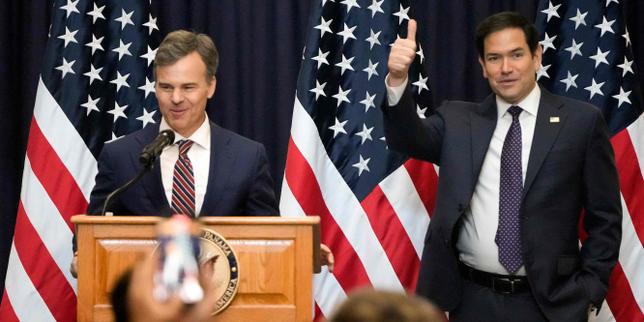
The appointment of a new "Chief of Mission" for the Venezuela Affairs Unit (VAU) is being treated by the legacy press as a strategic chess move. It isn't. It is bureaucratic performance art. While headlines frame this as a shift in diplomatic pressure or a fresh start for the State Department’s approach to Caracas, they miss the fundamental reality: you cannot have a diplomatic mission to a country where you have no physical presence, no functional leverage, and a policy based on a fantasy.
The mainstream narrative suggests that shuffling personnel in Bogotá—where the VAU is actually based—somehow impacts the grip Nicolás Maduro has on Miraflores. It doesn't. After years of "maximum pressure," the appointment of a new diplomat is less about foreign policy and more about maintaining the optics of relevance.
The Fiction of Remote Control Diplomacy
The United States currently practices what I call "Zoom Diplomacy." We appoint high-level officials to manage relationships with a country they cannot enter, to engage with an opposition that is increasingly fractured, and to oversee sanctions that have become a static background noise rather than a dynamic tool for change.
The competitor articles love to focus on the resume of the appointee. They talk about "extensive experience" and "regional expertise." That is a distraction. You could appoint the reincarnation of Talleyrand to the VAU and it wouldn't matter. Why? Because the structural foundation of the U.S.-Venezuela policy is built on the "Guaidó Residue"—the lingering belief that if we just keep pretending the 2019 status quo exists, reality will eventually bend to our will.
It hasn't. It won't.
The Sanctions Paradox No One Admits
The standard view is that sanctions are a dial you turn up to increase pain and force a transition. In reality, in Venezuela, sanctions have reached a point of diminishing returns where they now serve as a protective moat for the regime.
I have watched how these mechanisms play out on the ground for decades. When you cut off a regime from the global financial system, you don't starve the leaders; you formalize the black market. You move the economy from transparent, taxable transactions to shadow networks managed by the very military elites you are trying to flip.
By keeping the "Chief of Mission" in a neighboring country, the U.S. ensures it has zero eyes on the actual flow of capital within Caracas. We are effectively flying blind while claiming to hold the map.
Why the "Democratic Transition" Metric is Dead
Every briefing on this new appointment will mention "supporting a return to democracy." It’s a comfortable phrase. It’s also functionally meaningless.
- The Consensus: The U.S. can broker a deal between the opposition and Maduro.
- The Reality: Maduro has no incentive to negotiate his own exit when he has successfully navigated the worst of the hyperinflation and energy collapse.
- The Nuance: The opposition isn't a monolith; it is a collection of competing interests, many of whom are more interested in their own survival than in a unified front that Washington can actually use.
If you want to understand why this new diplomatic head will fail to move the needle, look at the energy sector. While the State Department plays musical chairs with titles, Chevron and other majors are negotiating specific licenses to keep the oil flowing. The real "diplomacy" is happening in the accounting offices of oil giants, not in the VAU offices in Bogotá.
The Geopolitical Vacuum
By sticking to this rigid, "legitimacy-based" diplomacy—where we pretend a government doesn't exist because we don't like it—we have handed the keys of the hemisphere to China, Russia, and Iran.
Every day the U.S. mission sits in Colombia is another day that Beijing cements its role as the primary creditor and infrastructure partner in Caracas. We are sacrificing regional influence on the altar of moral high ground. It’s a losing trade.
Imagine a scenario where the U.S. actually practiced realpolitik. It would involve a quiet, grimy, and deeply unpopular reopening of a presence in Caracas. Not because we endorse the regime, but because you cannot influence a room you aren't in. The current "Chief of Mission" role is a glorified observer status. It's like trying to coach a football team from the parking lot using a megaphone and a pair of binoculars.
The Myth of the "New" Strategy
Every time a new name pops up in these diplomatic roles, the press asks: "What does this mean for the sanctions?"
The answer is always: "Nothing."
Sanctions policy in Washington is a one-way ratchet. It is politically easy to apply and career-ending to remove. No diplomat, regardless of their "mission chief" title, has the political capital to dismantle the sanctions regime without a total capitulation from Maduro—which isn't coming. Therefore, the new appointee isn't a strategist; they are a caretaker of a frozen conflict.
The People Also Ask (And Get the Wrong Answers)
Q: Will this move help the Venezuelan people?
No. It’s an administrative update. The lives of people in Petare or Maracaibo are dictated by the price of the dollar and the reliability of the electrical grid, neither of which are influenced by a personnel change in a Bogotá office building.
Q: Does this signal a hardening of the U.S. stance?
Hardening implies there is still room to get tougher. We’ve already used the "nuclear" options in the financial toolkit. Anything else is just shouting louder into the wind.
Q: Is the U.S. preparing for a breakthrough?
A "breakthrough" requires two parties willing to talk. Currently, the U.S. only talks to the people it already agrees with. That’s not diplomacy; that’s an echo chamber.
The High Cost of Doing Something
The most dangerous thing in foreign policy is the "Do Something" Doctrine. When a policy isn't working, the instinct is to change the face of the policy rather than the substance.
We see this in corporate turnarounds all the time. A failing company fires the VP of Sales but keeps the broken product. The VAU is the VP of Sales. The product—the idea that isolation alone will collapse a petro-state—is what’s broken.
The new Chief of Mission will spend their tenure writing cables that reinforce what Washington wants to hear: that the regime is brittle, the opposition is surging, and "freedom is around the corner." I’ve read these cables for twenty years. They are works of fiction.
The reality is that Maduro has weathered the storm. He has a more loyal military, a more purged cabinet, and a more resigned population than he did in 2019. To send a new diplomat into this environment without a mandate to actually talk to the people in power is a waste of a salary.
Stop Watching the Personnel, Watch the Licenses
If you want to know what U.S. policy toward Venezuela actually is, ignore the State Department’s press releases about new mission chiefs. Instead, watch the Treasury Department’s Office of Foreign Assets Control (OFAC).
The real policy is the slow, quiet issuance of waivers to energy companies. The U.S. needs stable global oil markets more than it needs a democratic Venezuela. Everything else is a distraction. The new diplomat is there to provide the "pro-democracy" cover while the realists in the back room figure out how to get the crude moving again without looking like they’ve blinked.
This isn't a new chapter in Venezuelan history. It's a footnote in a book we’ve been reading since the Cold War. We are repeating the same mistakes we made with Cuba, expecting a different result because we changed the name on the office door.
Diplomacy requires presence. Anything else is just expensive shouting.