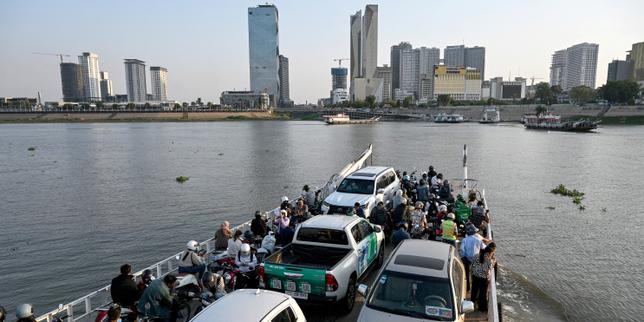
The water doesn’t just flow past a Cambodian village; it breathes.
In the floating villages of Tonle Sap, the great lake fed by the Mekong, life is measured in verticality. When the monsoon arrives, the river reverses its flow—a geological miracle found almost nowhere else on Earth—and the lake swells to five times its dry-season size. For centuries, this pulse was the heartbeat of the Khmer people. It dictated when to plant, when to fish, and when to pray.
But lately, the heartbeat is skipping.
Consider Samnang. He is a hypothetical composite of the dozens of fishermen I have spoken with along the banks of the Tonle Sap, but his struggle is entirely real. He sits on the edge of a wooden longboat, the engine silent, his net empty. In his grandfather’s time, the Mekong was a "mother" (Mekhong literally translates to Mother of Water). She was generous. She was predictable. Today, Samnang looks at the horizon not for clouds, but for the invisible shifts in a river managed by buttons and levers thousands of miles away.
The Mekong is no longer just a river. It is a battery.
The Concrete Wall Against History
The tragedy of the modern Mekong lies in a clash between ancient biology and 21st-century energy demands. To understand Cambodia's predicament, you have to look north. A massive string of hydroelectric dams, largely in China and Laos, has effectively put a kink in the garden hose.
While these dams provide the "clean" energy that fuels the neon skylights of Bangkok and the factories of Phnom Penh, they come with a hidden, heavy price tag. The Mekong’s power doesn't just come from its volume, but from its sediment. This nutrient-rich silt is the "blood" of the river. It feeds the rice paddies of the plains and sustains the largest inland fishery in the world.
When a dam stops the water, it also traps the silt.
The water that eventually reaches Samnang’s net is "hungry water." It is clear, devoid of the sediment that usually clouds it, and because it lacks its natural load, it is aggressive. It eats away at the riverbanks. It fails to nourish the floodplains. Without the sediment, the microscopic life that feeds the fish disappears. Without the fish, the people of Cambodia lose their primary source of protein.
We are witnessing the slow-motion starvation of a culture.
A Seesaw of Drought and Deluge
The Mekong has always been a river of extremes, but the extremes are becoming unrecognizable. In 2019 and 2020, the river hit record lows. The "reverse flow" into the Tonle Sap—that vital pulse—barely happened. The lake stayed shallow, the water grew hot, and the fish died in the millions.
Then comes the other side of the coin.
When the reservoirs behind those massive concrete walls upstream become too full during unexpected storms, the gates are opened. A surge of water rushes down, independent of the natural season. For a farmer in the Cambodian lowlands, this is a death sentence for his crop. He has timed his planting to the moon and the traditional seasons, only to have his fields drowned by a man-made flood in the middle of a dry spell.
The unpredictability is the true killer.
In the past, a "bad year" was a natural event that a community could prepare for through shared ritual and grain storage. Now, a bad year is a policy decision made in a boardroom in a different time zone. The invisible stakes are not just about liters of water or megawatts of power; they are about the erosion of trust between a people and their environment.
The Technology of Survival
Cambodia finds itself in a desperate paradox. The country needs electricity to modernize, to lift its people out of poverty, and to power the very smartphones Samnang now uses to check the water levels via satellite data apps.
There is a burgeoning movement to pivot toward solar and wind, leveraging the intense Southeast Asian sun rather than choking the last of the Mekong’s breath. But infrastructure moves slowly. Loans are tied to concrete. In the meantime, the river's ecology is being pushed toward a tipping point from which there may be no return.
Scientists refer to the Mekong as a "hotspot of biodiversity," second only to the Amazon. It is home to the giant freshwater stingray and the critically endangered Irrawaddy dolphin. These creatures are the ghosts of the river, haunting a habitat that is shrinking by the day. When we talk about the "menace" of the Mekong, we aren't talking about the water itself. We are talking about the consequences of trying to domesticate a wild force that was never meant to be tamed.
The Empty Net
Back on the Tonle Sap, Samnang pulls in his net. There are a few small, silver fish—barely enough for a single meal. A decade ago, this same cast would have yielded a bounty.
He speaks of the "spirits of the water" being angry, a lyrical way of describing a complex ecological collapse. It is easier to believe in vengeful spirits than to comprehend that your entire way of life is being sacrificed for a power grid you can't see.
The Mekong was once a promise of eternal abundance. It was a silver ribbon that tied the mountains to the sea. Now, it is a contested resource, a series of stagnant pools separated by walls of grey stone.
We often think of environmental collapse as a sudden explosion—a hurricane, a fire, a cliffside falling into the ocean. But for the six million Cambodians who depend on the Tonle Sap, the end of the world is quiet. It is the sound of a net hitting the water and coming up light. It is the sight of a river flowing the wrong way, at the wrong time, for the wrong reasons.
The Water Mother is still there, but she no longer recognizes her children.
The sun sets over the Great Lake, turning the water into a sheet of hammered gold. It looks beautiful, a postcard of timeless Southeast Asian life. But look closer at the stilts of the houses. They are tall—built for a flood that is increasingly hesitant to arrive. They stand like skeletal legs in the mud, waiting for a pulse that might never return to its full strength.
Silence.