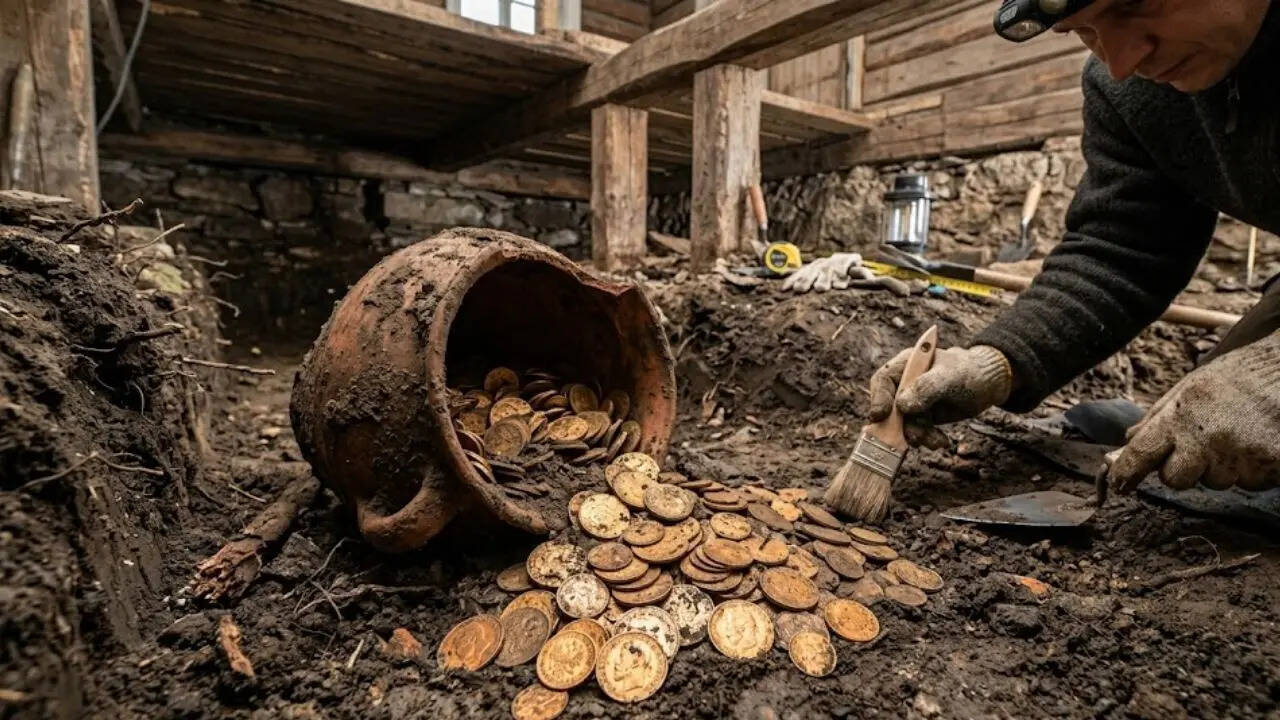
The discovery of 409 gold coins beneath a residential structure in Russia serves as a high-fidelity case study in the mechanics of capital preservation during systemic collapse. While general reports focus on the surface-level "treasure" narrative, a structural analysis reveals a calculated response to the hyper-volatility and political instability of the early 20th century. The hoard represents a deliberate attempt to convert liquid currency into a non-degradable, high-density value store to bypass a failing institutional environment.
The Anatomy of the 409 Coin Hoard
The cache consists of Nicholas II era gold coinage, primarily 5 and 10-ruble denominations. These assets were minted during the twilight of the Russian Empire, specifically between the late 1890s and 1911. To understand why this specific volume was sequestered, one must evaluate the Triple-Constraint Risk Model facing the original owner:
- Sovereign Risk: The total loss of faith in the issuing government's ability to honor paper currency (the "assignat" or credit note).
- Confiscation Risk: The immediate threat of asset seizure by revolutionary or paramilitary forces.
- Inflationary Erasure: The rapid devaluation of the ruble during the transition from the Imperial economy to the Soviet command economy.
The hoard’s composition reflects a preference for high-liquidity, standardized bullion. Unlike jewelry or art, 10-ruble gold coins possessed a fixed weight of approximately 8.6 grams ($0.900$ purity), making them fungible and easily tradable in a black-market or underground economy.
The Sequestration Logic: Depth and Placement
The physical location—buried under the floorboards of a basement—indicates a strategy of Last-Resort Liquidity. This wasn't a bank deposit; it was an insurance policy against total displacement. The decision to bury the assets suggests several tactical conclusions:
- Proximity vs. Security: The owner required immediate access to the capital, indicating they intended to remain in the residence despite the surrounding turmoil.
- The Decay of Institutional Trust: By forgoing formal storage, the owner accepted the physical risk of theft or fire in exchange for total autonomy over the asset.
- The Failure of Retrieval: The presence of the coins today confirms a fatal disruption in the retrieval chain. This occurs when the knowledge of the hoard is centralized in a single individual who is subsequently incapacitated, exiled, or killed without transferring the "access key"—in this case, the physical location—to an heir.
Technical Specification of the Nicholas II Gold Ruble
Evaluating the hoard requires a breakdown of the intrinsic value versus the numismatic premium. The 10-ruble "Chervonets" is the anchor of the find.
- Gross Weight: $8.6026$ grams.
- Fine Gold Content: $7.7423$ grams ($0.2489$ troy oz).
- Metallurgical Composition: $90%$ gold, $10%$ copper (alloyed for durability in circulation).
With 409 coins, the total fine gold weight exceeds 3 kilograms. In a contemporary context, the raw bullion value is significant, but the analytical value lies in the Purchasing Power Parity (PPP) at the time of burial. In 1910, 4,000 gold rubles could purchase a substantial estate or sustain a high-income household for several years. The sequestration of this specific amount suggests the owner was likely a merchant or a mid-to-high-level bureaucrat—someone with enough capital to diversify but enough visibility to fear persecution.
The Mechanisms of Discovery and Ownership Disruption
The modern discovery of such a hoard triggers a complex interaction between archaeology, property law, and forensic history. The primary bottleneck in resolving the "unknown owner" status is the Gaps in Document Continuity.
The Russian Revolution and subsequent Soviet urbanization programs systematically erased the ownership records of the 1900-1920 period. Reconstructing the lineage requires a three-tier forensic approach:
- Deed Stratigraphy: Mapping the historical chain of title for the specific plot of land back to the pre-revolutionary period.
- Architectural Dating: Confirming if the burial occurred during or after the house’s construction, which narrows the timeframe of the "Last Known Possessor."
- DNA and Genealogical Matching: If the original owner can be identified via deed records, tracing living descendants becomes the primary hurdle, complicated by the mass migrations of the 20th century.
Valuation Variance: Bullion vs. Numismatics
The market value of the find is bifurcated. A standard analyst might simply multiply the gold weight by the current spot price, but this misses the Rarity Multiplier.
- The Bullion Floor: This is the minimum value determined by the $XAU$ (gold) spot price. It is the liquid value of the metal regardless of its form.
- The Numismatic Ceiling: This is determined by the condition (grade) and the mintage year. Coins from years with lower production volumes or those showing "Mint State" (MS) qualities command a premium that can exceed the bullion value by 200-500%.
The preservation of the coins—found in a metal container—protected them from soil acidity, likely maintaining their strike quality and preventing the "environmental damage" tag that devalues many archaeological finds.
Strategic Implications of Hoard Retention
The discovery highlights the inherent flaw in physical gold as a long-term multi-generational wealth transfer mechanism: The Discovery Risk.
Physical sequestration is a binary outcome. Either the owner retrieves the capital and utilizes it, or it is lost to the environment until discovered by a third party with no legal or familial obligation to the original depositor. This creates a Negative Carry over decades, where the opportunity cost of the capital is total, as it remains unproductive and inaccessible for a century.
Furthermore, the legal framework in many jurisdictions, including Russia, dictates that "treasure" finds belong to the state, with only a percentage (often 25-50%) awarded to the finder and/or the landowner. This creates a significant divergence between the Nominal Value of the hoard and the Realized Value for the discoverer.
The Forensic Timeline of the Burial
We can hypothesize the burial window by analyzing the latest date found on the coins. If the newest coin is dated 1911, the burial likely occurred between 1914 (the start of WWI) and 1922 (the end of the Russian Civil War). This period represents the peak of the Insecurity Index.
The shift from 1911 coinage to burial indicates a "Wait and See" strategy that turned permanent. The owner likely transitioned from a strategy of "Capital Growth" to "Capital Survival." The fact that 409 coins remained suggests that the owner did not have the opportunity to draw down on the reserve during their lifetime, pointing toward a sudden or violent departure from the property.
Operational Protocols for Modern Discoveries
When a hoard of this magnitude is identified, the immediate requirement is a Non-Destructive Evaluation (NDE).
- Inventory Documentation: Immediate photography and weighing in situ to prevent shrinkage or "skimming."
- Chemical Analysis: Testing the container for residues that might identify the original owner (e.g., specific paper fibers from currency or letters that have since decayed).
- Numismatic Grading: Professional assessment of each coin to identify high-value outliers.
The 409 coins serve as a data point in the broader study of "Emergency Currencies." They are a testament to the durability of gold as a store of value, even when the institutional structures around it—the banks, the government, and the legal systems—evaporate entirely.
The strategic play for any entity managing a historical find is the transition from Asset Management to Narrative Management. The value of these coins is no longer just the gold content; it is the provenance. Establishing a definitive link to a historical figure or a specific event (such as the defense of a city) transforms the cache from a commodity into a cultural artifact, significantly increasing its auction potential. Until the ownership chain is verified, the asset remains in a state of legal and economic limbo, much like it did beneath the floorboards for the last hundred years.