History rarely arrives with the courtesy of a warning. More often, it slips through the cracks of ordinary mornings—the rattle of a teacup, the distant drone of distant headlines, the sudden tightness in a mother's chest as she watches her children walk toward the school gates. We think of geopolitics as a game played by men in oak-paneled rooms thousands of miles away, measured in treaties, sanctions, and ultimatums. But the true geography of conflict is drawn on the faces of ordinary people standing at their kitchen windows, realizing that the weather outside has changed permanently.
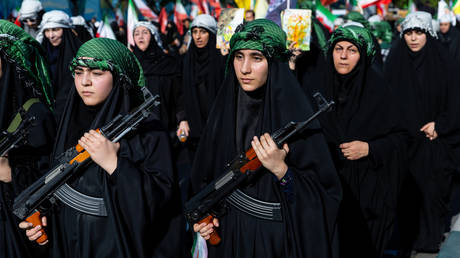
Consider what happens when external pressure meets an ancient, stubborn cultural gravity. In recent months, amid escalating tensions and the ever-present shadow of foreign threats, a profound visual has begun echoing across international media: Iranian women participating in civil defense drills, handling arms, and training for potential conflict. To view this simply as a military maneuver is to miss the entire human story. It is a moment charged with contradiction, resilience, and the fierce, protective instinct of people who feel they have nowhere left to retreat.
The Sound of a Changing Horizon
Imagine walking through the streets of Tehran at dusk. The air smells of roasted chestnuts, exhaust fumes, and the sharp ozone of approaching autumn. For decades, the public narrative surrounding women in Iran has been framed through the lens of restriction, protest, and a relentless struggle for autonomy against a rigid clerical establishment. That struggle has not vanished. It burns beneath the surface like a subterranean fire.
Yet, when the drumbeat of external war grows louder—when the threat of foreign intervention or military strikes becomes a daily dietary staple of state television—a different instinct awakens.
Survival.
It is a mistake to assume that all actions taken under the banner of national defense are endorsements of the regime commanding them. Human motivation is rarely monochromatic. When a foreign power rattles sabers across the water, the psychological reflex of a population shifts. The internal critique is temporarily eclipsed by a primal instinct: this is our home. Even those who despise the government find themselves confronting an uncomfortable realization. Bombs do not sort their victims by political affiliation.
Anatomy of an Image
The footage is stark. Rows of women in matching uniforms, their headscarves tucked securely beneath tactical helmets, gripping rifles with a mixture of apprehension and grim resolve.
Look closer at their hands. These are not the hands of professional soldiers. These are hands that knead dough, grade papers, write poetry, code software, and hold the hands of aging parents. They are civilian hands forced into an unfamiliar grip of cold steel.
Sociologists call this phenomenon the rally-round-the-flag effect. It is a well-documented behavioral pattern where external threats temporarily unify fractured populations. But statistics and political science models fail to capture the emotional reality in the room.
When a woman steps onto a firing range, she is negotiating a complex internal landscape. On one hand, there is the bitter irony of training to defend a state that severely curtails her daily freedoms. On the other, there is the fierce, protective love for family, neighborhood, and culture—things that exist independently of the men in power. History is filled with ironies of this magnitude. People routinely find themselves defending corrupted institutions because the alternative—foreign invasion and the total obliteration of their communities—is infinitely worse.
The Invisible Stakes
Why does this matter far beyond the borders of the Middle East? Because it exposes the profound limitations of modern statecraft.
For years, foreign policy analysts in Western capitals have operated under a neat, mathematical assumption. The logic goes like this: apply maximum economic pressure, isolate the leadership, broadcast messages of liberation, and the populace will inevitably rise up to dismantle the regime from within. It is a clean formula on a whiteboard.
Human beings refuse to cooperate with clean formulas.
When external threats escalate into actual perils of war, the psychological calculus shifts away from revolution and toward self-preservation. Instead of welcoming foreign intervention, populations often hunker down. They evaluate the threat not through the idealized lens of democratic liberation, but through the terrifying memory of Iraq, Libya, or Afghanistan—countries where foreign promises of rescue dissolved into endless civil strife and shattered infrastructure.
The sight of women taking up arms is a visible manifestation of that complex calculation. It communicates a silent, formidable message to the outside world: We may have deep internal quarrels, but we will write our own disasters. Do not mistake our domestic grief for an invitation.
Walking the Tightrope of Reality
It is easy to romanticize resistance, and it is equally easy to dismiss it as state-managed propaganda. The truth occupies the messy, uncomfortable space between those two extremes.
The state media broadcasts these training sessions with a clear objective: to project strength, deter aggression, and foster a narrative of national unity. That is propaganda 101. But to reduce the participants entirely to pawns is to strip them of their agency. These women are making active choices within a restricted set of terrible options. They are learning to protect themselves because they know, with a chilling clarity born of historical precedent, that when empires clash, civilians bear the cost.
Fear is a great clarifier. It strips away ideological luxuries and leaves only the bare necessities of existence: shelter, safety, the continuation of the bloodline, the preservation of the soil beneath one's feet.
The Long Shadow
As the drills end and the dust settles over the training grounds, the participants return to their normal lives. They buy groceries at hyperinflated prices, worry about their children's education, and navigate the daily constraints of their society. But something has shifted in the collective consciousness.
The image of the armed civilian woman remains burned into the regional imagination. It is a symbol with multiple conflicting meanings—a testament to resilience, a monument to tragic necessity, and a warning to anyone who thinks a nation can be easily broken from the outside.
We are left watching from a distance, peering through the pixelated lens of a video clip, trying to decode a reality we can scarcely imagine. We look for simple heroes and villains, forgetting that the world is populated entirely by people just trying to survive the history that is happening to them.
The sun sets over Tehran, casting long shadows across ancient mountains and modern concrete alike. Somewhere in a quiet apartment, a mother places her rifle in a closet, washes the dust from her hands, and goes to check on her sleeping child. The threats across the sea have not gone away. Neither has she.


