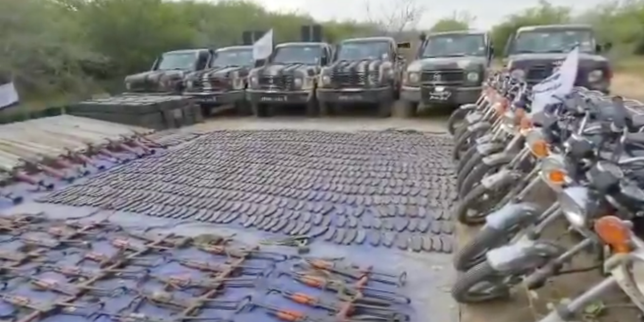
Every six months, a predictable panic ripples through European foreign ministries and Washington think tanks. The headline never changes. Another column of Toyota Land Cruisers rolls across the scrubland of central Mali, flags of the Group for the Support of Islam and Muslims flutter in the dust, and western analysts rush to type out the same tired diagnosis. They write about vacuum cleaner states, religious radicalization, and the unstoppable momentum of jihadist expansion. They treat a localized peasant rebellion wrapped in Salafi-Alevi branding like a Borg collective.
It is lazy, terrified thinking. And it is costing billions of dollars while ensuring the violence never stops.
If you listen to the conventional defense establishment, central Mali is falling because of divine inspiration and militant ideological zeal. That is convenient for generals asking for budget increases and politicians looking for a simple narrative. It ignores the grinding, prosaic reality on the ground. The men joining these insurgencies are not migrating south from the Sahara to impose seventh-century jurisprudence on rice farmers. They are defending their herds, settling blood feuds with corrupt municipal judges, and hiring themselves out to the highest bidder in an ongoing structural civil war over mud, water, and cattle routes.
Let us look past the black banners and examine the mechanics of what is actually happening in the Inner Niger Delta.
The Myth of the Ideological Wave
The standard framing treats JNIM as an ideological franchise sweeping across the Sahel like a software update. If you zoom out from the map in Paris, it looks that way. Swathes of Mopti and Segou regions slip out of Bamako control. Checkpoints appear. Taxes are levied. Sharia courts supplant secular magistrates.
Zoom in, and the grand ideological crusade dissolves into a collection of intensely local, hyper-pragmatic gangsterism and agrarian self-defense.
I have watched diplomats scratch their heads over why Fulani pastoralists in the Koro district suddenly align with jihadist commanders they share almost zero theological common ground with. The answer is not complex. When the state outsourcing of security to Dogon militia groups like Dan Nan Ambassagou results in your cousins being dumped in a dry well because of their ethnicity, you do not consult a radical cleric to decide your next move. You take whatever AK-47 ammunition and tactical protection you can buy, beg, or borrow.
The militant leadership knows this. They are not running theological seminars in the baobab forests; they are running an efficient protection racket. They provide swift, brutal dispute resolution in regions where the Malian state has spent decades offering nothing except bribery, extortion, and arbitrary arrests by underpaid soldiers who view the local population as a hostile foreign species.
When a JNIM commander settles a land dispute between two pastoral clans in forty-eight hours, he achieves what the Ministry of Justice in Bamako could not do in forty years. The fact that he does it under the banner of a transnational terrorist network is an administrative detail to the villagers paying the tax.
The State is the Insurgency’s Best Recruiter
Western capitals love to blame foreign meddling, climate change, and porous borders for the crisis in the Sahel. They almost never blame the people sitting in the air-conditioned offices of the capital city.
The central government in Bamako has treated its peripheries like internal colonies since independence. The current military junta, high on the rhetoric of national sovereignty and Russian air support, is doubling down on the exact same error. They treat the insurgency as a military problem requiring a military solution, which is equivalent to trying to put out a grease fire with a high-pressure hose.
Every time a Malian army patrol sweeps through a village in Mopti looking for informants, the arithmetic of the insurgency shifts in favor of the militants. Young men watch their elders humiliated, their granaries burned, or their brothers hauled away to interrogation centers from which few return. By sunset, the local self-defense group—previously neutral or even hostile to the jihadists—is sending an emissary to the nearest forest camp to negotiate terms.
We keep calling these areas "lost territories." They were never really part of the modern state to begin with. The administrative map of Mali is a colonial fiction drawn by cartographers who never stepped foot in the Sahel. Pretending that restoring a corrupt prefect to a mud-brick outpost constitutes the return of governance is a delusion.
The Economic Engine Nobody Wants to Discuss
Strip away the religious rhetoric, and the conflict in central Mali is an agrarian land war fueled by economic desperation.
Population growth, erratic rainfall, and the southward shift of the Sahara have compressed the zones where pastoralists and sedentary farmers can coexist. For generations, traditional mechanisms managed this friction. Elders negotiated cattle corridors. Local agreements dictated when livestock could graze stubble after a harvest.
Those mechanisms broke down because the state privatized or corrupted the arbitration process. Local mayors and corrupt forestry agents started selling grazing rights and farming permits to whoever could pay the highest bribe, regardless of customary law. A Fulani herder who finds his traditional migration route blocked by a newly cleared cotton field backed by a municipal bribe has two choices: starve his animals or take up arms against the system that legalized his displacement.
The insurgents did not invent this grievance; they monetized it. They positioned themselves as the champions of the marginalized pastoralist class against a predatory state apparatus. Until western analysts and African capitals address the land tenure crisis, the corruption of rural courts, and the weaponization of ethnic militias, no amount of drone strikes or foreign training missions will alter the trajectory of the war.
Why the Current Strategy is Guaranteed to Fail
The current playbook relies on a triad of fatal errors: decapitation strikes against militant leadership, outsourcing security to irregular militias, and doubling down on military force while ignoring governance.
Decapitation sounds good in a Pentagon briefing room. You take out a mid-level commander with a precision strike, and the press release writes itself. On the ground, you have just created a franchise opportunity. The decentralized cell structure of JNIM means that eliminating a commander simply sparks a bloody internal competition for succession, usually resulting in younger, more radical, and less predictable subordinates taking over who have fewer ties to local communities and fewer inhibitions about extreme violence.
Outsourcing counter-insurgency to ethnic self-defense groups is even more catastrophic. It institutionalizes ethnic cleansing. When you arm one community to fight another under the guise of counter-terrorism, you guarantee a generational cycle of revenge killings that no peace treaty can ever untangle.
We are treating a symptom of systemic state failure as if it were an alien invasion.
The Counter-Intuitive Reality
If you want to understand how central Mali stabilizes, you have to stop looking at the religious flags and start looking at municipal administration, land registry offices, and police corruption.
The insurgents cannot be defeated on the battlefield because they are not an army trying to conquer territory; they are a symptom of institutional rot. They win wherever the state is worse than they are. Conversely, they wither wherever local communities find functional, predictable, and non-predatory ways to manage their own affairs.
The uncomfortable truth for western policymakers and African leaders alike is that military intervention is often part of the disease, not the cure. Every foreign advisor, every armored personnel carrier, and every counter-terrorism strategy that ignores the political economy of rural survival is just another subsidy for a war economy that benefits everyone except the people trying to grow millet in the delta.
Stop funding the symptoms. Fix the courts, audit the land grants, and dismantle the predatory state apparatus that makes joining a jihadist militia look like the most rational career choice left in the Sahel.


