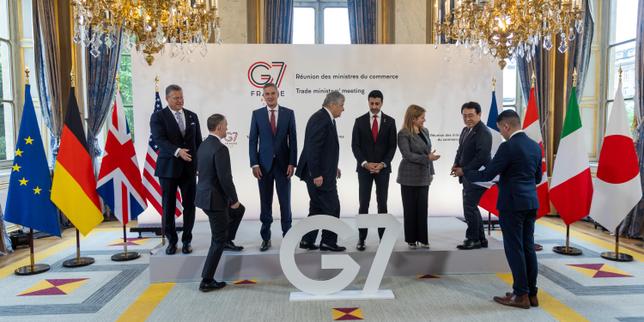
The hand-wringing from the international aid establishment has reached a predictable pitch. Commentators look at G7 partnerships and scream "aid blackmail" the moment a developed nation demands economic reforms, trade reciprocity, or strategic alignment in exchange for billions of dollars.
They have it completely backward.
The real threat to developing nations isn't the conditional string attached to a G7 loan. The real threat is the unconditional, guilt-driven handout that keeps dysfunctional economic structures on life support. For decades, the development narrative has been hijacked by a paternalistic consensus: that poor nations are perpetual victims, that Western aid is a moral debt, and that asking for a return on investment is a form of neo-colonial extortion.
I have spent twenty years sitting in rooms where development policy is hammered out. I have watched billions of dollars vanish into the black hole of state-managed monopolies, currency manipulation, and bureaucratic bloat—all subsidized by well-meaning Western donors who were too afraid of looking "imperialist" to demand basic fiscal discipline.
The "mutually beneficial partnership" criticized by ivory-tower activists is not a trap. It is the only sustainable path forward.
The Flawed Premise of Free Money
Let us dismantle the core argument of the anti-conditional aid crowd. The narrative claims that when the G7 or international financial institutions tie aid to market liberalization or resource access, they are exploiting vulnerable nations.
This argument ignores basic economic gravity.
Money is never free. When a sovereign nation accepts capital with no strings attached, it pays a hidden, far more destructive price: the destruction of local market incentives. Consider what economists call the "aid curse"—a phenomenon heavily documented by researchers like Dambisa Moyo in her seminal work Dead Aid. When a government relies on foreign assistance for a double-digit percentage of its budget, it stops relying on its citizens.
- The tax base is ignored.
- Local industries are crowded out.
- The state becomes accountable to foreign donors, not its own electorate.
When the G7 demands a "mutually beneficial" arrangement—such as securing supply chains for critical minerals in exchange for infrastructure development—it introduces a vital mechanism: reciprocity. A transaction creates a relationship of equals. A handout creates a relationship of dependency.
Imagine a scenario where a Western nation funds a massive solar grid in Sub-Saharan Africa, demanding that the contract use transparent bidding processes and allow foreign investment in the local energy sector. The critics call this "corporate capture." In reality, it forces the recipient government to build a regulatory framework that can actually attract private capital once the aid money runs out.
Dismantling the People Also Ask Myth: Is Conditional Aid Coercion?
If you search the internet for the impacts of foreign assistance, you will find a flood of variations on one central question: Does conditional aid violate national sovereignty?
The brutal, honest answer is no. Because no one is forcing these nations to sign the contract.
Sovereignty means the right to choose. It also means living with the consequences of those choices. When a developing nation needs capital, it has choices. It can reform its internal markets to attract private venture capital. It can borrow from the IMF and implement structural adjustments. Or it can take infrastructure loans from non-G7 actors who claim to offer "no strings attached" financing.
We have seen how that last option plays out. Look at Sri Lanka’s Hambantota port. Look at the balance sheets of nations heavily indebted to opaque, state-backed lenders who eschew G7-style transparency rules. They did not face "aid blackmail" in the form of policy demands. Instead, they faced literal asset foreclosure when the math stopped working.
G7 style conditionality—demanding fiscal transparency, anti-corruption measures, and market access—is a defense mechanism for both the donor's taxpayers and the recipient's citizens. Calling it coercion is a cheap rhetorical trick used by local politicians to deflect blame for their own economic mismanagement.
The Downside of My Approach (And Why It Is Still Better)
Let's be entirely transparent. Shifting from a model of humanitarian pity to hard-nosed economic reciprocity has sharp downsides.
If the G7 strictly enforces mutually beneficial terms, some nations will walk away from the table. Governments that refuse to reform their legal systems, protect property rights, or curb corruption will not get the capital they want. In the short term, that means projects will go unfunded. Roads will not be built. Power plants will stay on the drawing board.
It is a painful medicine. But the alternative is worse. Funding a road that falls into disrepair within five years because the local ministry used sub-standard materials and pocketed the delta does nothing for the poor. It only enriches the ruling class.
True development requires institutional friction. If a country wants access to the deepest capital markets in the world, it must build institutions capable of handling that capital.
The Three Rules of True Economic Partnership
If we want to stop the cycle of dependency and actualize real growth, we must entirely rewrite the rules of international engagement. Stop asking how much aid we can give. Start asking what the return is for both sides.
1. Treat Sovereignty as an Asset, Not a Shield
Developing nations must stop using the historical ledger to justify protectionist economic policies that harm their own people. If a G7 partner wants to invest in your agricultural sector but demands the removal of price controls that stifle production, that is not a violation of sovereignty. That is an invitation to join the global economy.
2. Price the Risk Accurately
Capital flows to where it is treated well. When aid is decoupled from risk, it distorts the market. If a country is a high-risk environment due to political instability, the terms of the investment must reflect that risk. Western nations should stop subsidizing bad behavior through soft-loan windows that never require repayment.
3. Demand Institutional Reciprocity
If a Western nation opens its markets to textiles or agricultural goods from a developing partner, that partner must dismantle the bureaucratic red tape that prevents Western companies from competing fairly in their domestic market. True partnerships are a two-way street.
The era of the patron-client relationship disguised as "international solidarity" is over. The nations that are currently lifted out of poverty are not the ones crying foul over G7 terms; they are the ones negotiating better terms, building competitive industries, and treating foreign capital as a tool for growth rather than a moral entitlement.
Stop trying to fix the aid system by stripping away its conditions. Double down on them. Demand more transparency. Demand market access. Demand profitability. Treat developing nations like business partners, not charity cases.


