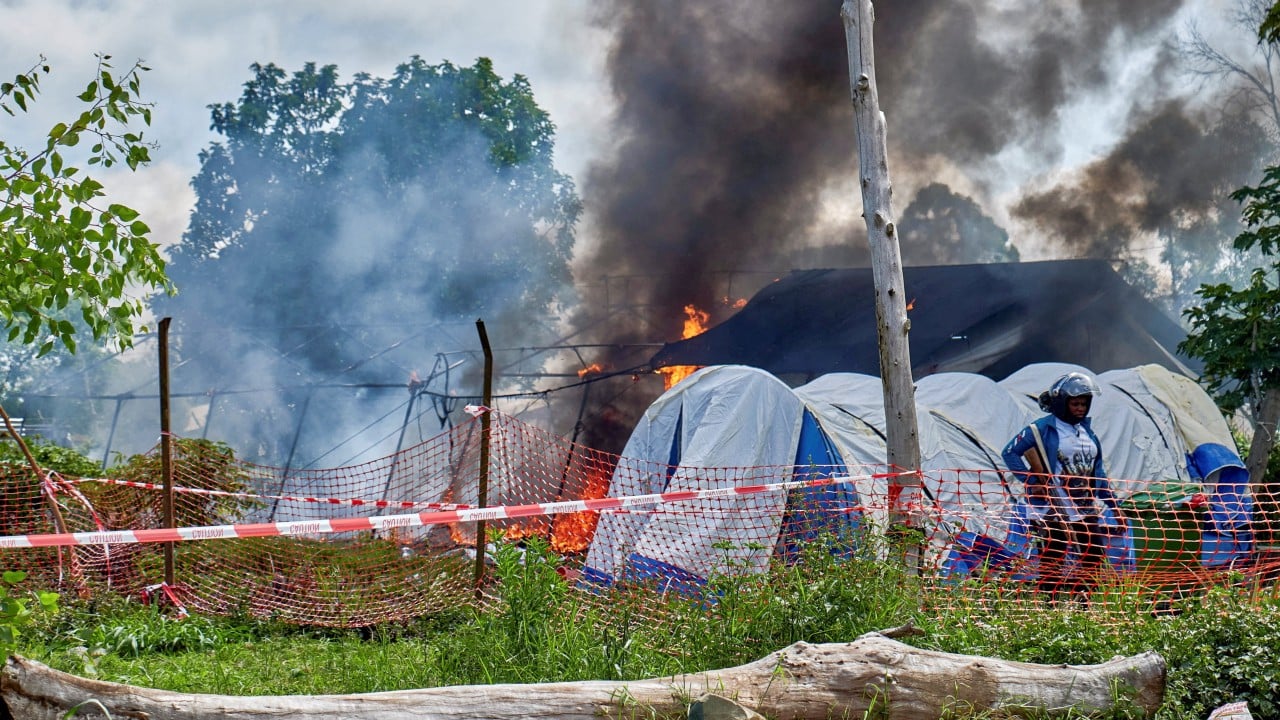
The international media loves a simple story. When a crowd of furious residents attacks an Ebola treatment center in the Democratic Republic of Congo, the global press corps reaches for a well-worn, lazy script. They blame "superstition." They blame "ignorance." They chalk up the violence to a tragic, backward misunderstanding of modern medicine.
That narrative is not just patronizing. It is factually illiterate.
Having analyzed the intersection of humanitarian logistics and local governance in conflict zones, I can tell you that the people throwing stones at Ebola centers are often acting on a rational, hyper-vigilant assessment of their own survival. They are not rioting because they do not understand science. They are rioting because they understand the local political economy perfectly.
When international non-governmental organizations (INGOs) and foreign health agencies flood a volatile region like North Kivu or Equateur province, they do not just bring vaccines. They bring millions of dollars into an environment defined by deep-seated institutional corruption and decades of state-sponsored neglect. To ignore this context is to misunderstand the entire dynamic of public health crises in Central Africa.
The Ebola Business: Follow the Money
Let us look at the mechanics of what locals call "Ebola business."
When an outbreak is declared, a massive influx of foreign capital arrives almost overnight. Suddenly, a city that has lacked clean drinking water, paved roads, and functional basic healthcare for thirty years is crawling with high-end SUVs. Foreign experts arrive earning massive per diems. Local politicians, military commanders, and well-connected elites secure lucrative contracts for security, logistics, vehicle rentals, and catering.
Meanwhile, the local population watches the state and international community spend thousands of dollars per day to treat a single disease, while treating every other lethal threat with utter indifference.
Consider the raw data. Malaria kills significantly more people in the DRC every single year than Ebola does, even during peak epidemic periods. Measles outbreaks regularly rip through Congolese villages, claiming the lives of thousands of children due to a lack of routine, low-cost vaccinations. Yet, the massive financial apparatus only activates when a hemorrhagic fever threatens to cross international borders and menace the Global North.
Imagine a scenario where your children are dying of preventable dehydration and malaria, and the local clinic has no medicine. Then, a highly contagious virus arrives, and suddenly a multi-million-dollar, state-of-the-art isolation ward appears down the street, surrounded by armed guards and highly paid bureaucrats.
Would you view that center as a monument to humanitarian altruism? Or would you view it as a predatory enterprise designed to enrich a corrupt political class at the expense of local suffering?
The anger directed at treatment centers is not a rejection of virology. It is a targeted, political protest against a deeply unequal distribution of resources.
The Security Dilemma and the Weaponization of Health
Western reporting consistently fails to connect public health resistance with the surrounding security architecture. In the eastern DRC, decades of conflict involving dozens of armed rebel groups have left the population with a justified, bone-deep distrust of anyone carrying a weapon.
When international health agencies demand armed escorts from the Congolese military (FARDC) or UN peacekeepers (MONUSCO) to enforce quarantine measures and safe burial protocols, they commit a fatal strategic error. They align the medical response with entities that the local population frequently views as predatory or complicit in local violence.
- Forced Quarantines: When health workers show up with soldiers to isolate a family member, it looks less like medical care and more like a state-sanctioned kidnapping.
- Disruption of Burial Rites: Forcing families to abandon traditional, highly sacred funeral practices without deep, prolonged community negotiation is an act of cultural violence. Doing it at gunpoint guarantees a violent backlash.
- The Militarization of Medicine: The moment a stethoscope is backed by an assault rifle, the medical worker ceases to be a healer. They become an agent of an oppressive state apparatus.
Medical anthropologists like Dr. Vinh-Kim Nguyen have documented how humanitarian interventions can inadvertently mimic colonial-era biopolitics. When the response prioritizes containing a pathogen over protecting a population, the population inevitably revolts. The riots are an act of self-defense against perceived state aggression.
Dismantling the "People Also Ask" Illusions
To fix the broken discourse around public health resistance, we must confront the fundamentally flawed assumptions built into the general public's understanding of these events.
Why do people in the DRC reject Ebola treatment?
They do not reject treatment; they reject the terms under which it is delivered. When early intervention protocols involved completely isolating patients from their families—meaning loved ones went into a tent and often returned in a body bag, buried secretly by strangers in hazmat suits—the treatment center looked like a slaughterhouse.
When agencies shifted toward transparent isolation cubes (like the Biosecure Emergency Care Unit, or CUBE) that allowed families to see and talk to patients, compliance skyrocketed. The problem was never a lack of intelligence; it was a lack of basic human dignity in the medical design.
Is misinformation the main driver of violence against health workers?
No. Misinformation exists everywhere, but it only takes root when there is a profound vacuum of trust. If a government has lied to, neglected, and robbed a population for three generations, why would that population suddenly believe the government's pamphlets about a invisible virus? Rumors that Ebola was manufactured to wipe out certain ethnic groups or to generate funding are entirely logical deductions based on the lived reality of political betrayal.
The High Cost of the Imperial Public Health Model
The current model of international crisis response is built on a boom-and-bust cycle that maximizes disruption and minimizes long-term resilience.
When the outbreak ends, the money vanishes. The SUVs drive away. The temporary contracts expire. The community is left exactly as it was before: destitute, with a broken health system and an even deeper resentment of foreign intervention. The infrastructure built to fight Ebola is rarely repurposed to support comprehensive primary care. It is dismantled and packed away until the next headline-grabbing emergency.
This approach is unsustainable, ineffective, and morally bankrupt.
If international donors actually want to stop the violence and eradicate these outbreaks swiftly, they must stop treating epidemics as isolated scientific problems to be solved with parachuted tech and armed guards. They must recognize that public health is an extension of local politics.
Stop funding top-heavy emergency responses that spend 80% of their budgets on foreign logistics and international consultant salaries. Divert those funds into permanent, locally staffed healthcare infrastructure that treats malaria, delivers clean water, and provides safe childbirth services year-round. Build trust when there is no crisis.
Until the international community stops treating the Congolese people as passive, ignorant vectors of disease and starts treating them as rational political actors, the stones will keep flying, the centers will keep burning, and the outbreaks will keep spreading.