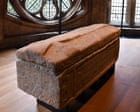
A Roman limestone coffin carved for a wealthy citizen in Londinium somehow wound up holding an Anglo-Saxon churchman nearly seven centuries later. That mismatch drove archaeologists nuts for over 150 years.
Now we actually have a strong answer. New research led by Professor Warwick Rodwell, consultant archaeologist at Westminster Abbey, and published in the Journal of the British Archaeological Association, points to a high-ranking Benedictine abbot buried there in the late 10th or early 11th century. Even better, the skeleton inside belongs to a middle-aged man who lived through real wear and tear, not the young guy Victorian observers imagined.
Honestly, this is why archaeology never gets boring. Stone lasts. Stories get tangled. And when modern lab work collides with messy 19th-century excavations, a neat "mystery solved" headline usually hides a far weirder chain of events.
What Was Actually Inside the Roman Sarcophagus
Start with the stone itself. The monolithic limestone coffin dates to the 4th century CE and carries an inscription dedicated to Valerius Amandinus. The lettering is sharp enough to tell us he was a person of real standing in Roman London, even if surviving records tell us next to nothing about his day job or career.
Look closer at the carving and you start spotting practical shortcuts that antique dealers and romantic writers love to miss. The coffin measures about 2.09 meters long by 0.71 meters wide and 0.46 meters high, with crudely bevelled corners at the foot end and a slightly narrower interior void there. That wasn't some secret ritual geometry. The Roman mason was working with an awkward block of oolitic limestone and simply pushed for the longest coffin possible without losing another 20 centimeters of length.
The back and sides were only roughly dressed with a narrow-bladed axe, while only the front face got fancy decoration: a recessed inscription panel flanked by pelta reliefs. That tells us the sarcophagus originally sat in a mausoleum recess where only the front and lid showed—not buried deep in dirt.
Then centuries rolled on, and reuse took over. First spotted in 1820 and excavated on the North Green by the sacristy courtyard in 1869, the stone lid had been recut in the late Saxon period with a large relief-carved Latin cross. A wooden coffin had been placed inside the Roman stone box, and radiocarbon dating on bone sent to the Scottish Universities Environmental Research Centre places the remains between 987 and 1052 CE.
Why Victorian Experts Got the Skeleton Wrong
Back in the 1800s, observers described the skeleton as a "robust young man," maybe 5 feet 7 inches tall and under 30. Take that with a massive grain of salt. Nineteenth-century osteology was often guesswork mixed with wishful thinking.
When human bone specialist James Young Langthorne of Pre-Construct Archaeology re-examined the remains alongside modern work, the picture shifted noticeably. The man was likely between 35 and 49 years old when he died and stood closer to 5 feet 9 inches. That's a big jump in age—and it completely changes which historical figures even qualify.
The bones also carry physical history. According to archaeological documentation from the investigation, the skeleton shows well-healed fractures on the left 10th and 11th ribs and signs of a nonspecific infection on the left tibia and fibula. Life in late Anglo-Saxon England wasn't gentle, even for senior churchmen.
Here's another twist that trips people up: old notes made it sound like the bones had gone missing over the years. When researchers lifted the lid in the lab during recent investigations (following work starting around 2016–2018), the skeleton was still there. Never trust a 19th-century inventory without checking the box yourself.
The Two Abbot Contenders in Westminster History
Once you know the man died roughly between 987 and 1052 CE, and you look at a grand stone coffin recarved with a major Latin cross, ordinary monks drop out of the running. As Rodwell noted, nobody low-ranking got a burial treatment like that.
Two leading candidates stand out from the abbey's late Saxon history:
- Abbot Ælfwig (died around 1020): Served for roughly 27 years as abbot of the Benedictine monastery at Westminster. Because he was already a Westminster monk before becoming abbot, Rodwell sees a slight edge in his favor, assuming he took office in his early twenties and reached around fifty by the end.
- Abbot Wulfnoth (died around 1049): Ælfwig's successor, also presumed buried at the abbey. Under the same rough age assumptions—entering leadership young and dying near fifty—he fits the radiocarbon window just as cleanly.
Notice how honest that conclusion is. We don't have birth certificates for either man. We don't have a name tag buried with the wooden coffin. Calling it a 100% DNA-style lock would overstate the evidence; calling it a solid, evidence-backed identification of a late Saxon abbot is spot-on.
Coffin Swapping Was Practical, Not Disrespectful
Modern readers sometimes react to ancient burial reuse like grave robbery or a weird horror trope. In medieval Britain, recycling Roman masonry was standard survival math.
Quarrying fresh stone, hauling heavy blocks, and carving monuments took serious labor and money. If a Roman sarcophagus already existed nearby and held an older pagan burial long forgotten—or long since disturbed—repurposing the stone for an honored abbot made practical sense. Adding a carved Latin cross to the lid Christianized the monument and signaled high ecclesiastical status.
Later still, during Henry III's mid-13th-century rebuilding program around 1258, burials were moved and relocated into the sacristy courtyard where 1869 excavators eventually uncovered it. That's four major chapters in one piece of stone: Roman elite monument, late Saxon abbot's tomb, Henry III era relocation, and modern museum display in The Queen's Diamond Jubilee Galleries at Westminster Abbey.
Common Mistakes When Reading Archaeology News
Whenever a story like this hits the news, readers tend to fall into three traps:
- Treating an inscription as a permanent owner's manual. An ancient name carved in stone tells you who first commissioned or used the object, not who occupied it centuries later.
- Trusting old excavation notes uncritically. Nineteenth-century measurements, age estimates, and "missing item" notes frequently fail modern re-examination.
- Expecting a single name when two fit. Good archaeology narrows the field to a tight date range and credible candidates rather than inventing false certainty.
If you want to dig deeper into how this case came together, read the formal study by Warwick Rodwell and colleagues in the Journal of the British Archaeological Association, check the official summary from Westminster Abbey, or plan a visit to see the sarcophagus in person in The Queen's Diamond Jubilee Galleries. Look at the bevelled foot, the reused lid, and the two centuries-apart worlds sitting in the same piece of stone—it's one of the best reminders in London that history gets reused long before it gets written down.


