The air in the eastern provinces of the Democratic Republic of Congo often smells of damp earth, woodsmoke, and the metallic tang of iron-rich rain. It is a heavy, enveloping air. Life moves to the rhythm of market days, bicycles piled high with plantains, and the steady, ancient flow of the river.
Then comes a silence. If you enjoyed this article, you might want to read: this related article.
Not the silence of peace, but the tight, breathless silence that settles over a village when a neighbor falls ill with a fever that refuses to break, and the local clinic locks its doors.
We talk about epidemics in numbers. We track curves, exponential growth factors, and case fatality rates on glowing screens thousands of miles away. But disease does not move as a statistic. It moves as a footstep on a dusty path. It travels in the back of a crowded taxi-bus, hidden behind a polite greeting or a weary smile. Right now, the Ebola outbreak in the DRC is far from contained. The risk of international spread is not a distant, academic theory. It is a live wire humming in the dark. For another angle on this event, refer to the latest update from Everyday Health.
To understand why this fire refuses to go out, we have to look past the global health bulletins. We have to look at the human cost of fear.
Imagine a woman named Amina. This is a hypothetical scenario, constructed from the real, documented testimonies of frontline responders, nurses, and survivors. Amina lives just outside a bustling trading hub. When her brother falls violently ill with vomiting and exhaustion, she does not think of international health regulations. She thinks of her mother, who taught her how to nurse the sick with warm water and cloth rags. She thinks of the local healer who has always brought comfort when the hospitals felt cold and distant.
She pulls her brother close. She washes his linens.
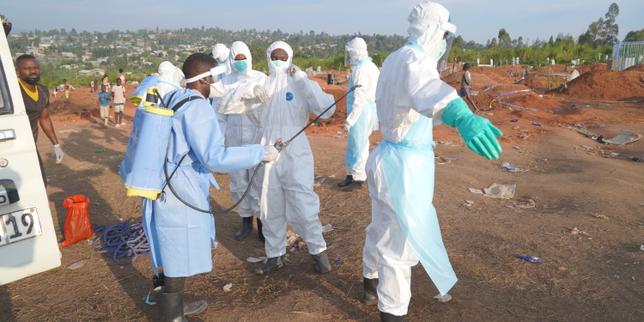
By the time the medical teams arrive in their hooded white suits—suits that look terrifyingly alien, like visitors from a hostile planet—the invisible contagion has already crossed the threshold. This is the cruel paradox of Ebola: the very instincts that make us human—tenderness, community, grief—are the exact channels the virus uses to survive.
Epidemiologists call this community resistance. It sounds clinical, sterile, and slightly judgmental, as if people are simply refusing to follow instructions. But resistance is rarely born of stubbornness. It is born of history. When communities have been overlooked, underserved, and battered by decades of conflict, trust becomes a scarce currency. Why believe a man in a white suit who tells you your loved one must be taken away, never to be seen again, when your entire life has taught you that nobody is coming to save you?
The World Health Organization and local health ministries face a formidable wall of mistrust. Every rumor is a spark. Every delayed burial is a dry branch added to the fire.
Consider what happens next in this chain reaction.
A border checkpoint, porous and stretching for hundreds of miles through dense jungle, sees thousands of traders cross every single day. They carry goods, currency, and dreams of a better harvest. They also carry the potential for silent infection. The incubation period is a cruel window—up to twenty-one days of normal life before the hammer falls. A merchant can feel entirely healthy, cross an international boundary, trade cloth at a crowded regional market, and only feel the first tremor of a fever when he has returned home, or worse, reached a neighboring country.
This is why international health bodies sound the alarm. A localized outbreak in a remote province is never just local. In our hyper-connected world, distance is an illusion. A flight from Goma or Kinshasa connects to major hubs across Africa, Europe, and beyond in a matter of hours. The virus does not care about visas, passports, or geopolitical borders. It only needs an open door.
Yet, painting this picture with only dread is a profound mistake. Because for every story of fear, there is a counter-story of extraordinary courage.
Walk into an Ebola treatment center in the DRC, and you will find a strange, quiet world behind orange plastic fencing. Inside, survivors are the true anchor of hope. They wear blue scrubs, their faces visible, carrying plastic cups of oral rehydration salts to the newly admitted.
When a survivor walks up to a terrified patient, looks them in the eye, and says, "I was where you are, and I walked out," the air changes. The invisible wall of the alien white suit crumbles. Trust is forged in a single sentence. The survivor takes the patient's hand—gloved, yes, but steady—and anchors them back to the land of the living.
Science gives us the tools. Vaccines exist now. Monoclonal antibodies have revolutionized treatment, turning what was once an almost certain death sentence into a survivable ordeal, provided it is caught early. But science without trust is just medicine sitting in a box, gathering dust.
The battle against the epidemic is won in the quiet conversations under corrugated tin roofs. It is won when a local community leader sits down with health workers to design a safe burial protocol that respects ancestral dignity rather than violating it. It is won when families are allowed to speak to their quarantined relatives via mobile phones, bridging the terrifying chasm of the isolation ward.
We are standing at a precarious juncture. The virus thrives in the shadows of our collective fatigue. The world moves on to new headlines, new crises, new distractions. But the river does not stop flowing, and the marketplace does not stop breathing.
If we look away now, we invite the fire back into the house.
The data tells us the risk is high. The history tells us the path is steep. But the human heart, stubborn in its capacity for adaptation and care, remains our greatest and most unpredictable variable.
Night falls quickly over the Congo River. The water mirrors the vast, indifferent expanse of the southern stars. Somewhere along its banks, a fire flickers against the dark, and a nurse checks her watch, preparing for another shift in the quiet war to keep the world safe from the invisible enemy at the door.