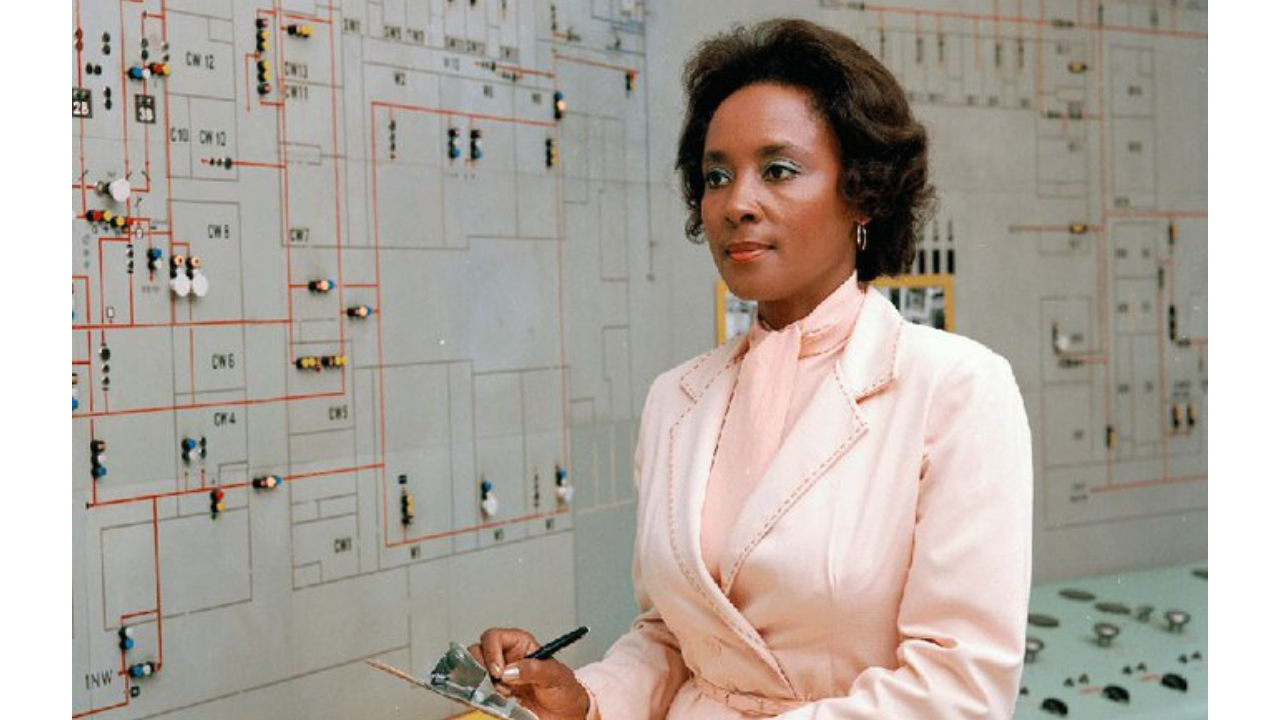
The air in the West Area Computing unit smelled of pencil shavings and nervous sweat. It was 1943, and the world was screaming. War consumed the horizon, but inside this room at the Langley Memorial Aeronautical Laboratory, the loudest sound was the rhythmic, frantic scratching of graphite against paper. There were no cooling fans. No hum of electricity. Just the collective breath of women who were expected to be invisible while performing the impossible.
Katherine Johnson sat among them.
To the men in the flight research divisions, she and her colleagues were not engineers or mathematicians in the social sense. They were "computers." They were a utility, like the lights or the heating, meant to process the raw data of wind tunnel tests and flight trajectories so the "real" work could happen elsewhere. But the math didn't care about social hierarchies. The math was cold, absolute, and terrifyingly complex.
The Weight of a Decimal Point
Imagine standing on a moving platform, trying to throw a grain of sand into a bottle that is also moving, while a hurricane blows between you. That is a simplified version of orbital mechanics.
In the early days of the space race, there was no room for "close enough." If a calculation for a reentry angle was off by a fraction of a degree, a human being wouldn't just miss their target. They would skip off the atmosphere like a stone across a pond, lost to the void forever. Or they would incinerate.
Katherine didn't have a digital interface to warn her of a syntax error. She didn't have a "delete" key. She had her mind and a slide rule.
The slide rule is a relic to most now, a sliding stick of numbers that looks like a ruler but functions as a manual analog computer. It requires the user to track the decimal point in their head. If you lose track of where that dot goes, you aren't off by a little. You are off by a factor of ten. A factor of a hundred. When Katherine calculated the trajectory for Alan Shepard’s Freedom 7 mission—the first time an American would touch the edge of space—she was carrying the weight of a man’s life in a pencil lead.
She was a Black woman in a segregated Virginia, navigating a world that demanded she use separate bathrooms and sit at separate tables. Yet, she was the one determining the path through the heavens. It was a staggering paradox. She was legally viewed as "lesser" on the ground, while being intellectually superior to almost everyone involved in the mission to leave the ground.
The Moment the Machines Failed
By 1962, the "electronic computers" had finally arrived. These were the IBM 7090s, massive, room-filling towers of vacuum tubes and magnetic tape that could crunch numbers faster than any human hand. The era of the human computer was supposedly over. The future had arrived, and it was made of silicon.
But John Glenn didn't trust the future.
Glenn was preparing to become the first American to orbit the Earth. It was a mission fraught with more variables than anything NASA had ever attempted. The IBMs had been programmed to calculate the orbital path and the precise moment the retrorockets needed to fire to bring him home. But these machines were temperamental. They were prone to "glitches"—a word that was becoming a terrifying part of the aerospace lexicon.
Glenn sat in his capsule, the Atlas rocket beneath him a controlled explosion waiting to happen. He looked at the technicians and issued a demand that has since become legend: "Get the girl."
He meant Katherine.
He refused to trust his life to the humming boxes in the basement until Katherine Johnson personally verified every number the machine had produced. He knew that a machine could follow an algorithm, but it couldn't feel the math. It couldn't spot an anomaly born of a subtle logic error in the programming.
"If she says they're good," Glenn famously said, "then I'm ready to go."
Katherine spent a day and a half submerged in the numbers. She wasn't just checking math; she was auditing the machine's soul. She worked until her eyes burned, running the same long-form equations that the IBM had processed in seconds. When she finished, the numbers matched.
Only then did the countdown begin.
The Geometry of the Dark
NASA eventually moved toward the moon. The stakes transitioned from "dangerous" to "impossible."
For the Apollo missions, Katherine’s work shifted to the lunar module. Consider the complexity: a spacecraft leaves Earth, enters lunar orbit, drops a lander to the surface, and then that lander must blast off and rendezvous with a command module that is screaming across the lunar sky at thousands of miles per hour.
This is the geometry of the dark.
Katherine worked on the backup navigation charts. She was the safety net. If the sophisticated electronic systems failed—which they did during the harrowing Apollo 13 mission—the astronauts would have to rely on the stars and the manual charts Katherine had helped create.
She wasn't just a calculator. She was a cartographer of the invisible. She mapped the gravity wells and the celestial intersections that allowed three men to find their way home through a quarter-million miles of black nothingness.
The Ghost in the Code
We live in an age where we assume the answer is always at our fingertips. We trust the "cloud." We trust the algorithm. We have outsourced our critical thinking to processors that we couldn't begin to explain if asked.
But the story of Katherine Johnson reminds us that at the heart of every great technological leap, there is a human heartbeat. There is a person who had to ask "Why?" when the machine just said "Because."
She faced a double-walled fortress of prejudice. She was a woman in a field of men, and she was Black in a country still gripped by Jim Crow. She didn't break those walls with a sledgehammer; she dissolved them with the terrifying precision of her intellect. She made herself indispensable. You can ignore a person, but you cannot ignore the truth of $1 + 1 = 2$.
When she was finally awarded the Presidential Medal of Freedom in 2015, she was nearly a century old. She looked at the cameras with the same quiet, steady gaze she must have used when staring down the IBM's errors decades prior.
She didn't see herself as a hero. She saw herself as someone who had a job to do.
The next time you look at a photograph of the Earth from space—that fragile, blue marble hanging in the dark—remember that it was a woman with a pencil who drew the line that led us there. She didn't have a screen. She didn't have a hard drive.
She just had the math, and the courage to follow it wherever it led.
The graphite on her paper has long since faded. The IBM 7090s are in museums, their vacuum tubes cold and useless. But the trajectories she calculated are still there, etched into the physics of our solar system, invisible paths through the stars that remain perfectly, elegantly true.
Katherine Johnson didn't just calculate the future.
She made sure we arrived there safely.