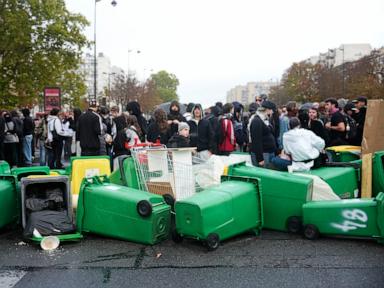
The widespread mobilization of French high school students, known locally as lycéens, represents a fundamental friction point between institutional design and operational reality. Rather than an isolated emotional outburst or a transient seasonal disruption, the protests that emerged across educational districts expose clear failure modes in resource allocation, infrastructure maintenance, and administrative governance. To understand the mechanics of this movement, one must deconstruct the structural inputs that transformed localized grievances into a nationwide political phenomenon.
The Core Drivers of Institutional Friction
The grievances voiced by students and educational staff rest on quantifiable systemic strains.
- Resource Deficits and Infrastructure Decay: Decades of fiscal pressure have left secondary institutions grappling with severe maintenance deficits. Facilities in suburban areas, such as Seine-Saint-Denis, routinely exhibit chronic physical degradation, ranging from non-functional heating and sanitary infrastructure to compromised architectural integrity. These physical failures directly impact the delivery of educational services.
- The Staffing Bottleneck: A persistent shortage of tenured educators and administrative support personnel—including school nurses, social workers, and assistants—has degraded student-to-staff ratios. Ministries have increasingly relied on fixed-term contract teachers to plug recruitment gaps, introducing variance in pedagogical quality and continuity.
- Administrative Friction in Higher Education Access: The centralized undergraduate admissions platform, Parcoursup, acts as a centralized bottleneck. The algorithmic sorting mechanism generates acute performance anxiety, as students perceive the transition criteria as opaque and disconnected from localized classroom performance.
The Mechanics of Escalation and Alliance Formation
Student movements in France scale through predictable network effects. When individual grievances at a single facility remain unaddressed, operational blockades serve as a low-cost, high-visibility signaling mechanism.
The escalation vector follows a distinct trajectory:
- Local Discontent: A specific institutional failure occurs, such as an unreplaced teacher or hazardous classroom conditions.
- Signaling via Blockade: Students physically restrict access to the establishment, disrupting operations to force administrative attention.
- Horizontal Network Propagation: Using digital communication channels, student unions coordinate synchronized walkouts across neighboring académies.
- Coalition Ingress: External entities—including university students, labor confederations, and political factions—attach their respective agendas to the student nucleus.
This coalition ingress changes the operational dynamics of the protest. What begins as a localized demand for structural repairs or staffing replacements rapidly scales into a generalized referendum on executive governance and macroeconomic policy.
The Asymmetric Response Function
A critical variable in the lifecycle of these movements is the state's response function, characterized by a structural asymmetry. The central government frequently displays high friction when attempting to deploy capital resources or operational fixes for infrastructure, yet exhibits immediate capacity when deploying coercive mechanisms to manage public order.
The heavy reliance on law enforcement intervention during demonstrations involving minors creates secondary feedback loops. Images of aggressive policing or administrative crackdowns harden student resolve, diminish institutional trust, and broaden public sympathy for the demonstrators. Consequently, the state's attempt to restore order often achieves the inverse, accelerating mobilization and driving higher participation rates among secondary schools.
Strategic Outlook for Governance and Policy
Resolving systemic unrest of this magnitude requires moving beyond temporary concessions or emergency funding patches. The structural deficit within the public education sector is compounded by broader macroeconomic pressures, including high national debt-to-GDP ratios and stringent public spending constraints.
Policymakers face a strict optimization problem: balancing fiscal austerity mandates against the imperative of maintaining core social infrastructure. If the state fails to decouple administrative modernization from punitive policing, future cohorts will continue to utilize institutional disruption as their primary feedback mechanism, further eroding the social contract between the centralized administration and the youth demographic.