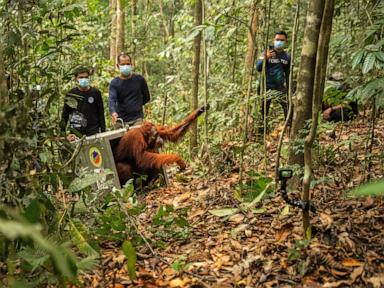
Wildlife conservation interventions are routinely evaluated through a superficial lens of immediate action metrics. When eight rehabilitated orangutans are transported from temporary holding facilities and released into a protected Indonesian forest following displacement by wildfires, public commentary typically frames the event as a definitive ecological victory. This perspective misdiagnoses the structural reality of modern habitat management. A translocation event is not a permanent solution to ecological degradation; it is an emergency supply-chain reallocation under crisis constraints. To understand the long-term viability of species preservation in regions impacted by agricultural conversion and seasonal burning, one must analyze the systemic cost functions, carrying capacity limits, and behavioral bottlenecks that govern successful reintroductions.
The primary constraint governing any wildlife relocation protocol is carrying capacity, a biological threshold frequently mismanaged in emergency interventions. Protected forests are rarely vacant ecosystems; they are mature biological markets operating at or near equilibrium resource utilization. Introducing displaced fauna into an existing territory creates an immediate resource shock.
The Carrying Capacity Bottleneck
When wild orangutans are moved into a protected forest, three immediate pressures dictate survival probability:
- Resource Competition: Established resident populations already occupy optimal foraging ranges, forcing translocated individuals into marginal zones with lower caloric density.
- Territorial Friction: Arboreal primates maintain strict home ranges. Forced integration precipitates aggressive territorial defense mechanisms, elevating stress hormones and energy expenditure.
- Pathogen Exposure: Bringing rehabilitated animals from captive or semi-wild rescue centers into contact with wild populations introduces vector risks in both directions, lacking pre-screening immunity profiles.
Standard reporting glosses over these systemic variables, preferring binary narratives of rescue and release. A rigorous framework demands that we evaluate the post-release mortality rate and tracking efficiency over a five-year horizon rather than celebrating the initial release day.
The Cost Function of Habitat Degradation
Wildfires in Indonesia are rarely random natural disasters; they are anthropogenic instruments of land clearing for palm oil and pulpwood production. Consequently, the crisis management model relies on downstream remediation while upstream economic incentives for deforestation remain entirely unchecked.
[Deforestation Drivers] -> [Habitat Fragmentation] -> [Forced Displacement] -> [Emergency Relocation] -> [Carrying Capacity Stress]
This linear pipeline demonstrates the inherent flaw in relying on translocation as a core conservation strategy. Without addressing the foundational drivers of land-use change, conservation organizations operate within a negative feedback loop. They absorb the escalating capital costs of capture, veterinary care, quarantine, transport, and post-release monitoring, while the total pool of viable habitat shrinks annually.
The financial capital required to sustain a single rehabilitated orangutan through rescue, medical stabilization, and multi-year forest school training before release represents a high-cost intervention. Scaling this model to address systemic displacement is economically unsustainable. Capital allocation must shift from reactive rescue logistics toward preventative habitat defense and legal enforcement against illegal burning.
Behavioral Reintegration Variables
The probability of survival for a translocated animal depends heavily on its developmental origin. Orphaned orangutans raised in human-managed facilities lack critical survival knowledge that is typically transmitted vertically through maternal lineages during the first decade of life.
- Foraging Efficiency: Captive-reared or prematurely displaced juveniles fail to identify the full spectrum of seasonal mast fruiting events, resulting in chronic caloric deficits during lean periods.
- Nest Construction Mechanics: Arboreal safety requires precise biomechanical execution in nest building to avoid nocturnal predation and exposure; deficiencies in this skill set lead directly to rapid mortality post-release.
- Human-Wildlife Conflict Proximity: Displaced populations often settle near the forest perimeter where degraded edges bleed into agricultural plots, exponentially increasing the probability of negative human encounters.
These behavioral deficits transform the release site into an extended management zone requiring human intervention, supplemental feeding, and veterinary surveillance, blurring the line between a wild population and a managed sanctuary.
Strategic Realignment for Long-Term Viability
To transition from fragile crisis management to resilient ecological stability, conservation architecture must abandon single-event metrics. The focus must pivot toward landscape-level connectivity and strict legal enforcement of buffer zones around designated national parks.
Resource allocation protocols require immediate restructuring:
- Cap-and-Verify Interventions: Halt new translocation initiatives into saturated forests where carrying capacity models indicate high competitive exclusion risks.
- Buffer Zone Monetization: Create direct financial incentives for local agrarian communities to maintain forested corridors rather than converting marginal edges into polyculture cash crops.
- Longitudinal Tracking Infrastructure: Mandate multi-year telemetry and health monitoring tied directly to institutional funding, ensuring accountability for post-release outcomes.
The survival of critically endangered apex species in fragmented tropical ecosystems will not be secured by the frequency of rescue operations. It will be determined by our willingness to confront the economic drivers of habitat destruction and enforce strict biological limits on ecosystems under siege.