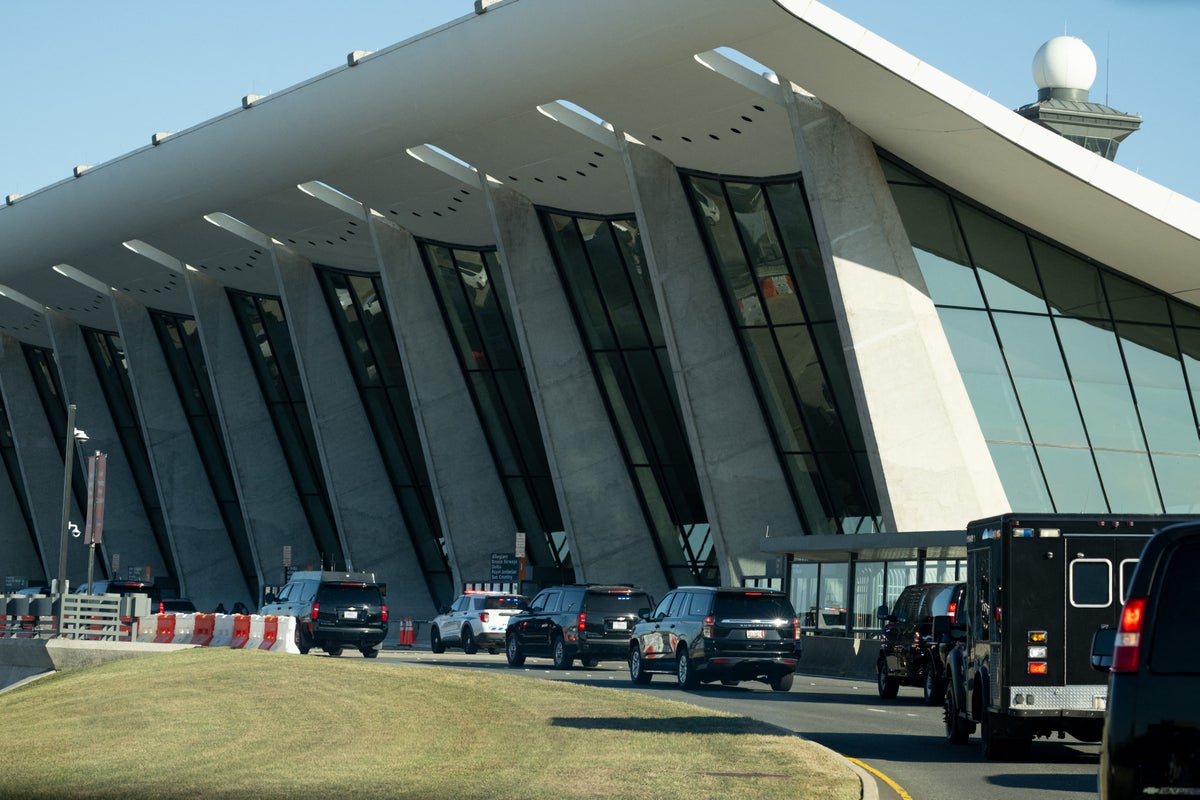
When physical models of Washington Dulles International Airport were transported to the Oval Office for direct executive evaluation, the operational paradigm of federal infrastructure management shifted from standard administrative delegation to direct micro-intervention. This phenomenon exposes a fundamental friction point between institutional bureaucratic design and executive fiat. Understanding this event requires stripping away media sensationalism to evaluate the structural mechanics of how high-level stakeholders interact with complex transportation assets.
The Operational Anatomy of Infrastructure Planning
Major aviation hubs operate as hyper-complex systems comprising passenger throughput matrices, airside logistics, security bottlenecks, and long-term capital allocation strategies. Standard governance models delegate these variables to specialized agencies such as the Federal Aviation Administration and the Metropolitan Washington Airports Authority. These bodies utilize quantitative forecasting tools, environmental impact studies, and traffic demand modeling to dictate architectural adaptations.
When political executives bypass these traditional administrative filters to evaluate physical models directly, the decision-making process undergoes a fundamental transformation.
- Compression of Feedback Loops: Bureaucratic evaluation requires multi-tiered reviews over quarters or years. Executive inspection collapses this timeline into immediate subjective impressions.
- Shift from Data-Driven to Visual Criteria: Quantitative metrics like passenger movement per square meter are sidelined in favor of aesthetic, symbolic, or highly personalized spatial preferences.
- Centralization of Authority: Operational jurisdiction moves from distributed engineering teams to a single centralized decision-maker relying on heuristic judgment.
This dynamic creates severe administrative friction. Infrastructure changes implemented through direct executive order often conflict with master planning documents designed to accommodate decades of traffic growth.
The Cost Function of Direct Intervention
Every architectural adjustment to an international terminal carries a measurable economic and operational footprint. When interventions are driven by non-technical stakeholders viewing physical prototypes, the associated cost function escalates rapidly across three distinct vectors.
Capital Allocation Distortion
Capital expenditure in aviation infrastructure must yield predictable return on investment, typically measured through cost-per-enplanement metrics for commercial airlines. Executive-level redesigns often prioritize immediate visual impact over long-term capital efficiency. If a terminal layout is altered to satisfy a specific geometric or stylistic preference, the underlying engineering must be retrofitted, leading to budget overruns and schedule inflation.
Operational Inefficiencies
Dulles International Airport, particularly its iconic Main Terminal designed by Eero Saarinen, represents a specific modernist architectural philosophy coupled with high-capacity processing needs. Introducing modifications based on ad hoc physical modeling risks compromising the delicate balance between curb-side vehicular flow, baggage handling automation, and security screening footprints. A change that appears optimal on a scale model can introduce severe pinch points in real-world pedestrian traffic.
Regulatory and Compliance Overhead
Federal infrastructure projects are bound by strict statutory frameworks, including environmental reviews, safety compliance mandates, and historic preservation acts. When executive interventions force rapid pivots in design direction, legal and compliance teams must scramble to retroactively justify changes or secure exemptions. This introduces institutional drag that frequently outweighs the perceived speed of a top-down decision.
Institutional Precedents and Governance Failure Modes
The involvement of chief executives in public works projects is not unprecedented, but it consistently highlights structural vulnerabilities in public administration. Historically, when political leaders step outside their macro-policy mandate to dictate micro-design elements, project outcomes diverge sharply from initial projections.
The root cause is a misalignment of expertise. Engineers optimize for constraints; politicians often optimize for narrative or visual impact. When physical models are brought into executive spaces, the environment encourages a designer-client dynamic rather than a governance-regulator dynamic. The feedback mechanism is broken because subordinates hesitate to challenge the spatial assumptions of the chief executive, regardless of what the empirical data indicates about passenger flow or structural integrity.
To evaluate the long-term viability of any infrastructure project subjected to this level of interference, analysts must measure the degree to which administrative independence is eroded. If the institutional machinery cannot push back against unvetted physical redesigns, systemic inefficiencies become permanently baked into the concrete and steel of the facility.
Establish a formal threshold where executive spatial proposals must pass through an independent technical audit before design funds are allocated. If a proposed modification fails to clear baseline capacity simulations within a standard simulation environment, it must be automatically remanded to the regional authority for structural reconciliation.