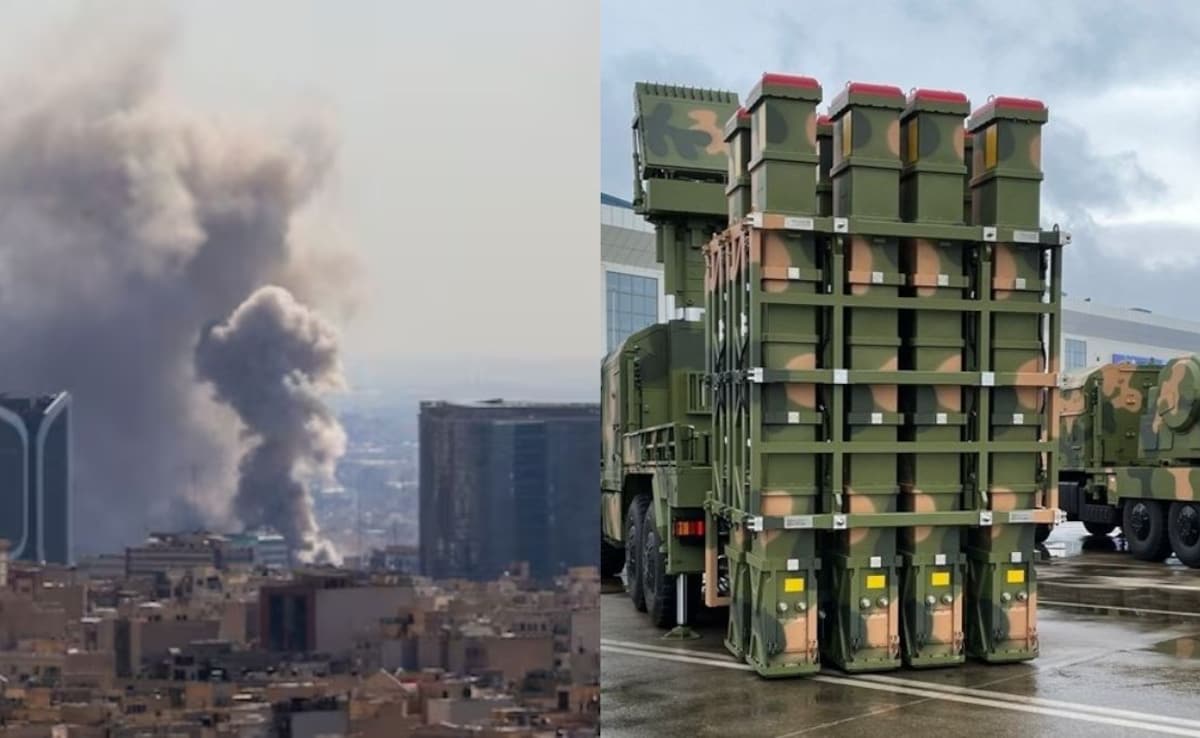
The smoke rising from the outskirts of Isfahan and Tehran has cleared, but the debris left behind tells a story that Beijing’s defense contractors never wanted told. China’s premier long-range surface-to-air missile system, the HQ-9B, was marketed as a world-class shield capable of denying entry to the most advanced Western aircraft and precision munitions. Recent kinetic events across the Iranian plateau suggest otherwise. While the official narrative often blames human error or overwhelming numbers, a cold-eyed look at the hardware reveals a fundamental mismatch between advertised specifications and real-world performance against a first-tier adversary.
The HQ-9B did not just fail to stop the strikes; it failed to see them coming until the munitions were already in their terminal phase. This isn't just an Iranian problem. It is a crisis of confidence for every nation that has traded Western or Russian hardware for Chinese alternatives. To understand why the HQ-9B crumbled, one must look past the glossy brochures and into the specific limitations of its radar architecture, its integration gaps, and the harsh reality of modern electronic warfare.
The Radar Blind Spot That No One Talks About
At the heart of any air defense system is its ability to maintain a track on low-observable targets. The HQ-9B relies on the HT-233 PESA (Passive Electronically Scanned Array) radar. On paper, it tracks dozens of targets and engages several simultaneously. In practice, the system struggles with the "clutter" of modern electronic countermeasures.
When an attacking force uses sophisticated jamming pods, the HT-233 often suffers from what engineers call "gain compression." The radar is effectively blinded by noise, forcing it to increase its power output, which only serves as a massive homing beacon for anti-radiation missiles. During the recent strikes, there is evidence that the Iranian batteries were forced to operate in "standby" modes to avoid being targeted, rendering them useless during the critical opening minutes of the engagement.
Furthermore, the HQ-9B is built on a philosophy of high-altitude interception. It excels at hitting a high-flying, non-maneuvering tanker or a transport plane. However, the recent strikes utilized low-profile cruise missiles and small-diameter bombs that hug the terrain. The Chinese system’s software algorithms, designed to prioritize high-speed ballistic threats, appear to have been "spoofed" by the smaller, slower, and more numerous decoys that preceded the actual warheads.
Integration Failure and the Myth of the Integrated Shield
Air defense is a team sport. No single battery, no matter how advanced, can protect a city in isolation. Iran’s air defense network is a patchwork of aging Soviet S-300s, indigenous copies, and the Chinese HQ-9B. This "Frankenstein" architecture is where the HQ-9B’s second major flaw emerged.
For an air defense system to work, it needs a Unified Command and Control (C2) structure. The HQ-9B uses proprietary Chinese data links that do not "talk" effectively to older Russian systems or domestic Iranian sensors. During the height of the recent incursions, the various layers of the defense grid were likely operating as silos.
Why Interoperability Matters
- Sensor Fusion: Combining data from long-range UHF radars with the HQ-9B’s X-band engagement radar.
- Target Handoff: The ability to pass a target from one battery to another as it moves across the battlespace.
- Identification Friend or Foe (IFF): Preventing "blue-on-blue" incidents, which often causes operators to hesitate during a real attack.
Because the HQ-9B was never fully integrated into a holistic national picture, its operators were essentially looking through a soda straw. They could see what was right in front of them, but they had no "over-the-horizon" awareness. By the time the HT-233 radar locked onto an incoming threat, the window for a successful kinetic interception had already closed.
The Kinematics of a Missed Interception
The HQ-9B missile itself is a formidable piece of engineering, capable of reaching speeds of Mach 4.2. However, speed is irrelevant if the missile cannot turn. Modern Western strike packages utilize "high-G" terminal maneuvers.
Analysis of the wreckage in Iran suggests that several HQ-9B interceptors were fired but failed to achieve a proximity kill. This points to a deficiency in the seeker head's processing speed. If the target makes a sharp course correction in the final three seconds of flight, the interceptor’s onboard computer must recalculate the intercept point instantly. If the processor lags by even a fraction of a second, the missile sails harmlessly past the target.
In the vacuum of a test range in the Gobi Desert, these missiles look like world-beaters. In the chaotic, signal-dense environment over a major city like Isfahan, the "digital brain" of the HQ-9B appears to have been overwhelmed by the sheer volume of data it had to process.
The Economic Fallout of a Technical Failure
China has spent the last decade positioning itself as the "value-oriented" alternative to the U.S. Patriot system or the Russian S-400. They offered the HQ-9B at a fraction of the cost, often bundled with infrastructure projects and favorable financing. For many nations in the Middle East, Africa, and Southeast Asia, it seemed like a bargain.
That bargain now looks like a liability.
The failure in Iran is a loud signal to other buyers, such as Pakistan and potentially Turkey or North African states, that the Chinese "shield" may be made of glass. When a nation buys an air defense system, they aren't just buying missiles; they are buying an insurance policy for their sovereignty. If the insurance doesn't pay out when the house is on fire, the policy is worthless.
We are likely to see a shift in the global arms market. Countries that were leaning toward Chinese hardware are now looking back at Russian systems—despite their own issues in Ukraine—or desperately trying to navigate the political hurdles required to buy Western technology. The HQ-9B was supposed to be China’s grand entry into the top tier of military exporters. Instead, it has become a cautionary tale about the dangers of prioritizing "specs on a page" over combat-proven reliability.
The Hidden Human Element
Beyond the hardware and the software, there is the matter of training and doctrine. Chinese military exports come with a "standard operating procedure" that is often rigid and top-down. Iranian crews, trained in this Chinese style, may have lacked the tactical flexibility to adapt when the primary radar was jammed.
Modern air defense requires an "operator-in-the-loop" who can manually filter out noise and make split-second decisions based on intuition and experience. The HQ-9B is heavily automated. While automation is great for PR videos, it creates a "brittleness" in real combat. When the computer encountered a scenario it hadn't been programmed for—specifically, a saturated environment of low-cost drones and high-end cruise missiles—it likely defaulted to errors or failed to authorize a launch.
A Systemic Reality Check
The HQ-9B is a derivative of the S-300, but it is not a direct copy. China made significant changes to the electronics and the propulsion. In doing so, they may have prioritized the wrong metrics. They built a system that is excellent at shooting down a target at 200 kilometers in perfect conditions, but one that is remarkably poor at defending itself against a target at 20 kilometers in a contested electronic environment.
This is the fundamental flaw of the "Anti-Access/Area Denial" (A2/AD) strategy when it relies on unproven hardware. The "bubble" of protection is only as strong as its weakest link. In the skies over Iran, the HQ-9B proved to be that link. It was out-thought, out-maneuvered, and ultimately out-classed by an adversary that understood its limitations better than its own operators did.
The lesson for any military commander is clear. Do not mistake a high price tag or a sleek design for a guarantee of safety. In the world of high-stakes air defense, the only metric that matters is the "probability of kill" under fire. For the HQ-9B, that number just plummeted.
If you are a defense minister in a developing nation, you are currently staring at the satellite imagery of charred hangars and wondering if your "state-of-the-art" Chinese batteries are actually just expensive monuments to a false sense of security. The era of the Chinese "bargain" defense may have just ended in a ball of fire.