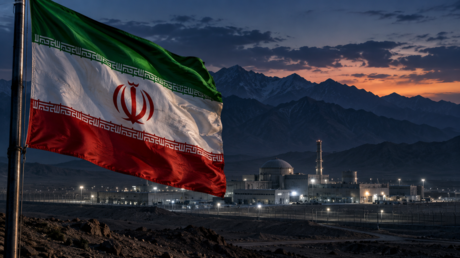
The operational stability of the Middle East rests on a precise matrix of deterrence failures, asymmetric cost functions, and threshold engineering. When strategic actors evaluate the utility of acquiring nuclear weapons, the decision is rarely driven by ideological abstraction. It is governed by a cold optimization problem balancing regime vulnerability against conventional military inferiority. Tehran’s strategic posture demonstrates how a state under severe economic strangulation and conventional military overmatch systematically compresses its nuclear breakout timeline to construct an invisible shield against regime decapitation. Understanding this trajectory requires moving past speculative rhetoric to examine the structural mechanics of enrichment capacity, proxy network degradation, and the shifting calculus of preemption.
The Cost Function of Threshold Status
For decades, the Islamic Republic maintained a policy of calculated ambiguity, stopping short of assembling a functional weapon while accumulating the technical know-how required to do so. This posture was designed to extract maximum diplomatic leverage while staying below the threshold that would trigger a unified, devastating preventive military response from the United States and Israel.
However, the cost function shifted dramatically following the systemic degradation of Iran's forward-deployed proxy networks and the direct kinetic exchanges that exposed the limitations of its conventional deterrent. When conventional deterrence fails to prevent direct strikes on sovereign territory, the value of a nuclear deterrent shifts from a distant political aspiration to an operational imperative.
The economic cost of this pursuit has been staggering. Decades of sanctions, capital flight, and misallocated industrial capacity have crippled domestic infrastructure. Yet, within the internal logic of the regime, these expenditures are viewed as an unavoidable insurance premium against regime change. The optimization model is stark: endure permanent economic anemia or achieve an irreversible nuclear threshold status that guarantees regime survival.
The Three Pillars of Technical Acceleration
The physical reality of Iran's nuclear program centers on three interdependent technical variables: feedstock accumulation, centrifuge efficiency, and facility hardening.
[Natural Uranium]
       ↓
[Enrichment Cascades (IR-1 to IR-6)]
       ↓
[Stockpile Purity Scaling (3.67% → 20% → 60%)]
       ↓
[Breakout Threshold (90% Weapons-Grade)]
Feedstock and Purity Scaling
The primary bottleneck in any nuclear weapons program is the transition from natural uranium to low-enriched uranium (LEU), and subsequently to high-enriched uranium (HEU). By systematically expanding its stockpile of 60% enriched uranium, Tehran reduced its theoretical breakout time—the window required to produce sufficient weapons-grade material for a device—from a year under the constraints of the Joint Comprehensive Plan of Action down to a matter of weeks. Having 60% material means the hardest part of the physics problem is already solved; the remaining jump to 90% weapons-grade purity requires only a fraction of the time and centrifuge rotations.
Centrifuge Innovation and Cascade Efficiency
Numerical quantity tells only part of the story; separative work units (SWU) dictate the actual output. The deployment of advanced centrifuge generations—ranging from the IR-2m to the IR-6—multiples processing speeds exponentially compared to the obsolete IR-1 machines. These cascades allow for rapid reconfigurations, making clandestine diversion much harder to detect in real-time by International Atomic Energy Agency inspectors.
Facility Hardening and Dispersion
Recognizing that declared and centralized enrichment plants are primary targets for kinetic strikes, the infrastructural strategy relies on deep underground installations, such as those embedded within mountainous terrain at Fordow and Natanz. This spatial distribution and subterranean reinforcement represent an explicit attempt to deny adversaries a single-point-of-failure knockout blow, complicating military planning and forcing any preventive campaign to calculate diminishing returns.
The Regional Security Dilemma and Proliferation Cascades
The pursuit of a nuclear threshold capability by Tehran triggers an immediate security dilemma across the wider Middle East. Regional competitors cannot afford to treat Iran's nuclear advancement as a theoretical exercise. When one state approaches the precipice of weaponization, neighboring powers face their own structural pressures to hedge against strategic inferiority.
+-----------------------------------+     +-----------------------------------+
|     Iran Enriches to Threshold    | --> |   Regional Powers Face Security   |
|         Capacity (60%-90%)        |     |         Dilemma / Pressure        |
+-----------------------------------+     +-----------------------------------+
                                                            |
                                                            v
+-----------------------------------+     +-----------------------------------+
|      Proliferation Cascades       | <-- |  Hedging via Civilian Nuclear     |
|    Threaten Global Stability      |     |     Infrastructure & Alignment    |
+-----------------------------------+     +-----------------------------------+
This dynamic introduces the risk of a multi-state proliferation cascade. Neighboring Sunni-majority states, viewing a nuclear-armed Iran through an existential lens, have historically signaled their intent to develop independent domestic enrichment capabilities or formalize security umbrellas that constrain non-proliferation norms. The erosion of the Non-Proliferation Treaty framework in the Middle East would not be a sudden diplomatic collapse, but a gradual normalization of hedging behavior, where states quietly build out dual-use civilian nuclear infrastructure designed to be weaponized on short notice.
Furthermore, the integration of advanced ballistic missile arsenals with a nascent nuclear warhead delivery capability changes the tactical equation for regional maritime chokepoints. Control over energy corridors, such as the Strait of Hormuz, is no longer maintained solely through conventional asymmetric naval forces. It is backed by the ultimate deterrent, raising the cost of any international intervention to prohibitive levels.
Strategic Realities and Preemptive Limitations
As technical milestones converge, the strategic options available to external powers narrow significantly. Preventive military strikes carry a high probability of inducing the exact outcome they seek to prevent. Rather than terminating a nuclear program, a conventional air campaign against hardened underground facilities may merely drive remaining technicians to disperse, underground remnants to rebuild, and the political leadership to formally withdraw from international inspection regimes, removing what little transparency remains.
Diplomatic containment strategies face an equally severe structural flaw: trust has been systematically liquidated. Without verifiable, permanent rollback mechanisms that include the removal of advanced centrifuge components and the export of enriched stockpiles, incremental diplomacy functions primarily as a delaying tactic for Tehran to complete its technical mastery.
The Middle East is consequently transitioning into a permanent posture of high-readiness deterrence. The region's stability will no longer be preserved by non-proliferation enforcement, but by the management of mutual vulnerability. The central question for strategists is not whether Iran can be permanently denied the bomb through economic coercion, but how international security architecture will adapt when deterrence failures carry terminal systemic costs.